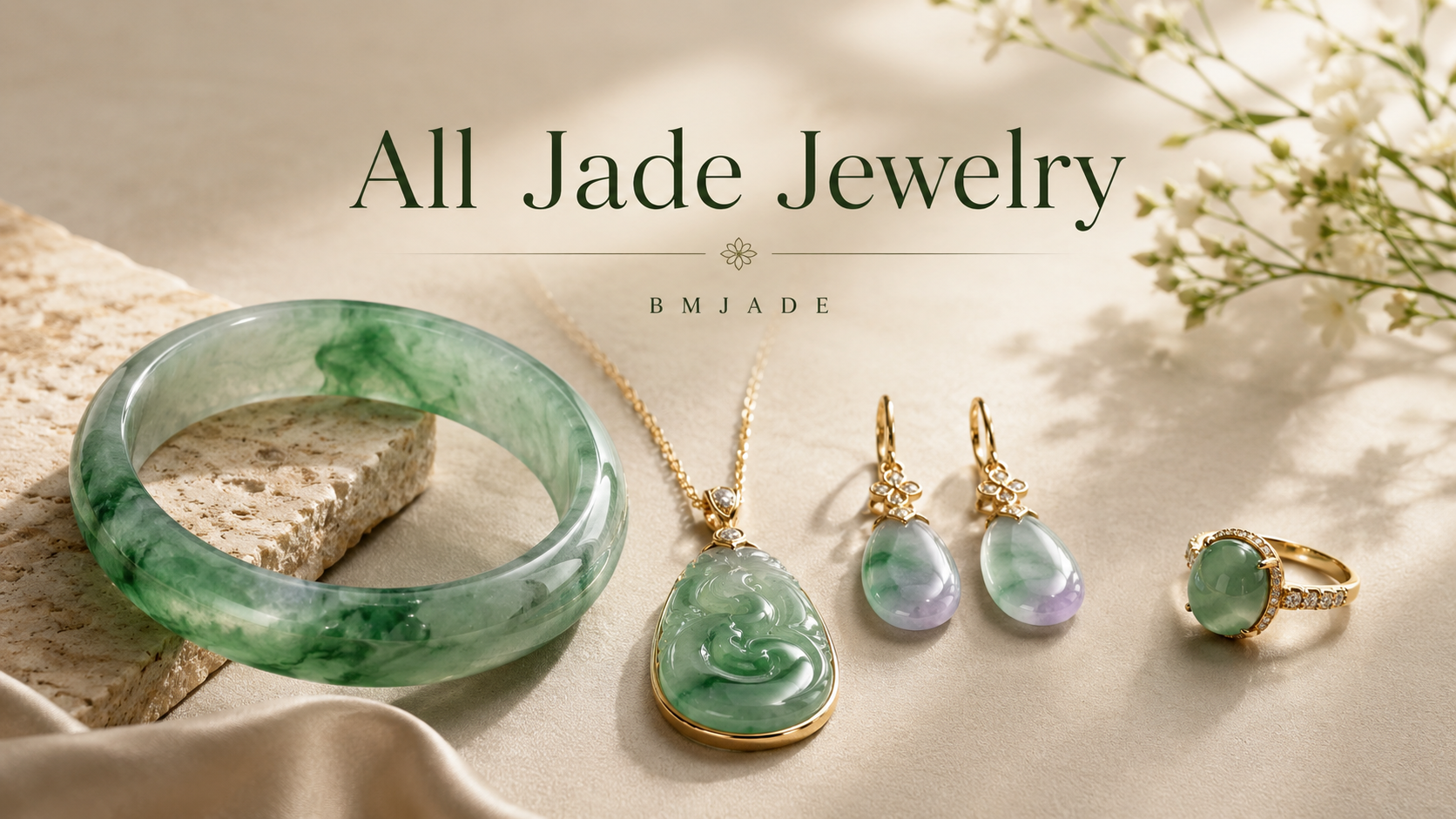
People ask me this question more than almost any other about jade: "Is jade my birthstone?" Sometimes the question comes from genuine curiosity about an obscure cultural detail. Sometimes it comes from someone whose mother told them they were "born under jade" and they want to verify. Sometimes it comes from a shopper trying to decide whether jade is appropriate as a birthday gift for a March-born friend. Sometimes it comes from a customer who simply loves jade and wants permission to claim it as their personal stone.
The honest answer is more nuanced than most online sources admit. Jade is not on the modern Western birthstone list — the standardized chart most jewelers use, which assigns one or two stones to each month and was codified by the National Association of Jewellers in 1912. That list, the one printed in calendars and used by mass-market jewelers, places aquamarine and bloodstone in March, peridot in August, and so on.
But jade does appear in several legitimate parallel birthstone traditions — the mystical birthstone list, the Tibetan birthstone list, certain zodiac stone assignments, and the hour-of-birth tradition. These aren't fringe new-age inventions. The mystical and Tibetan lists predate the modern Western system by centuries, with roots in ancient astrology and cultural lore that the 1912 standardization simply didn't include.
I'm Hong, the founder of BMjade. Over nearly a decade between the Hpakant market in Myanmar and our Kunming workshop, I've watched the "is jade my birthstone?" question generate a particular kind of customer — someone who has felt drawn to jade for years, sometimes their whole life, and is looking for cultural validation that the connection is real. The answer, almost always, is yes — jade has more legitimate birthstone connections than the modern chart suggests, and the question of "is it really yours" usually answers itself in the practice of wearing.
This guide gives you the complete picture: every legitimate birthstone tradition that includes jade, the specific months and zodiac signs where jade has been assigned, the historical lineage of each tradition, and how to think about claiming jade as your birthstone today. By the end, you'll know exactly whether jade is your birthstone — and the answer may be more affirmative than you expected.
For the foundation underneath this question — what jade actually is as a material — see our complete primer on jade as a gemstone. For the cultural depth behind why jade has so many parallel traditions, see our complete guide to jade meaning across civilizations.

How birthstone traditions actually work
Before tracing where jade fits, it helps to understand the layered history of birthstone tradition itself. Most people assume there is "one" birthstone list — but there are actually several, developed in different cultures across different centuries, sometimes agreeing and sometimes contradicting each other.

The Biblical and ancient origin
Birthstone traditions trace back to the 1st century CE, when scholars connected two Biblical lists — the twelve stones on the breastplate of the High Priest Aaron (Exodus 28:17-20) and the twelve foundation stones of the New Jerusalem in the Book of Revelation (21:19-20) — to the twelve months of the calendar and the twelve zodiac signs. The connection was made by Saint Jerome and others in early Christian writings. From this religious foundation, the concept of personal stones tied to birth month evolved.
But the original Biblical lists referenced stones that we cannot now reliably identify. Ancient Hebrew and Greek gem terminology doesn't map cleanly onto modern mineralogical categories. Centuries of translation, copying, and cultural transmission introduced variations. Different traditions ended up with different lists.
The modern Western list (1912 standardization)
The chart most people recognize today was created by the National Association of Jewellers (now Jewellers of America) in 1912. The Jewelry Industry Council of America updated it in 1952. This list deliberately simplified and standardized centuries of varying traditions into a single commercial chart — partly to support the jewelry industry's marketing, partly to create consumer clarity.
The modern list is what most calendars print: January-garnet, February-amethyst, March-aquamarine, April-diamond, and so on. Jade does not appear on this list at all.
But this is the commercial list, not the complete list. The mystical, Tibetan, zodiac, and hour-of-birth traditions all continue to exist alongside the modern chart, with their own legitimate historical lineages.
The mystical birthstone tradition
The mystical birthstone list is significantly older than the modern Western chart, with origins traced to ancient Tibet — typically dated to around 1500 BCE. Tibetan astrology developed its own birthstone framework based on different astrological principles and different gem-mineral associations than the European-derived modern list.
The mystical list includes stones that the modern Western list omits. Jade appears as the mystical birthstone for March.
This isn't a recent invention. The Tibetan association of jade with March is rooted in ancient astrology, with the stone tied to spring renewal, new beginnings, and the energetic qualities of the transitional month between winter and spring. Buddhist and Hindu traditions also incorporated jade into their birthstone-equivalent frameworks for similar reasons.

Zodiac stones (different from monthly birthstones)
Parallel to monthly birthstones, zodiac stones assign gemstones to each of the twelve astrological signs. The zodiac sign tradition runs through different sources and varies more than the monthly chart, but jade appears in multiple zodiac stone systems, most consistently associated with:
- Virgo (August 23 – September 22) — primary zodiac association in some traditions
- Taurus and Libra (the signs ruled by Venus) — assigned in beauty-and-balance focused zodiac systems
- Pisces (February 19 – March 20) — as an alternate stone in some traditions
- Gemini — listed as a beneficial stone in some grounding-focused traditions
These zodiac assignments aren't competing — they reflect different astrological logic and different cultural traditions. A Virgo can claim jade through one tradition; a Taurus through another; a Pisces through another.

Hour-of-birth stones
A less commonly discussed tradition assigns stones to specific hours of the day at which a person is born. In this framework, jade is associated with 9 PM. This is rooted in older Chinese and Tibetan astrological practice, where birth hour was considered as significant as birth date in determining personal stone affinities.
For the practical reader: if you're not sure what hour you were born, this tradition is likely the least useful of the four. But if you happen to know, and you were born around 9 PM, jade has yet another legitimate claim on you.
Historical European birthstones
Less commonly cited but documented in some sources: in older European birthstone traditions, jade was sometimes assigned to May as a historical birthstone, particularly in connection with the Taurus zodiac sign and the spring season. This European May-jade association predates the modern 1912 chart but isn't represented in the standardized modern list.
So is jade your birthstone? The complete answer
Based on the parallel traditions covered above, here is the honest answer organized by who might be asking:
"I was born in March."
Yes — jade is your mystical birthstone. The Tibetan and mystical birthstone tradition has assigned jade to March for centuries, predating the modern Western list. You have a legitimate, historically grounded claim to jade as your birthstone, even though it's not on the commercial chart printed in calendars.
This applies whether you're a Pisces (February 19 – March 20) or an Aries (March 21 – April 19). The mystical tradition associates jade with the whole spring-equinox month of March, not specifically with one zodiac sign within it.
Many March babies feel a strong pull toward jade their whole lives without knowing why. The mystical birthstone tradition explains the connection.

"I'm a Virgo (August 23 – September 22)."
Yes — jade is your primary zodiac stone in multiple traditions. Some sources call this "jade as the September birthstone" since most of Virgo falls in September.
"I'm a Taurus (April 20 – May 20) or Libra (September 23 – October 22)."
Yes — jade is your Venus-zodiac stone. Both Taurus and Libra are ruled by Venus in astrology, and jade is assigned to Venus-ruled signs in some traditions because of its association with beauty, harmony, and balance.
"I'm a Pisces (February 19 – March 20)."
Yes (with one path) — jade is your alternate zodiac stone. As Pisces overlaps with March, you have access to jade through both the March mystical birthstone tradition and the Pisces alternate zodiac assignment.
"I'm a Gemini, Aquarius, or another sign not listed above."
Likely yes through personal resonance — jade is listed in some traditions as beneficial for Gemini (grounding airy energy), and various other signs have softer jade associations. The honest answer here is that jade isn't formally your birthstone, but it can still be your personal stone of choice through what mystical traditions call "personal resonance" — the genuine pull a person feels toward a particular material.
"I was born in May."
Maybe — jade has a documented historical European association with May, though this is less universally recognized than the March or zodiac connections. If you feel drawn to jade and were born in May, the European tradition gives you legitimate ground to claim it.
"I was born at 9 PM (or around that hour)."
Yes — jade is your hour-of-birth stone. This is the most specific of the traditions and the least commonly known, but it's legitimately documented in older astrological systems.
"I just love jade and I want it to be my birthstone."
Yes — modern mystical practice allows this. Crystal and gemstone traditions across the world recognize that personal resonance with a stone is itself meaningful, separate from formal birthstone assignments. Many modern wearers claim jade through personal connection rather than calendar — and this is increasingly accepted in jewelry tradition as well.
The bottom line: if you've been drawn to jade, there is almost certainly a legitimate tradition that includes you among its wearers.

What jade specifically represents as a birthstone
Beyond the question of whether jade is your birthstone, it's worth understanding what jade specifically represents within the birthstone framework — what qualities the stone is traditionally believed to bring to its wearer.
Within mystical March tradition
For March babies claiming jade as their mystical birthstone, the stone represents:
Renewal and new beginnings. March marks the spring equinox in the Northern Hemisphere — the moment when winter releases and life returns. Jade's association with March emphasizes growth, the unfolding of potential, and the renewal that follows dormancy. For someone born in this month, jade is a daily reminder of their birth into a season of fresh starts.
Balance during transition. March itself is transitional — neither winter nor spring, holding both. Jade's energetic qualities of grounding combined with openness suit someone born into this in-between moment. The stone helps its wearer navigate periods of change with steadiness.
Connection to spring waters. In Tibetan astrology, March is associated with melting ice, returning rivers, and the flow of water after winter's freeze. Jade has water associations across many cultures — Chinese tradition links jade to rivers, springs, and the dragon's domain of water. A March-born jade wearer is connected through their stone to the season's defining element.
Within Virgo zodiac tradition
For Virgos claiming jade as their primary zodiac stone:
Practical wisdom. Virgo is associated with discernment, careful analysis, and practical service. Jade reinforces these qualities and is believed to help a Virgo bring kindness to their natural critical attention — analyzing without becoming harsh, serving without burning out.
Health and well-being. Virgo's association with health and physical wellness aligns with jade's traditional reputation as a healing stone (particularly through Traditional Chinese Medicine, the longest jade-and-health tradition in history). A Virgo with jade is double-anchored in the wellness theme.
Earth element grounding. Virgo is an earth sign, and jade's mineral connection to earth, slow-formed deep in the planet, reinforces the grounded, practical, embodied quality of the sign.
Within Taurus/Libra (Venus) zodiac tradition
For Venus-ruled signs claiming jade as their stone:
Aesthetic appreciation. Both Taurus and Libra are Venus-ruled and naturally drawn to beauty. Jade's visual qualities — depth, color, fine texture — appeal directly to these signs' aesthetic sensibilities.
Harmony and balance. Venus governs love, harmony, and aesthetic balance. Jade's symbolic associations with yin-yang harmony, with relational balance, and with the gentle integration of complementary forces align with Venus's domain.
Pleasure and sensory enjoyment. Venus signs enjoy sensory experience, and jade is one of the most pleasing stones to physically wear — cool against skin, satisfying weight, smooth polish that invites touch.
Within personal resonance practice
For wearers claiming jade through personal connection rather than calendar:
Intentional symbolism. Choosing jade because it resonates is itself meaningful — the practice of wearing a meaningful stone creates the same symbolic anchoring effect as wearing a "formally assigned" birthstone. The mechanism is symbolic and psychological, not astrological.
For the full framework on the spiritual, emotional, and psychological benefits of wearing jade with intention, see our complete guide to jade benefits across belief-based, documented, and cultural dimensions.

Choosing a jade birthstone piece
If you've concluded that jade is your birthstone (or someone else's), the next question is which piece to choose. Several factors matter.
Material — Type A natural jadeite only
For birthstone jewelry specifically, authenticity matters as much as for any other significant jade purchase. Type A natural jadeite (or genuine Hetian nephrite) carries the full symbolic weight; treated jade (Type B, C, or B+C) is considered energetically inert in traditional practice and visually degrades over time.
A birthstone piece is meant to be worn over years and decades — making the question of long-term physical and symbolic integrity essential. Insist on lab certification (NGTC for jadeite is the Asian standard; GIA is the global gemological standard). Our piece on why home tests aren't enough to verify authentic jade covers the authentication framework in depth.
Color for birthstone wearers
While the modern Western birthstone chart often specifies a single color per stone, the multiple jade birthstone traditions don't restrict you to one color. Choose by:
Mystical March wearers — Spring-energy colors work particularly well: apple green (the freshest, brightest spring green), pale green (gentler), white or icy (for clarity emerging from winter). Imperial green is also appropriate but reads as more formal than the spring symbolism strictly requires.
Virgo wearers — Earth-tones and refined neutrals match Virgo's grounded sensibility: white jadeite, Hetian nephrite, apple green, or yellow honey. Avoid colors that read as too dramatic or attention-seeking; Virgo prefers refined understatement.
Taurus/Libra (Venus) wearers — Aesthetically rich colors that emphasize beauty: imperial green (the most prestigious), lavender (gentle and refined), or multi-color (the most artistically interesting). Venus signs appreciate the visually impressive piece more than other signs typically do.
Personal resonance wearers — Choose the color that genuinely draws you. There's no traditional restriction; the personal connection is what defines the practice.
For the complete framework on jade colors and their meanings, see our deep dive into jade colors and what causes each hue.

Piece type — what to wear as a birthstone
Several piece types serve well as birthstone jewelry:
Pendant — the most flexible birthstone form. Worn close to the heart (or wherever feels right on the chest), pendants make daily birthstone wearing easy. Pendant carving choices can be either symbolic (Pixiu, Buddha, Guan Yin, Ping An Kou) or simply elegant (a polished cabochon or geometric form). For the master overview of pendant options, see our complete guide to 12 traditional pendant carvings.
Ring — particularly meaningful as a birthstone because rings are visible on the hand throughout the day. Birthstone rings are a classic Western jewelry category, and jade rings work beautifully in this tradition.
Bracelet or bangle — daily-wear bracelets create constant physical contact between wearer and birthstone, which traditional practice considers particularly nourishing. Our comprehensive bangle sizing and selection guide covers fit and choice in depth.
Earrings — frame the face daily and integrate with most outfits. Earrings make a softer birthstone statement than rings or pendants.
Multiple pieces — many serious birthstone wearers eventually accumulate multiple jade pieces over years, building a personal collection that marks different occasions, different aspects of the birthstone's meaning, and different gifts received over time.

Birthday gifting context
For someone giving jade as a birthstone gift:
- For someone born in March: lean toward fresh spring colors (apple green, lavender, white). Frame the gift around the mystical birthstone tradition — "you may not know this, but jade has been the mystical birthstone for March for centuries."
- For a Virgo (late August / September): lean toward earth-tones (white, Hetian nephrite, apple green, yellow). Frame around the Virgo zodiac stone tradition.
- For someone you know has been drawn to jade: simply frame the gift around personal resonance. The piece itself does the talking.
- For anyone of any month: acknowledge that you know their formal birthstone isn't jade but explain why you chose jade specifically (mystical, zodiac, or personal connection). This framing avoids any awkwardness about not matching the calendar list.
For full guidance on choosing jade as a meaningful gift, see our complete jade anniversary gift guide, which covers similar gift-decision principles in detail.
Cultural considerations across traditions
The birthstone question intersects with cultural identity in interesting ways. A few considerations for different reader contexts.
Chinese cultural context
In Chinese tradition, the birthstone-by-month system is not a primary framework. Chinese astrology operates on different principles — the zodiac year (12-animal cycle), the five elements, lunar calendar associations — and personal stone selection in Chinese practice often follows lunar calendar timing and personal element-balancing rather than Gregorian-month birthstones.
This means a Chinese-tradition wearer can claim jade through a different framework entirely: their birth year animal, their dominant element, or their lunar birth date associations. Jade in Chinese tradition isn't a "birthstone" in the Western sense — it's a culturally universal stone available to anyone of any birth month.
For Chinese readers exploring the Western birthstone framework: you can either claim jade through the mystical March tradition (if your birthday falls in March) or simply note that the Chinese system treats jade more broadly as a cultural inheritance available regardless of birth date.
Western cultural context
Western readers asking "is jade my birthstone?" are typically asking within the modern 1912 chart framework. The honest answer is that jade isn't on that specific chart, but appears legitimately in several parallel traditions that the chart simply didn't include. This nuance matters because it means there's no need to "force" jade to fit the modern chart — the parallel traditions are real and valid.
Cross-cultural and modern syncretic practice
Modern crystal and gemstone practice increasingly draws from multiple traditions simultaneously. A practitioner today might consider:
- Their modern Western birthstone (the calendar list)
- Their mystical birthstone (the Tibetan-derived list)
- Their zodiac stone (astrological assignment)
- Their hour-of-birth stone (Chinese-Tibetan tradition)
- Their personal resonance stone (modern crystal practice)
- Their cultural heritage stone (family or ethnic tradition)
For most modern practitioners, multiple of these categories apply, and any of them is legitimate. Jade likely appears in at least one of your categories, making the answer to "is jade my birthstone?" almost always yes from some valid angle.

Caring for a birthstone jade piece
Beyond the symbolic dimension, the physical care of a birthstone jade piece is the same as any fine jade jewelry.
Daily care:
- Avoid impact against hard surfaces
- Remove before showering, swimming, bathing
- Avoid contact with perfume, lotion, sunscreen, harsh chemicals
- For birthstone pieces worn daily, develop habits that protect the piece — putting on jewelry last when dressing, removing it first when arriving home
Routine cleaning:
- Wipe gently with a soft slightly damp cloth after wearing
- Monthly: brief soak in mild soapy water (gentle dish soap), rinse thoroughly, dry completely
- Avoid ultrasonic cleaners, harsh jewelry chemicals, prolonged hot water
Storage:
- Soft pouch or padded jewelry box, separated from other jewelry
- For birthstone wearers building a collection over years, dedicated jewelry storage that keeps related pieces together becomes meaningful as the collection grows
For piece-type-specific care: the jade necklace care guide for pendants, the bracelet care guide for bangles, the ring care guide, and the earring care guide.
Frequently asked questions
What month is jade the birthstone for?
Jade is the mystical birthstone for March in the Tibetan-derived mystical tradition. It's not on the modern Western chart (which lists aquamarine and bloodstone for March), but the mystical assignment is older and historically legitimate. Some sources also cite jade as a historical European birthstone for May, and it's an alternate or zodiac-tied stone for several other months indirectly.
Is jade a birthstone for any zodiac sign?
Yes — jade is associated with several zodiac signs in different traditions. Virgo (August 23 – September 22) is the most consistent primary assignment. Taurus and Libra (the two Venus-ruled signs) are assigned jade in beauty-and-balance focused systems. Pisces has jade as an alternate stone, and jade is also listed as beneficial for Gemini in grounding traditions.
Can I wear jade as my birthstone even if I'm not born in March?
Yes. Beyond the March mystical tradition, jade is the zodiac stone for Virgo, Taurus, and Libra; an alternate for Pisces; historically associated with May; and the hour-of-birth stone for 9 PM. Modern crystal practice also accepts personal resonance — choosing jade because you feel drawn to it — as legitimate. There's almost always a tradition that includes you.
What's the difference between a "birthstone" and a "mystical birthstone"?
The modern Western birthstone chart was standardized by the National Association of Jewellers in 1912. The mystical birthstone list is significantly older, with origins in Tibetan astrology dated to around 1500 BCE. The two lists assign different stones to several months because they emerged from different cultural and astrological systems. Both are legitimate; the mystical list simply isn't the one commercial jewelers typically use.
Why isn't jade on the modern Western birthstone list?
The 1912 standardization process was led by Western jewelers focused on commercially available stones in European-American markets at that time. Jade, while ancient and culturally significant, wasn't part of the European jewelry tradition the way garnet, amethyst, aquamarine, and similar stones were. The list reflects commercial Western jewelry conventions of the early 20th century rather than the full historical reality of birthstone tradition.
Is jade a birthstone in Chinese culture?
Not in the Western birthstone-by-month sense. Chinese astrology operates on different principles — zodiac year (12-animal cycle), five elements, lunar calendar — and personal stone selection follows these frameworks rather than Gregorian-month assignments. In Chinese tradition, jade is treated more broadly as a culturally universal stone available regardless of birth date, with selection guided by personal compatibility rather than month assignment.
Can a jade birthstone gift be inappropriate?
Rarely, but a few considerations: if the recipient strongly identifies with their modern birthstone (and is the "I love my birthstone" type), introducing a non-modern-chart birthstone can feel like overriding their identification — frame the gift around mystical/zodiac/personal resonance rather than claiming jade replaces their "real" birthstone. If the recipient has clear cultural identification with a different stone tradition (e.g., Hindu tradition has its own gem-planet-zodiac framework), respect that tradition rather than imposing the Western mystical tradition.
What color jade is best for a March birthstone gift?
Spring colors work particularly well: apple green (the freshest, brightest spring green), pale green (gentler), white or icy jadeite (for clarity emerging from winter), or lavender (gentle feminine). Imperial green is also appropriate but feels more formal than the spring-renewal symbolism strictly requires. Choose based on the recipient's existing jewelry tone and personal aesthetic.
Is jade more expensive than my modern birthstone?
It depends. Authentic Type A jadeite ranges from $50 to millions per piece, covering essentially every price tier. Compared to specific modern birthstones: jade can be much more expensive than amethyst, citrine, garnet, or peridot (most months' standard stones); roughly comparable to fine emerald, ruby, or sapphire at top tiers; and generally less expensive than diamond at the top of the diamond market. For pricing context across every tier, see our complete 2026 jade price guide.
Where can I find authentic jade birthstone jewelry?
For authentic Type A Burmese jadeite birthstone pieces across bracelets, pendants, rings, and earrings — NGTC certified and hand-finished in our Kunming workshop — see the BMjade jewelry collection. Every piece is individually photographed, ships with original NGTC certification, and is appropriate for birthstone gifting at every quality tier.
Conclusion
Whether you came to this article through the March birthstone question, a Virgo zodiac search, or simply because something has drawn you to jade for years, the conclusion is the same: there is a legitimate tradition that places jade in your hands. Choose a piece worth the relationship, wear it with intention, and let the connection deepen across years of wearing. If you have specific questions about birthstone selection or want help matching a piece to your birth month or zodiac sign, email me directly at jadeworldchina@outlook.com — Hong.