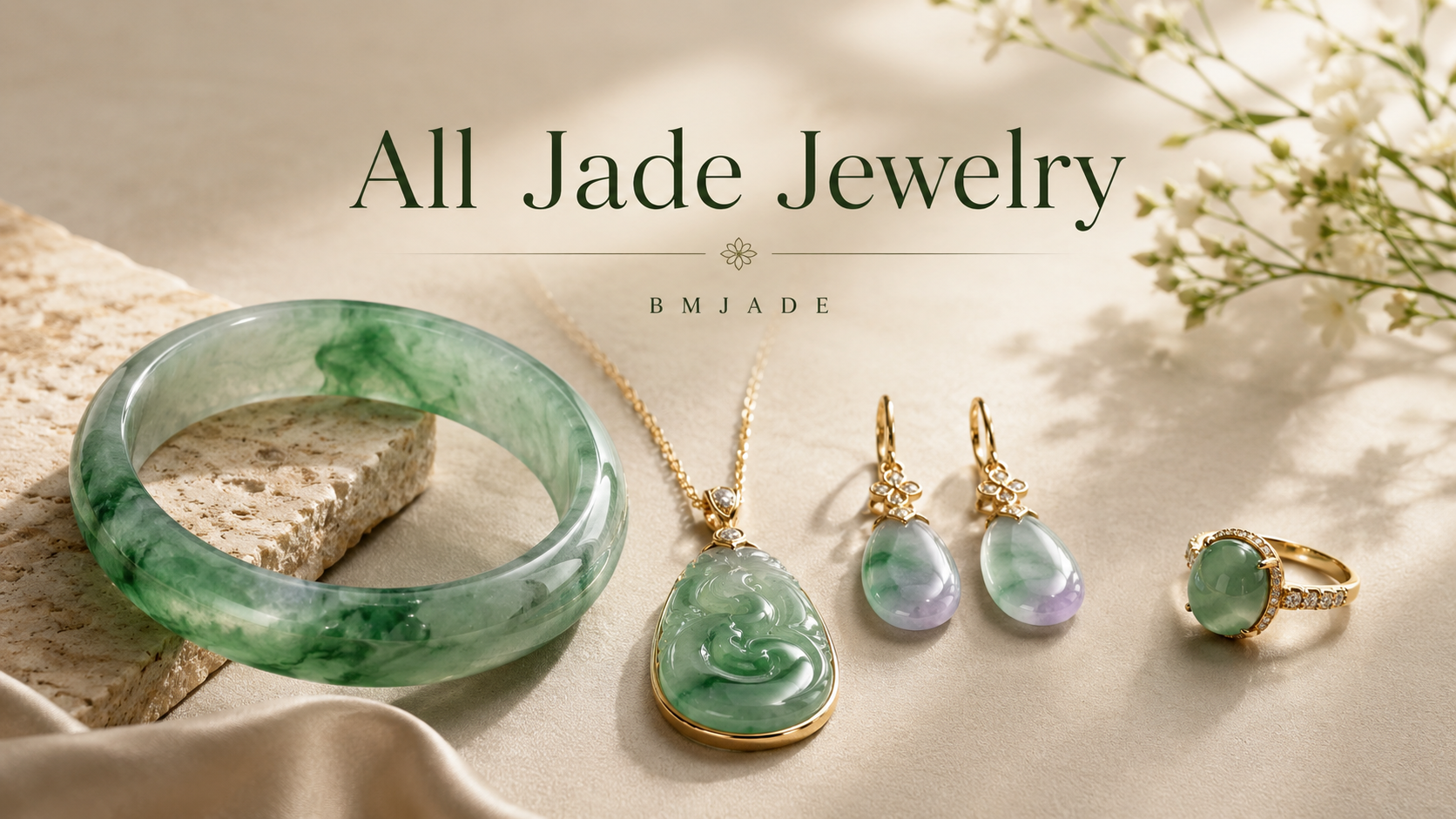
The Chinese word 玉 (yù) has never meant the same thing as the English word "jade," and almost every confusing jade purchase starts in that gap. Gemology recognizes exactly two jades: jadeite and nephrite. Chinese tradition recognizes dozens of stones as 玉, some of them geologically unrelated to either. Both usages are legitimate. The problem is that a seller can move between them without saying so, and the price difference between two stones both honestly called "jade" can be a factor of ten thousand. If you're not yet sure why "jadeite" and "nephrite" are two different words in the first place, start with the basics before diving into the twenty-plus varieties below. If you want to see what certified material actually looks like while you read, our full jade jewelry collection is the reference point for everything described below.
I'm Hong, founder of BMjade. Over nearly a decade between the Hpakant rough market in Myanmar and our workshop in Kunming, I've had most of the stones in this guide across the counter — sometimes because a customer brought one in believing it was jadeite.
That last part is the reason this guide exists. The most common way people lose money on jade in China isn't fake material. It's real material sold under a name that belongs to something else: Xiuyan serpentine described as jade, quartzite dyed and called Malaysia jade, sodium feldspar sold as glass-grade jadeite. Every one of those stones is genuine. Only the label is wrong.
This guide sorts the entire Chinese jade family — twenty-plus named varieties across six mineral groups — into what each one actually is, how to recognize it, and where it sits relative to the two gemological jades. By the end you'll be able to hear a stone's name and know roughly what you're being offered before you look at the price.
If you want the material science first, what jade is as a mineral covers the geology. This guide is the taxonomy.

Hetian jade vs jadeite — the comparison that decides everything else
(Jadeite vs nephrite: the same question in gemological language)
Two stones dominate Chinese jade, and nearly every other variety in this guide gets compared to one of them. Hetian jade (和田玉, hé tián yù) is nephrite. Jadeite (翡翠, fěi cuì) is jadeite. They are unrelated minerals, they came into Chinese culture three thousand years apart, and they are judged by different standards.
| Hetian jade / nephrite (和田玉/软玉) | Jadeite (翡翠/硬玉) | |
|---|---|---|
| Mineral | Tremolite–actinolite, amphibole group | Sodium aluminum silicate, pyroxene group |
| Chinese name | 软玉 ruǎn yù, "soft jade" | 硬玉 yìng yù, "hard jade" |
| Mohs hardness | 6 – 6.5 | 6.5 – 7 |
| Specific gravity | 2.90 – 3.03 | 3.30 – 3.38 |
| Structure | Felted microscopic fibers | Interlocking granular crystals |
| Luster | Oily, warm (油脂光泽) | Glassy, sharp (玻璃光泽) |
| Toughness | Highest of any gem material | Very high, below nephrite |
| Main source | Kunlun range, Xinjiang | Hpakant, Kachin State, Myanmar |
| In Chinese use since | Neolithic, ~5,000+ years | Qing dynasty, ~300 years |
| Graded on | Color, oiliness, texture, form (籽料/山料) | 种水色 — texture, translucency, color |
| Top material | Mutton-fat white 羊脂白玉 | Imperial green 帝王绿 |
The single most useful line in that table is luster. Nephrite looks oily. Jadeite looks wet. Hold both under a lamp and the difference is immediate and doesn't require any equipment. Nephrite's light seems to sit on the surface and diffuse warmly; jadeite's light appears to go into the stone and come back. That one observation separates the two families faster than any other test a buyer can do unaided.
A terminology note that matters commercially: Type A, B and C are jadeite-only terms. Nephrite is never graded A, B or C. A genuine Hetian report reads "natural nephrite," which is the correct equivalent standard for the material, not a lesser one. Anyone selling you "Type A Hetian jade" is either confused or counting on you being confused. What each treatment grade means.

Hetian jade in detail — the stone Chinese culture was built on
Hetian jade comes from the Kunlun range and the riverbeds of Xinjiang. It is the material of imperial seals, ritual discs, scholar's objects, and the entire moral vocabulary that attaches jade to human character in Chinese thought. When a classical text says 玉, it means this.
The eight Hetian colors
| Grade | Chinese | What it looks like | Position |
|---|---|---|---|
| Mutton-fat white | 羊脂白玉 | White as congealed fat, warm and pure, faint translucency at the edges | The summit. Extremely limited output |
| White jade | 白玉 | Clean white, fine texture | Just below mutton-fat |
| Blue-white jade | 青白玉 | White with a green-gray cast | Between white and green |
| Green jade | 青玉 | Restrained, sober gray-green | The most-used material in classical carving |
| Spinach green | 碧玉 | Green to dark green, chromium-colored | Distinct market of its own |
| Yellow jade | 黄玉 | Pale to deep yellow | Imperial reserve historically. Rare |
| Ink jade | 墨玉 | Black as ink, colored by graphite | Sought for carving contrast |
| Sugar jade | 糖玉 | Red-brown or yellow-brown surface, the color of brown sugar | Prized when the carver uses the color deliberately |
Note that 碧玉 (spinach green nephrite) and 墨玉 (ink nephrite) are different stones from the jadeite colors with similar English names. Jade colors and what causes each hue covers the chemistry across both species.
The three forms — and why form changes the price
This is the part of Hetian grading that has no equivalent in jadeite, and buyers outside China rarely hear about it.
| Form | Chinese | What it is | Quality |
|---|---|---|---|
| River pebble | 籽料 zǐ liào | Tumbled in riverbeds over geological time. Rounded, dense, with a natural skin | Best. Water has already destroyed everything with a flaw |
| Mountain-river | 山流水 shān liú shuǐ | Moved a shorter distance from the source. Partly rounded | Between the two |
| Mountain rough | 山料 shān liào | Cut directly from the primary deposit. Angular | Base grade |
The logic behind that hierarchy is worth stating plainly, because it explains most of the price gap: a river pebble has already been quality-tested by a few million years of water. Material with cracks, coarse grain or weak structure doesn't survive the journey. What arrives in the riverbed is the material that couldn't be broken. That is why 籽料 with an intact natural skin commands multiples of identical-looking mountain rough, and why fake skins are one of the most common frauds in the Chinese domestic market.
Nephrite that isn't Hetian
Hetian is a name that gets attached to nephrite from anywhere. These are the four you'll actually meet:
| Variety | Chinese | Source | How it differs |
|---|---|---|---|
| Qinghai jade | 青海玉 / 昆仑玉 | Qinghai | Good translucency but thin on oiliness. Often shows internal "water lines" |
| Russian jade | 俄料 | Russia | Very white but dry-looking; looser structure. The main Hetian substitute by volume |
| Korean jade | 韩料 | South Korea | Green-yellow cast, coarser, light in the hand, poor oiliness |
| He-mo jade | 河磨玉 | Xiuyan, Liaoning | Genuine tremolite with a weathered rind. Harder and more valuable than ordinary Xiuyan |
All four are real nephrite. None is Hetian. A seller should describe the material and the source separately, and be willing to say "Russian nephrite" out loud. If the only word offered is "Hetian," that's the answer to a question you didn't ask.

Jadeite — the king of the modern market
Jadeite arrived from Burma during the Qing dynasty and took over the top of the Chinese jade market within a few generations. It is now the most liquid, most recognized, and most expensive category, and it is the material we specialize in.
Jadeite is graded on three characters, in this order:
种 (zhǒng), texture. Crystal grain fineness, on a five-step scale: glass 玻璃种 > icy 冰种 > waxy 糯种 > bean 豆种. Finer grain lets light travel further before scattering. This is the largest value driver and the one photographs flatten.
水 (shuǐ), water. How deep light penetrates. Read with a flashlight behind the piece, never under shop lighting.
色 (sè), color. Emerald green is the summit, followed by 翡 (red and yellow), 春 (lavender) and 墨翠 (ink jadeite). Evenness matters more than intensity.
The most common thing buyers get wrong here: a vividly green piece with coarse 种 routinely sells below a modestly colored piece with very fine 种. Color is what you notice and what cameras exaggerate. Texture is what costs money.
For what each grade actually costs, see the 2026 jade price guide. For why Burmese material dominates the top of the market, see Burmese vs Guatemalan vs Hetian.
China's Four Great Jades
The traditional list is Hetian, Dushan, Xiuyan and Lantian. Note what it doesn't include: jadeite isn't on it. The list predates jadeite's arrival in China, which tells you how recent the "king of jade" really is.
| Variety | Chinese | Source | Mineral | Mohs | Defining trait |
|---|---|---|---|---|---|
| Hetian jade | 和田玉 | Xinjiang | Nephrite | 6 – 6.5 | Oily luster, mutton-fat white at the top |
| Dushan jade | 独山玉 | Nanyang, Henan | Multi-mineral rock | 6.0 – 6.5 | up to 77 natural color tones in one stone |
| Xiuyan jade | 岫岩玉 | Xiuyan, Liaoning | Mostly serpentine | 4.5 – 5.5 | Waxy luster, largest reserves in China |
| Lantian jade | 蓝田玉 | Lantian, Shaanxi | Marble / serpentine mix | 2—7 | Earliest worked jade in China, 5,000+ years |
Dushan jade (独山玉)
Sometimes called "Nanyang jadeite," which is exactly the kind of name this guide exists to correct. Dushan is a multi-mineral rock, not jadeite, and its distinction is color range: green, white, purple, yellow and brown can appear in a single stone, with up to seventy-seven recognized natural tones. That makes it the best material in China for 俏色巧雕 — carving that routes each color into a different element of the figure. The Yuan dynasty national treasure 渎山大玉海 is Dushan.
It is culturally important and genuinely collectible. It is not jadeite, and it should never be priced as jadeite.
Xiuyan jade (岫岩玉)
China's most affordable major jade and its largest reserve. It splits in two, and the split matters:
- Serpentine Xiuyan — the common material. Bright, translucent, waxy, and soft at 4.5–5.5 Mohs. It scratches. Sold everywhere as "jade," and it genuinely is 玉 in the Chinese sense.
- Tremolite Xiuyan (老玉 / 河磨玉) — geologically the same family as Hetian. Harder, denser, considerably more valuable.
Two stones, one place name, very different prices. Ask which one.
Lantian jade (蓝田玉)
The earliest jade worked in China, quarried since the Neolithic. Li Shangyin's line 「蓝田日暖玉生烟」 refers to this stone. Hard, fine, mostly green and white. Historically important, commercially modest today.

Quartz-family jades — where most of the naming trouble lives
Silica-based stones are the largest jade category by volume in China, and by far the most common source of misleading names. Every stone below is quartz or a quartz rock, hardness around 7, and none of them is jade in the gemological sense.
| Variety | Chinese | Source | Trait |
|---|---|---|---|
| Nanhong agate | 南红 | Liangshan Sichuan, Baoshan Yunnan | Dense red with visible cinnabar-like dots under a flashlight. Collector category |
| Agate | 玛瑙 | Xinjiang, Inner Mongolia | Banded structure. Many named types |
| Chalcedony | 玉髓 | Same regions | Even color, no banding. Finer than agate |
| Aventurine | 东陵玉 | India, Xinjiang, Inner Mongolia | Chromium mica gives golden glitter (砂金效应). Entry level. Commonly used to imitate jadeite |
| Golden-silk jade | 金丝玉 | Junggar Basin, Xinjiang | "Radish grain" structure. Top grade 宝石光 is translucent and vivid |
| Huanglong jade | 黄龙玉 | Longling, Yunnan | Named only in 2004. Gold-dominant, called "the second jadeite." Prices spiked then normalized |
| Jing white jade | 京白玉 | Beijing | White quartzite, fine texture |
| Mi jade | 密玉 | Miyang, Henan | Green quartzite, "Henan emerald" |
| Guicui | 贵翠 | Guizhou | Green kaolin-bearing quartzite |
| Gobi jade | 戈壁玉 | Xinjiang | Wind-abraded, dense and hard |
Nanhong (南红) deserves a note. Fine persimmon-red 柿子红 nanhong has crossed a thousand dollar per gram in recent years, driven by low yield, small block size and heavy fracturing in the rough, plus its established role in Tibetan Buddhist prayer beads. It is not jade. It is also not cheap. Both facts can be true.
Aventurine (东陵玉) is the one to memorize. Hardness 7, green, translucent, and the single most common stone sold as jadeite to tourists in China. The tell is the glitter: chromium mica flakes catch the light in a way no jadeite ever does. Tilt it slowly under a lamp and the sparkle appears.
Colored gemstone jades
| Variety | Chinese | Source | Mohs | Trait |
|---|---|---|---|---|
| Turquoise | 绿松石 | Shiyan, Hubei | 5 – 6 | Hydrated copper aluminum phosphate. 高瓷高蓝 is the top grade |
| Lapis lazuli | 青金石 | Mostly Afghanistan | 5 – 6 | Deep blue with pyrite flecks and calcite veining |
| Malachite | 孔雀石 | Hubei and others | 3.5 – 4 | Concentric or radiating green banding, named for peacock feathers |
Turquoise carries the heaviest cultural weight of the three. It is one of the seven treasures of Tibetan Buddhism, and Shiyan in Hubei is the world's main source of fine material.
Lapis has its own four-step Chinese grading — 青金石 > 青金 > 金克浪 > 催生石 — and one memorable rule: 「青金不带金」, the best lapis carries no visible gold. Pyrite flecks read as decorative in the West and as a defect in the Chinese market.
The three great seal stones (印石三杰)
Not jade by any definition, and inseparable from Chinese jade culture. These are the stones of literati seal carving, and they are priced like jade.
Shoushan stone (寿山石), Fuzhou, Fujian. Warm, fine, exceptional under the blade. Its top variety is 田黄 tián huáng, the "emperor of stones" — yellow, found in the paddy soil along the Shoushan stream, identified by its skin, red veining and radish-grain structure. The saying is 「一两田黄三两金」: one liang of tianhuang is worth three of gold.
Chicken-blood stone (鸡血石), Changhua in Zhejiang and Bailin in Inner Mongolia. Colored by cinnabar, mercury sulfide, in a red so vivid it's named for blood. Graded on how much red, how bright, and how it's distributed. Called 「石中皇后」, queen of stones, paired with tianhuang as the two summits of seal material.
Qingtian stone (青田石), Qingtian, Zhejiang. The carver's favorite for cutting feel. Named varieties include 灯光冻, 封门青 and 蓝星.
Lookalikes — the stones that exist to be mistaken
| Variety | Chinese | What it actually is | The tell |
|---|---|---|---|
| Feicui-water stone | 水沫玉 | Sodium feldspar, found alongside jadeite in Myanmar | Tiny bubble-like inclusions "as if water is splashing." Lighter in the hand |
| Dulong jade | 独龙玉 | Quartzite, Yunnan | Green with gray drift; looks strikingly like jadeite. Lacks jadeite's heft |
| Tianshan cui | 天山翠 | Quartzite, Xinjiang | Bright green, hard, no jadeite structure |
| Shetai cui | 佘太翠 | Quartzite, Inner Mongolia | Same family as aventurine |
| Daqian jade | 大千玉 | Tremolite, Tuo River, Sichuan | Recently identified nephrite-family material |
| Bamboo-leaf jade | 都兰岫玉 / 竹叶玉 | Serpentinite, Dulan, Qinghai | Bamboo-leaf patterning |
| Peach blossom stone | 桃花石 | Pink carving stone, Zhejiang | Used for carving, not jade |
| Jiulong bi | 九龙璧 | Hua'an stone, Fujian | Jasper-quality, hard |
| Petrified wood | 硅化木 / 树化玉 | Silicified ancient timber | Wood grain visible in stone |
水沫玉 is the one that costs people real money. It sits in the same Burmese deposits as jadeite, arrives through the same channels, and at a glance looks like fine icy jadeite. It is sodium feldspar. Two things separate it: those characteristic bubble-like inclusions, and weight — jadeite at SG 3.30–3.38 has a heft that feldspar at around 2.6 simply doesn't.
Quick identification: luster and heft
No equipment, thirty seconds, narrows any stone to a family.
| Luster | Stones |
|---|---|
| Glassy, sharp (玻璃光泽) | Jadeite, chalcedony |
| Oily, warm (油脂光泽) | Hetian nephrite, aventurine |
| Waxy, muted (蜡状光泽) | Xiuyan, golden-silk jade, Huanglong jade |
| Resinous (树脂光泽) | Agate, Dushan jade |
| Heft in the hand | Stones |
|---|---|
| Heavy for its size | Jadeite, Hetian nephrite, chalcedony |
| Light for its size | Xiuyan, 水沫玉 |
Two stones, same size, same color, one noticeably heavier: the heavy one is the denser mineral, and density is the fastest free discriminator available to a buyer. For the measured version of this test, see 7 home tests and what each one actually proves.

What to ask before you buy — and where this guide's limits are
We sell jadeite and Hetian nephrite. We don't sell Dushan, Xiuyan, nanhong, turquoise or seal stones, and we aren't the people to price them. What we can tell you is what to ask, because the questions are the same across every category.
Ask for the mineral name, not the place name. "Hetian" is a place. "Nephrite" is a material. A seller who will only give you the place name is choosing the vaguer of two available answers.
Ask which Xiuyan. Serpentine or tremolite. The price difference is large and the name is identical.
Ask whether the skin is natural. For Hetian 籽料, fake skins are among the most common frauds in the Chinese domestic market, and a convincing fake skin can double an asking price.
Ask for the certificate before the money, not after. Whatever the material, an accredited laboratory names the mineral. How to choose and verify a certificate.
And be honest with yourself about which purchase you're making. Buying Xiuyan because you like how it looks at that price is a perfectly good decision. Buying Xiuyan because someone told you it was jadeite is a different transaction entirely. The stone is the same either way; what changes is whether you were told the truth.
Frequently asked questions
What are the four great jades of China?
Hetian jade from Xinjiang, Dushan jade from Henan, Xiuyan jade from Liaoning, and Lantian jade from Shaanxi. Jadeite is not on the list, because the list predates jadeite's arrival in China during the Qing dynasty. Some modern versions substitute turquoise from Hubei for Lantian.
Is Hetian jade the same as nephrite?
Hetian jade is nephrite, but not all nephrite is Hetian. Nephrite from Qinghai, Russia, Korea and Liaoning is the same mineral from different deposits, with different texture and oiliness. "Hetian" has become a quality label as much as a geographic one in the Chinese market, which is why the mineral name and the source should be stated separately.
What is the difference between jadeite and nephrite?
They are unrelated minerals. Jadeite is a pyroxene, harder at 6.5–7 Mohs, denser at 3.30–3.38, with a glassy luster and interlocking granular structure. Nephrite is an amphibole, 6–6.5 Mohs, 2.90–3.03, with an oily luster and a felted fibrous structure that makes it the toughest gem material known. Jadeite dominates the top of the modern market; nephrite carries the older Chinese tradition.
What is jadeite called in Chinese?
翡翠 (fěi cuì). Nephrite is called 软玉 (ruǎn yù, "soft jade") or, when specifically from Xinjiang, 和田玉 (hé tián yù, Hetian jade). The umbrella word 玉 (yù) covers both minerals plus a much wider family of stones considered jade in Chinese cultural tradition, which is the entire reason this guide exists — gemology and Chinese usage don't draw the line in the same place.
Is Xiuyan jade real jade?
It depends which Xiuyan and which definition. Most Xiuyan is serpentine, which is 玉 in the Chinese cultural sense but not jade in the gemological sense. Xiuyan also produces tremolite material known as 老玉 or 河磨玉, which is nephrite and therefore jade under both definitions. The two trade under the same place name at very different prices.
Why is Dushan jade sometimes called Nanyang jadeite?
Because it comes from Nanyang in Henan and can be strongly colored. The name is misleading: Dushan is a multi-mineral rock, not jadeite. It is genuinely collectible in its own category, particularly for multi-color carving, but it should be described and priced as Dushan jade.
What is 籽料 and why does it cost more?
籽料 is Hetian nephrite recovered from riverbeds, tumbled and rounded over geological time. It costs more because the river has already removed everything flawed: material with cracks, coarse grain or weak structure doesn't survive the journey. What reaches the riverbed is what couldn't be broken. Fake natural skins are a common fraud, so the skin needs checking as carefully as the stone.
What stone is most often sold as jadeite?
Aventurine (东陵玉) and dyed quartzite are the most common by volume, and 水沫玉 — sodium feldspar from the same Burmese deposits — is the one that fools the most experienced buyers. Aventurine gives itself away with metallic glitter under a tilting light. 水沫玉 gives itself away by weight and by bubble-like internal inclusions.
I inherited a piece and don't know what it is. What now?
Start with luster and heft: glassy and heavy points toward jadeite or chalcedony, oily and heavy toward nephrite, waxy and light toward serpentine. That narrows the family in under a minute. For anything you might insure, sell or pass on, an accredited laboratory report naming the mineral is the only answer that holds up, and it costs a small fraction of what a mistaken assumption can.
Conclusion
Chinese jade isn't one stone and never was. It's a family of more than twenty materials spanning six mineral groups, four thousand years of carving, and a price range from a few dollars to more than gold by weight. Every one of them is a legitimate stone with its own tradition. The only illegitimate thing in the entire category is a name pointed at the wrong material.
Learn the two questions — what mineral, and from where — and most of the risk in this market disappears. If you have a piece you can't place, email me directly at jadeworldchina@outlook.com and describe the luster and the weight. That's usually enough to narrow it. — Hong