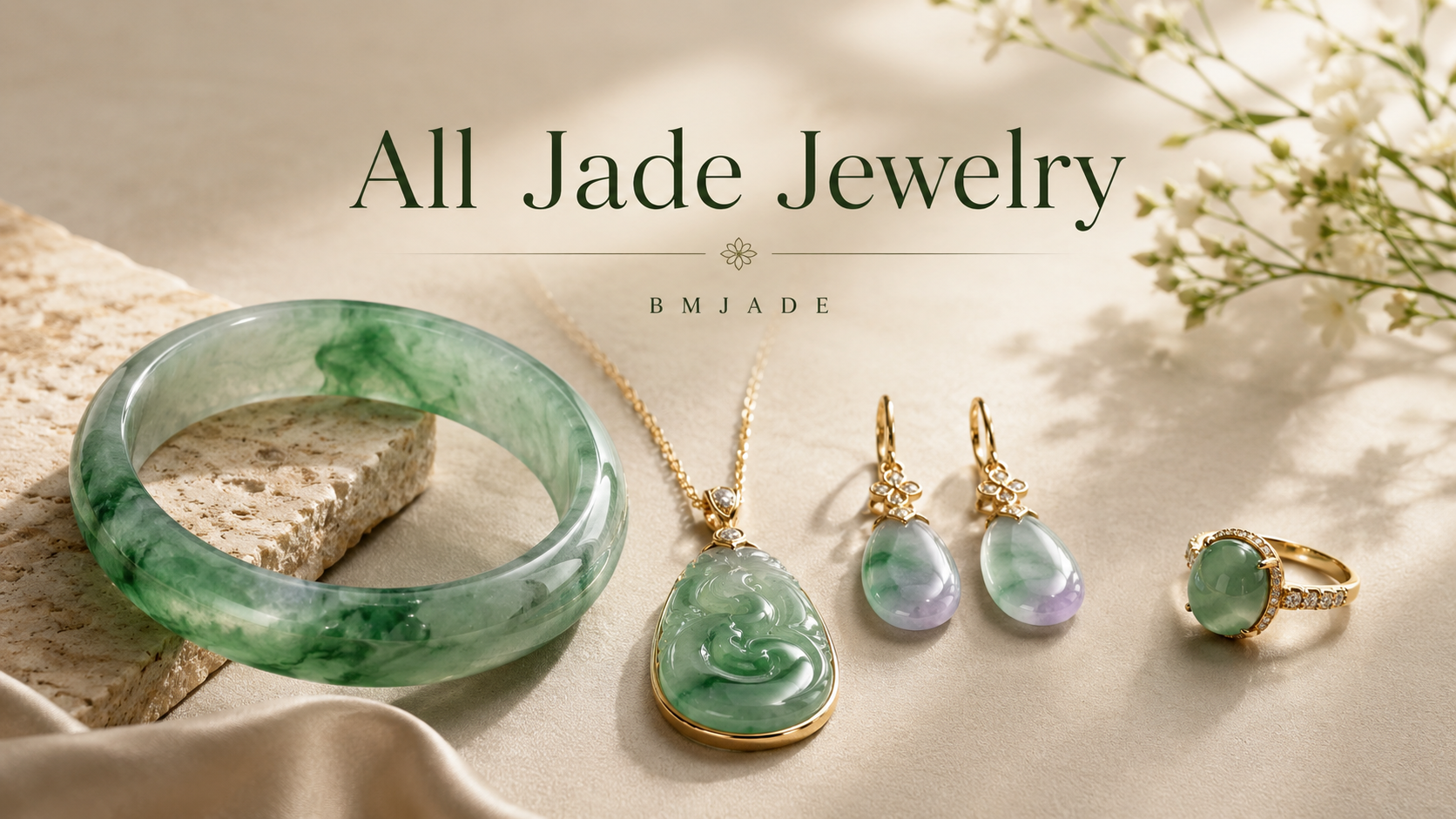
Ask most people what color jade is, and they'll say green. They're not wrong — green has been jade's defining color for so long that the two words sit together in our minds almost automatically. But green is just the entrance to a much larger room. Authentic natural jade occurs across a spectrum that includes lavender, white, yellow, black, red, blue, and the rare multi-color stones that combine several hues in a single piece.
Each color carries its own story. Each is caused by a specific combination of trace elements interacting with the jade's crystal structure deep inside the earth. Each holds a different position in the value hierarchy of the jade market. And each, across thousands of years of cultural use, has accumulated symbolic meaning that shapes how it's chosen, gifted, and worn.
I'm Hong, the founder of BMjade. Over nearly a decade between the Hpakant market in Myanmar and our workshop in Kunming, Yunnan, I've handled jade in every color this guide covers. Some pieces — the genuinely fine imperial greens and pure saturated lavenders — are rare enough that selecting one feels like watching for something specific to appear in a slow river. Others are common but undervalued, with meaning that deserves more recognition than the market gives them.
At BMjade, we focus on certified Type A natural jadeite jewelry because jade color should be natural, honestly described, and supported by clear material information. If you are choosing jade by color, browse BMjade’s certified Type A jadeite jewelry, including jade bracelets, necklaces, earrings, and rings.
This guide walks through each major jade color — the geology that creates it, the cultural meanings attached to it, where it sits in the value hierarchy, and how to recognize quality within that color. By the end you'll be able to look at any piece of jade and read more than just "green or not green" — you'll read what the color is saying.
If you're newer to jade as a material, the primer on what jade actually is is the foundation. For the deeper cultural context behind the symbolism, see the full background on jade meaning across civilizations. This article focuses specifically on color.

Every jade color at a glance
Natural jade occurs in eight color families. Here is the whole spectrum before we go into each one.
| Color | What causes it | Trade names you'll see | Rarity |
|---|---|---|---|
| Green | Chromium (Cr³⁺) | Imperial, kingfisher, apple, spinach, moss-in-snow | Common to extremely rare at the top |
| Lavender / purple | Manganese (Mn³⁺) | 春色 spring, 桃花紫 peach blossom, 藕粉紫 lotus root, 茄紫 aubergine | Very rare in saturated grades |
| White | Absence of trace elements | 冰种 icy, 玻璃种 glass (jadeite); 羊脂白 mutton-fat (nephrite) | Moderate to rare |
| Yellow | Iron oxidation in the boulder's skin | 蜜糖黄 honey, 鸡油黄 imperial yellow | Less common |
| Black | High chromium via kosmochlor, or graphite inclusions | True black, dark-green-read-as-black | Moderately rare |
| Red | Iron oxide in the weathered rind | Cinnabar, persimmon, iron red, sunset red | Very rare in true red |
| Blue | Iron oxidation states, sometimes with omphacite | Olmec blue, 蓝水 blue water | Rarest of all |
| Multi-color | Two or more of the above in one stone | 三彩玉 three-color, 福禄寿 Fu Lu Shou, 飘花翡翠 floating flower | Very rare |
Two things to notice before reading further.
Color and value are not the same question. A pale apple-green piece with fine texture and high translucency routinely outprices a deeper imperial-toned piece that is coarse or opaque. Color is what you see first and what photographs exaggerate; texture is what costs money and what photographs flatten.
And color is not proof of anything. Dyed material can show colors more vivid than natural stone. Every color below assumes certified Type A material.
How jade gets its colors — the chemistry in plain language
Before walking through the individual colors, here's the underlying science. Pure jadeite, by chemistry alone, is colorless or white. The full spectrum of jade colors comes from trace amounts of other elements that work their way into the crystal structure during the stone's formation.
According to research published by the Swiss Gemmological Institute SSEF, three trace elements account for most of the natural color variation in jade:
Chromium (Cr³⁺) produces vivid greens. Even small amounts of chromium yield the saturated emerald hue that defines imperial jadeite. Higher chromium concentrations push the color toward dark green or even black (the latter through a related mineral called kosmochlor). All the highest-grade green jadeite from Myanmar owes its color to chromium.
Iron (Fe²⁺ and Fe³⁺) produces a wide range of colors depending on the oxidation state and concentration. Iron in its trivalent form (Fe³⁺) contributes to muted greens and grays. Iron in its divalent form (Fe²⁺) can produce blue or gray tones. Surface oxidation of iron, occurring after the rough stone is exposed to weather over geological time, creates the orange-red-brown spectrum often grouped as "red jade." Most of nephrite's color also comes from iron.
Manganese (Mn³⁺) produces lavender and purple. The exact shade — from soft pastel lavender to deeper aubergine purple to blue-violet — depends on the manganese concentration and whether other trace elements like titanium are also present. A 2025 study published in the peer-reviewed journal Crystals identified manganese-rich chromite as a critical source of the manganese that creates Myanmar's most prized lavender jadeite, using electron probe microanalysis to trace how chromium and manganese diffuse together through the stone's formation.
The translucency and texture of the underlying jade matter as much as the trace elements. A piece of jadeite with the exact same chromium content can look spectacular if the texture is fine and the translucency high, or unremarkable if the texture is coarse and the stone is opaque. This is why two pieces with technically identical color readings can differ wildly in market value — and why color discussions always have to consider translucency and texture as co-variables, not separate factors.
A note on geographic distinction: chromium-rich Burmese jadeite produces the world's brightest greens, while iron-influenced Guatemalan jadeite tends toward darker, more blue-influenced greens. Hetian nephrite from China's Xinjiang region runs heavily toward iron-influenced whites and greens with the soft "oily" luster that defines the variety. The colors you encounter are not random — they reflect where the stone was born.

Green jade — the classic and the standard
Green is the color most people picture when they think of jade, and for good reason. It's the most common color across both jadeite and nephrite, the most culturally significant in every major jade-using tradition, and the color that contains the single most valuable category of jade in the world.
But "green jade" is not one color. The jadeite trade recognizes a hierarchy of greens, each with its own name and price tier.
| Tier | Chinese | What it looks like |
|---|---|---|
| Imperial green | 帝王绿 | Deeply saturated semi-translucent emerald; vivid without being neon, even distribution, light penetrating a few millimeters before diffusing softly |
| Kingfisher green | 翠绿 | One tier below imperial; slightly less saturated but still vivid. The practical "fine quality" green most collectors actually acquire |
| Apple green | 苹果绿 | Lighter, more yellow-tinged; cheerful rather than imperial. Popular for daily wear |
| Spinach green | 菠菜绿 | Mainly nephrite. Deeper, grounded green with gray undertones. Classic Siberian and Canadian color |
| Moss-in-snow | 雪里藏苔 / 白底飘花 | Translucent white jadeite with bright green veining running through it |
There is more to say about green than fits in a color overview — the difference between the named green tiers, how color and translucency trade off against each other, and what the trade names are actually describing. Our complete guide to green jade meaning, color grades and origins covers all of it.
For the practical buyer, green jade offers the widest range of price points and the broadest meaning, making it the safest starting color for anyone new to wearing jade. Our curated selection of authenticated Type A jade includes pieces across the full green spectrum from apple green to imperial.

Lavender jade — the second crown
Lavender jade is the second most valuable color category, and in the highest grades it can rival or even exceed imperial green at auction. A 2018 sale at Beijing Poly Auction saw a 35-bead lavender jadeite necklace reach approximately USD $2.7 million — a record for the color and a signal of how serious top-tier lavender has become as a collector category.
The color comes from manganese in the jadeite crystal structure, sometimes interacting with titanium to push toward more blue-violet tones. The trade recognizes several distinct sub-shades, each with its own poetic Chinese name:
| Sub-shade | Chinese | What it looks like |
|---|---|---|
| Spring color | 春色 | Lightest and most romantic lavender, delicate pinkish undertones. The classic lavender jadeite of fine jewelry |
| Peach blossom purple | 桃花紫 | Slightly deeper, warmer purple with rose undertones. Considered especially feminine |
| Lotus root purple | 藕粉紫 | Soft, almost dusty purple-pink, named after a lotus root cross-section. Subtle rather than dramatic |
| Aubergine purple | 茄紫 | Deepest natural lavender, approaching true purple, sometimes with faint blue undertones. Rare |
| Spring with color | 春帶彩 | Extremely rare. Lavender, green and sometimes yellow in distinct regions of one stone |
Meaning. Lavender jade is traditionally associated with emotional healing, spiritual nourishment, and feminine energy. In modern crystal practice, it's the stone of choice for working through grief, emotional wounds, and periods of difficult transition. Its softness — visually and energetically — makes it the traditional comforting gift between mothers and daughters, between close friends, and as a self-purchase during life's harder seasons.
Lavender's quiet aesthetic also makes it favored among collectors who want jade that doesn't shout. It pairs particularly well with rose gold and white gold settings, and its modest weight in market awareness compared to green jade means well-chosen lavender pieces still represent good value relative to their material quality.

White jade — purity and the imperial nephrite tradition
White jade splits in two directions depending on whether it's jadeite or nephrite, and the distinction matters.
| Type | Chinese | Species | What it looks like |
|---|---|---|---|
| Icy jade | 冰种 | Jadeite | Nearly transparent, faint blue or green tint, glass-like inner glow |
| Glass jade | 玻璃种 | Jadeite | Even more translucent than icy, and rarer still |
| Mutton-fat white | 羊脂白 | Nephrite | Warm off-white with the soft, almost greasy luster of polished fat; subtle translucency at the edges |
| Chicken-bone white | 鸡骨白 | Nephrite | More opaque, slightly yellowish |
| Sugar white | 糖白 | Nephrite | With brownish surface staining |
Where the white comes from. White is what jadeite looks like when chromium, manganese and iron are all absent. A second mechanism runs alongside it — light scattering at grain boundaries and inclusions — which is why some white jade is opaque and some is nearly transparent despite near-identical chemistry.
Meaning, briefly. White stands for purity and integrity of character, an association that comes from Chinese texts reading jade's physical properties as a model for conduct rather than from colour symbolism assigned later.
There is more to say about white than fits in a colour overview — where each material is mined, what the trade names do and don't establish, and how to tell white jadeite from white nephrite in the hand. Our complete guide to white jade meaning, types and origins covers all of it.

Yellow jade — the rising star
Yellow jade has had an unusual market trajectory. For most of jade's history, yellow was a niche category — beautiful but not particularly prestigious. Over the past decade, both the Chinese collector market and Western designers have rediscovered yellow jadeite, and prices have moved upward significantly.
The color comes from iron oxidation, typically occurring as the boulder weathered before being mined. This means yellow jadeite often appears as the surface or "skin" of a stone with white or green interior — a feature that skilled carvers exploit for dramatic two-tone effects.
The trade distinguishes several yellow grades:
| Grade | Chinese | What it looks like |
|---|---|---|
| Honey yellow | 蜜糖黄 | Warm translucent yellow with golden depth. The most desirable grade |
| Imperial yellow | 鸡油黄 | Literally "chicken-fat yellow." Richer, more saturated, historically imperial associations |
| Pale yellow | 淡黄色 | Softer, sometimes with cream or off-white undertones. Often combined with other colors in carved pieces |
| Brown-yellow | 棕黄色 | Overlaps into brown; darker, earth-toned. Lower in the hierarchy but used effectively in traditional carving |
Meaning. In Chinese tradition, yellow was the imperial color — reserved historically for the emperor's robes and ceremonial objects. By extension, yellow jade carries associations with dignity, abundance, joy, and elevated status. In feng shui, yellow jade is connected to the earth element and is used to encourage stability, accumulation, and grounding. In modern crystal practice, yellow jade is associated with optimism, confidence, and energetic warmth.
The contemporary appeal of yellow jade is partly aesthetic — its warm tone pairs beautifully with skin tones across the range, and it integrates with gold settings in a way that green sometimes struggles to do. For buyers wanting jade that doesn't read as "expected" but still carries traditional weight, yellow is a strong choice. Pricing typically ranges from $50 to $800 per carat for fine grades, though exceptional honey-yellow pieces with high translucency can exceed this range substantially.

Black jade — protection and grounding
Black jade is the most assertive color in the jade spectrum, and one of the most misunderstood. Many "black jade" pieces on the market are actually very dark green that reads as black under normal light, with the green visible only when held against a strong backlight. True black jade — where the color is fundamentally black rather than dark green — exists but is relatively rare.
The color comes from different sources depending on whether the stone is jadeite or nephrite. In jadeite, very high chromium concentrations push the color from green through to black via the related mineral kosmochlor. Iron in certain combinations can also produce black coloration. In nephrite, black coloration usually comes from microscopic inclusions of dark minerals — primarily graphite, but also chromite and magnetite.
The trade recognizes a few main grades:
| Grade | What it looks like | How to tell |
|---|---|---|
| True black | Opaque, jet-black throughout | No green undertones visible even under bright light. Rare in jadeite, more common in nephrite |
| Dark green read as black | Appears black at first glance | Reveals deep emerald or forest green when held to strong backlight. Most material sold as "black jade" |
| Black with green flashes | Distinct color zones | Deep black areas with brighter green sections. Often used for dragon and warrior carvings |
There is more to say about black than fits in a colour overview — how black jadeite and black nephrite get their colour differently, how to separate true black from dark green, and what a certificate can and can't confirm. Our complete guide to black jade meaning, types and origins covers all of it.
Stylistically, black jade has become particularly popular in men's jewelry over the past decade. The deep color works with both formal dress and casual settings without reading as overtly "Chinese gemstone." Pricing typically runs $100 to $1,500 per carat for quality material, with exceptional pieces well above that range.

Red jade — vitality and ceremonial fire
True red jade — vivid, saturated, pure red — is one of the rarest natural colors in the entire jade spectrum. Most stones sold as "red jade" actually show orange, orange-red, or brown-red coloration rather than pure red. The color comes from iron oxide, typically formed when the rough stone's surface weathered over geological time. This means red jadeite frequently appears as a colored "skin" or rind on a stone whose interior is white, green, or another base color — a feature carvers prize for dramatic two-tone effects.
The category includes several sub-shades:
| Sub-shade | What it looks like |
|---|---|
| Cinnabar red | The deepest, most saturated red. Extremely rare |
| Persimmon red | Warm orange-red resembling the fruit. The most common "red" actually seen on the market |
| Iron red | Darker, more brown-influenced; often the surface coloration on otherwise white jadeite |
| Sunset red | Softer red-orange, sometimes with pink undertones |
A note on orange. Some of what the market calls "red jade" is, strictly, orange — persimmon red and sunset red both sit closer to orange than to true red on a color wheel, and searches for "orange jade" specifically are common enough to deserve a direct answer: yes, orange jade is real, and it shares red's cause. The same surface iron oxidation that produces red jade's rind produces orange jade when the iron concentration or oxidation state is slightly different. It is not a separate mineral or a separate grade — it's a point on the same red-orange-brown spectrum caused by the same weathering process, and pieces are sold as "orange jade" or "amber jade" interchangeably with persimmon red depending on the seller's preference for the name.
Meaning. Red is the most auspicious color in Chinese culture — the color of celebrations, weddings, the New Year, and protection against evil. Red jade carries all of these associations, plus the more specific symbolism of vitality, life force, courage, and decisive action. In modern crystal practice, red jade is described as a stone for dispelling fear and motivating movement forward; it's the jade associated with the root chakra and physical groundedness.
Red jade is traditionally chosen for marking new ventures, weddings, and ceremonial occasions. It's particularly common in pieces given for Chinese New Year, for business launches, and for couples beginning marriage. The rarity of true pure red makes high-quality pieces collectible, with prices ranging widely depending on saturation, evenness, and overall stone quality.

Blue jade — the rarest of all
Blue jade is so rare that most jade dealers will never handle it in their entire careers. When it appears, it generates serious collector attention.
True blue jade — a clean, distinct blue color rather than blue-tinted green or gray — comes from iron in specific oxidation states, sometimes combined with the related mineral omphacite. Guatemalan jadeite is the primary source of natural blue jade in the world, producing the famous "Olmec blue" used by ancient Mesoamerican civilizations and identifiable today by its slightly gray-blue, somewhat mottled appearance. Burmese jadeite occasionally produces blue stones as well, but they're vanishingly rare in fine grades.
The trade recognizes several blue variants:
| Variant | Chinese | Source | What it looks like |
|---|---|---|---|
| Olmec blue | — | Guatemala | The historical blue used by Maya and Olmec carvers. Slightly gray-blue with variability across a single piece |
| Blue water jade | 蓝水 | Myanmar | Soft blue-green with high translucency, sometimes called "ice blue." A modern collector category, highly desirable in Asian markets |
| True blue | — | Rare in both | Distinctly blue without strong green or gray undertones. The rarest grade |
Meaning. Blue jade is associated with tranquility, courage, communication, and clarity of mind. In modern crystal practice, blue jade is connected to the throat chakra, used for honest self-expression and clear communication. In Mesoamerican tradition, the blue jade of the Olmec was associated with water and divine power. The color is also linked in modern symbolism to peace, calm thinking under pressure, and the steadiness needed for sustained mental work.
For collectors, blue jade is one of the few jade colors where rarity alone — without considering imperial-tier saturation or fine texture — can drive value sharply. Even a relatively modest blue piece, if its color is genuinely blue rather than blue-green, can command prices comparable to or exceeding fine green jade. Authentication is especially important here because of the rarity premium; we always recommend that significant blue jade purchases come with proper lab certification through NGTC or equivalent.

Multi-color jade — the rare combinations
Some of the most prized jade pieces in the world combine multiple colors in a single stone, and the names for these combinations are part of the deeper jade vocabulary.
| Combination | Chinese | What it is |
|---|---|---|
| Three-color jade | 三彩玉 | One piece showing three distinct colors, typically green/white/lavender or green/white/red |
| Fu Lu Shou jade | 福禄寿翡翠 | Specifically red, green and purple together. Happiness, prosperity, longevity. The most fortunate combination possible |
| Moss-in-snow | 春色花 | White jadeite with bright green moss-like inclusions |
| Floating flower jade | 飘花翡翠 | Predominantly white or icy jadeite with wisps or clouds of green or lavender drifting through |
| Spring with color | 春带彩 | Lavender with green and sometimes yellow in distinct zones. Extremely rare |
Multi-color jades reward careful carving because skilled artisans can position the design so that each color represents a specific element of the figure — for example, a Pixiu carved so that its body is green, its face is white, and its eyes are lavender. These pieces are essentially one-of-a-kind by definition; no two stones share the same color distribution.

How color affects value
Color is one of five quality factors, and on its own it is the least reliable predictor of price. The rough order of the color hierarchy for top-quality material is:
imperial green > top lavender > true blue (rarity premium) > icy white jadeite > apple green > black > yellow > red
Multi-color stones like Fu Lu Shou sit outside this ranking and typically command a premium over any single color.
For actual per-carat price ranges by color, grade and jewelry type, see the 2026 jade price guide — it carries the full pricing framework and is updated as the market moves.
A few cautions:
- Color alone doesn't determine value. A pale apple-green piece with excellent translucency and fine texture can outprice a deeper imperial-toned piece with poor texture or opacity. The five quality factors — color, translucency, texture, clarity, and craftsmanship — interact multiplicatively.
- Untreated material only. All values above assume Type A natural jade. Type B (acid-bleached and polymer-impregnated) and Type C (dyed) material has effectively no investment value regardless of color appearance.
- Buying-for-meaning vs buying-for-value are different decisions. If you're choosing color for symbolic resonance, you might choose lavender for emotional healing even though green has higher market liquidity. If you're buying as an investment, the calculation shifts toward color rarity and resale considerations. Our investment perspective on jade in 2026 covers this trade-off in depth.

How to choose a jade color — practical guidance
If you're trying to decide which color to buy, the most useful framework is to start with intention, then narrow within that intention by personal aesthetics and skin tone.
For everyday wear and broadest meaning: Apple green or kingfisher green offers the widest cultural resonance, the most versatile pairing with clothing, and the broadest range of price points. Hard to go wrong here.
For emotional support or self-care: Lavender is the traditional choice. Soft, comforting, with feminine and gentle energetic associations.
For clarity and understated wear: White jade — icy jadeite or fine Hetian nephrite — is the colour traditionally tied to clear thinking and unmarked conduct. How to choose white jade
For warmth, optimism, and joy: Yellow jade brings cheerful energy without losing dignity.
For protection and strength: Black jade is the traditional shield, particularly for men and people in high-stakes professional roles.
For new beginnings, weddings, and ceremonial moments: Red jade carries celebration, vitality, and life force.
For collectors and those wanting something unique: Blue or multi-color jade. Rarity drives both visual interest and long-term value.
Skin tone considerations. This is rarely discussed but practically matters. Warm-toned skin (yellow or olive undertones) tends to harmonize particularly well with apple green, yellow, and warm-toned lavender. Cool-toned skin (pink or blue undertones) tends to flatter imperial green, icy white, blue, and cool-toned lavender. These are guidelines, not rules — personal preference matters more — but they can help when narrowing among options.
For category-specific color guidance: necklace pendants show off color most dramatically because they're worn against the chest; bracelets and bangles showcase translucency well because they wrap around the wrist; rings and earrings work best with vivid colors that read clearly at smaller scales.

Frequently asked questions
What is the most valuable color of jade?
At the top of the market, imperial green jadeite is generally considered the most valuable, with top auction pieces reaching prices unmatched by any other color. However, top-grade lavender can occasionally surpass imperial green at auction, and rare multi-color Fu Lu Shou stones can exceed both. Among single colors, the hierarchy is roughly: imperial green > top lavender > true blue (rarity premium) > icy white jadeite > apple green > black > yellow > red. Within each color, quality varies enormously, so a fine piece of "lower-tier" color can outprice a poor piece of "higher-tier" color.
What is the rarest color of jade?
True blue jade is the rarest natural color. Many jade dealers go their entire careers without seeing a fine blue piece. Pure red (without orange or brown undertones) is similarly rare. Three-color and multi-color combinations like Fu Lu Shou jade are extremely rare in fine quality. Imperial green, while not the rarest by sheer occurrence, is the rarest at the very top quality grade.
What does each color of jade mean?
Brief summary: Green — growth, prosperity, harmony, heart chakra; Lavender — emotional healing, spiritual nourishment, feminine energy; White — purity, clarity, moral integrity; Yellow — abundance, optimism, joy, earth element; Black — protection, grounding, inner strength; Red — vitality, courage, celebration, life force; Blue — tranquility, communication, clear thinking. Each color carries additional layers of meaning within specific cultural traditions, which our deeper guide to jade's symbolism and cultural significance covers.
Is darker or lighter jade more valuable?
Neither, inherently. Value depends on the specific color, its saturation, evenness, and translucency. In green jadeite, a medium-deep, vivid, evenly distributed color is typically most valuable — too dark reads as black or muddy, too light reads as washed out. In lavender, the saturated colors are generally more prized than the palest. In white, the question depends on whether you're judging jadeite (where translucent icy white is at the top) or nephrite (where the warm cream of mutton-fat is at the top).
Does jade changing color mean something spiritually?
In some folk and crystal-healing traditions, a piece of jade appearing to shift in color or clarity is read as the stone "absorbing" something on the wearer's behalf — taking on negativity, illness, or misfortune so the wearer doesn't have to. This belief has real cultural weight and we're not going to wave it away; it sits alongside the broken-jade tradition, which reads a cracked piece the same way.
The material reality is more prosaic, and worth knowing regardless of which framework you hold: natural Type A jade does not change color under normal wear. What people are usually seeing is one of three things — surface residue changing how light reflects off the piece (a cleaning issue, not a color change), a genuine perception shift from viewing the stone in different lighting, or, if the change is real and persistent, a Type B or C treated piece where the polymer or dye is beginning to degrade. That last one is worth having checked rather than left as a mystery. See the next question for what a genuine color change usually indicates.
Can jade change color over time?
Authentic Type A jade does not change color significantly under normal wear. The stone may develop a subtle patina from skin contact over decades, and the polish may dull and need restoration over very long periods, but the underlying color is structurally stable. If a piece you own appears to be changing color visibly — fading, going greener, going more transparent — it may be a Type B or C treated piece where the polymer or dye is degrading. This is why we ship every BMjade piece with NGTC Type A certification.
Is dyed jade always a bad purchase?
For investment, yes — dyed jade has minimal resale value. For purely aesthetic or decorative purposes at low price points, dyed jadeite (sold transparently as such) can be perfectly fine as long as you know what you're buying. The problem isn't dyed jade existing; it's dyed jade being sold as natural Type A. Honest disclosure is the key distinction.
How do I match jade color to skin tone?
Warm-toned skin (yellow, olive, or golden undertones) tends to be flattered by apple green, yellow, warm lavender, and red jade. Cool-toned skin (pink, rosy, or blue undertones) is typically flattered by imperial green, icy white, blue, and cool-toned lavender. Neutral skin tones work well with most jade colors. These are aesthetic guidelines; cultural meaning, personal preference, and the specific piece often matter more.
Why is my jade two different colors?
Many natural jade stones contain multiple colors due to variations in trace element concentration during formation. This is normal and often valued — multi-color jade is one of the most prized categories, with combinations like green/white, lavender/green, and three-color Fu Lu Shou jade reaching premium prices. The key is whether the color transitions look natural (gradual, irregular, integrated into the stone's structure) or artificial (sharp lines, perfectly uniform sections, color sitting on the surface rather than going through the stone).
Conclusion
Color in jade isn't just a visual preference. It's a signal — about geology, about cultural meaning, about market position, and ultimately about what the wearer is choosing to carry. Choose the color whose story most resonates with yours, and the piece will mean more for longer. If you have questions about a specific color or stone, email me directly at jadeworldchina@outlook.com — Hong.