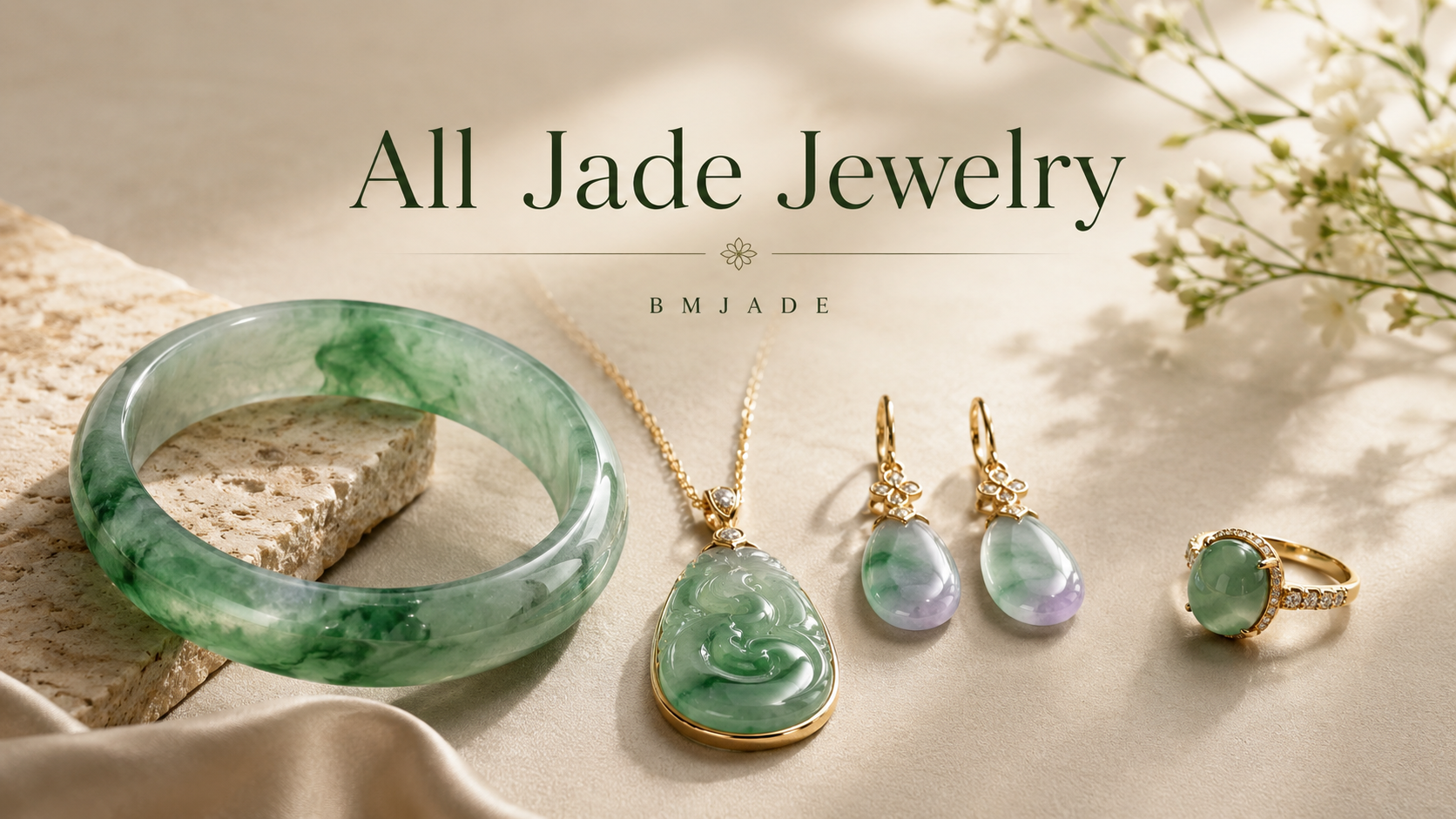
Search what jade symbolizes and you'll be told it opens the heart chakra, attracts abundance, and connects you to your spirit guides. None of that comes from any jade-using culture. It comes from a twentieth-century Western crystal literature that assigned meanings to stones by association, and it has quietly replaced three genuine traditions that are older, better documented, and considerably more interesting. Everything in our jade collection sits inside one of those traditions.
I'm Hong, founder of BMjade. Nine years between the Hpakant rough auctions and our Kunming workshop, and the question I'm asked more than any other about meaning is some version of: is this real, or did someone make it up?
It's a fair question and it has a clean answer. Jade's symbolism is unusually well documented. There is a Han dynasty text that lists exactly what jade stands for and why. There is a living Māori tradition with legal standing in New Zealand. There is archaeological evidence of what Maya rulers were buried holding. You can check all of it, which is more than can be said for most of what's written about gemstone meaning.
This guide covers what jade actually symbolizes in the three cultures that built traditions around it, where each claim comes from, and — at the end — which popular meanings have no source at all.
One boundary before we start. This page is about symbolism. It is not about what jade does, which is a separate question with a separate answer, and we handle the evidence side separately.

What does jade symbolize?
In Chinese tradition, jade symbolizes five virtues of human character: benevolence, integrity, wisdom, courage and honesty. In Māori culture, pounamu symbolizes inherited mana and connection to ancestors, and is given rather than bought for oneself. In Mesoamerican cultures, jade symbolized breath, maize and life itself, and was valued above gold.
Three traditions, three different answers, and all three are documented rather than invented.
The five virtues: the oldest documented answer
Around 100 CE, the scholar Xu Shen compiled the Shuowen Jiezi (说文解字), China's first systematic dictionary. Its entry for 玉 does something no dictionary does anymore: it explains what the stone means, and it grounds each meaning in a physical property.
| Virtue | Chinese | The physical property it's read from |
|---|---|---|
| Benevolence | 仁 rén | Its warm, moist luster — jade feels kind to the touch |
| Integrity | 义 yì | Its translucency: the inside can be seen from outside. It conceals nothing |
| Wisdom | 智 zhì | Its sound, clear and carrying far when struck |
| Courage | 勇 yǒng | It breaks rather than bends |
| Honesty | 洁 jié | Its edges are sharp but do not cut |
Notice what that list is doing. Each virtue is derived from something you can verify by handling the stone. This isn't assigned symbolism — it's a reading of material properties as a model for character, and it's the reason jade carries moral weight in Chinese thought that no Western gemstone carries.
Confucius made the same move earlier. Asked by his student Zigong why jade was valued so far above ordinary stone, he answered that the gentleman compares his virtue to jade — 君子比德于玉. Not because jade was rarer. Because it behaved in ways worth imitating.
From the same body of ritual texts comes the line that governed how jade was worn: 「君子无故,玉不去身」 — a gentleman does not part with his jade without cause. The wearing was continuous, and it was continuous because the reminder was the point. How that played out in practice.
The part that changes how you read everything else
Here's the distinction that separates the Chinese tradition from what's usually written about crystals, and it's worth stating plainly.
Chinese jade symbolism is about who you are, not about what happens to you.
The five virtues are qualities of character. Not outcomes. Not luck, not money, not protection from harm. The stone stands for benevolence and courage the way a wedding ring stands for a promise — it doesn't produce the thing, it reminds you of it.
That's a meaningfully different proposition from "this stone will attract abundance," and it's why the Chinese tradition survived three thousand years while assigned-meaning systems come and go. A claim about character can't be falsified by a bad year. A claim about outcomes can.
Where prosperity symbolism does appear in Chinese practice — Pixiu, the cabbage carving, the gourd — it's carried by the carved motif rather than by the material, and it's understood as a symbol rather than a mechanism. What each traditional carving means.
Māori pounamu: symbolism you inherit
New Zealand's jade tradition is nephrite, called pounamu in te reo Māori, and it's the one living jade culture where the symbolism has legal force.
Pounamu is taonga — treasure, in a sense closer to "something held in trust" than "something owned." Its meaning is not fixed by the stone but accumulates through it: each wearer's mana passes into the piece, so a pounamu that has been through several hands carries more than a new one. The stone is a record of the people who wore it.
It's given, not bought for yourself. This is the most widely known Māori convention around pounamu and the one most often mentioned and least often explained. The reason follows from the first point: if the piece carries the giver's mana, a piece you bought for yourself carries nobody's.
Form carries meaning. Hei-tiki, the human figure worn at the neck, is associated with ancestry and fertility and is among the most prized forms. Mere pounamu, the short flat weapon, was both a fighting implement and a chiefly heirloom — jade valued for exactly the toughness the Chinese tradition read as courage.
And it has standing in law. The Ngāi Tahu (Pounamu Vesting) Act 1997 — a standalone statute dealing with pounamu alone, passed 1 October 1997 — vested ownership of naturally occurring pounamu within Ngāi Tahu's territory, including the adjacent coastline, in Te Rūnanga o Ngāi Tahu. That is not symbolism as decoration. That's a jade tradition with statutory recognition, specific enough to have its own act of parliament.
Mesoamerican jade: breath, maize, and the afterlife
The Olmec and Maya built the third great jade tradition, entirely around jadeite from the Motagua Valley in what is now Guatemala, and it ran on a different logic again.
Jade was valued above gold. Not comparably — above. In a region with substantial gold working, jade sat at the top of the material hierarchy.
The symbolism was green, and green meant maize. Jade's color tied it to young maize, to water, to breath and to life itself. In a maize civilization, the association isn't decorative; it points at the thing everything depended on.
It followed the dead. A jade bead placed in the mouth of the deceased is a documented Maya practice, connected to breath and to the continuation of life. The most famous surviving expression is the jade mosaic funerary mask of K'inich Janaab' Pakal at Palenque — a ruler's face rebuilt in jade for what came after.
This tradition was largely lost to outside knowledge for centuries after the Spanish conquest, and the Motagua sources weren't rediscovered commercially until the twentieth century. How Guatemalan jadeite sits in today's market.

What jade symbolizes today
Modern symbolism draws mostly from the Chinese tradition, and it clusters around a few occasions.
| Context | What it stands for |
|---|---|
| Given at a wedding | Harmony and endurance in a marriage |
| Given to a child or graduate | Safe passage — usually as a Ping An Kou, the plain peace disc |
| Worn daily | Steadiness of character; the original and most traditional use |
| Passed down | Continuity between generations. The piece carries the previous wearer |
| Given at a milestone | Recognition that something has been endured or achieved |
Which occasion suits which piece is covered in the jade gift guide.
Does origin change the symbolism? Burmese jade specifically
A common question, and worth a direct answer: does jade from Myanmar carry stronger or different symbolic meaning than jade from elsewhere?
No — the symbolism attaches to the tradition and the form, not to the mine. The five virtues from the Shuowen Jiezi describe jade as a category; nothing in the text distinguishes stone by origin. A Ping An Kou means the same thing whether the jadeite is Burmese, Guatemalan, or the piece is Hetian nephrite.
What is true, and worth separating cleanly from symbolism, is market history: Burmese jadeite is what reached the Qing court and became the material most associated with fine Chinese jade jewelry from the eighteenth century on. That's a statement about quality and reputation in the trade, not about spiritual potency — the same distinction we draw in more detail in jade benefits, graded by evidence.
What jade does not symbolize
We sell jade, so writing this section costs us something. It's worth writing anyway.
The heart chakra. The chakra system is Sanskrit, from Indian yogic tradition, and it entered Western esoteric thought via Theosophy in the late nineteenth century. Assigning jade to a chakra is a twentieth-century Western practice. It is not Chinese, not Māori, and not Mesoamerican.
Attracting abundance and money. Chinese prosperity symbolism exists, but it attaches to specific carved motifs and is understood as symbolic. "This stone will attract wealth to you" is not a claim any of the three traditions makes.
Psychic ability, spirit guides, mediumship. These come from twentieth-century Western occult writing. No source in any jade-using culture describes the stone this way.
Healing conditions of the body. This one has a traceable origin worth knowing: sixteenth-century Spanish colonists called jade piedra de la ijada, loin stone, believing it cured kidney complaints. The Latin lapis nephriticus followed, and that is literally where the word nephrite comes from. The belief is documented. The efficacy is not, and we treat that question separately and on the evidence.
The test we'd suggest you apply, to us as much as to anyone: ask which culture a claim comes from and roughly when. Genuine jade symbolism has an address — a text, a practice, a language. Invented symbolism doesn't, which is why it's always phrased as jade is known to rather than this text says.
Where the other meanings live
Symbolism is one question and this page answers only that one.
- What each color means → jade colors and their meanings
- What each carving means — Pixiu, dragon, Ping An Kou, Buddha, Guanyin → twelve traditional carvings
- What jade does, and what the evidence says → jade benefits, graded by evidence
- Where to place jade at home → jade placement guide
- What to do with a new piece → cleansing and first wear
- The full history → jade history, culture and formation
- Is jade a birthstone? → the modern list vs the mystical one
Frequently asked questions
What does jade symbolize in Chinese culture?
Five virtues of character, set out in the Han dynasty Shuowen Jiezi around 100 CE: benevolence from its warm luster, integrity from its translucency, wisdom from the clear sound it makes when struck, courage from breaking rather than bending, and honesty from edges that are sharp but don't cut. Confucius framed the same idea as 君子比德于玉 — the gentleman compares his virtue to jade.
Is jade a symbol of good luck?
Partly, and less directly than usually claimed. Chinese prosperity symbolism attaches to specific carved motifs such as Pixiu or the cabbage rather than to the material itself, and it's understood as symbolic rather than causal. The core Chinese meaning of jade is about character, not outcomes.
What does jade symbolize spiritually?
It depends entirely which tradition you're asking about. In Chinese thought it stands for moral qualities rather than spiritual powers. In Māori culture pounamu carries inherited mana and connection to ancestors. In Maya and Olmec cultures jade was associated with breath, maize and continued life after death. The chakra and energy-healing associations found on most English-language crystal sites come from twentieth-century Western esoteric writing, not from any of these.
What does pounamu symbolize?
Pounamu is New Zealand nephrite and is treated as taonga — treasure held in trust. Its meaning accumulates: each wearer's mana passes into the piece, so an inherited pounamu carries more than a new one. Convention holds that pounamu should be given rather than bought for oneself, because a piece you bought carries nobody's mana. Ownership of naturally occurring pounamu within Ngāi Tahu's territory was vested in Te Rūnanga o Ngāi Tahu under the Ngāi Tahu (Pounamu Vesting) Act 1997, a standalone statute dedicated to pounamu specifically.
Why was jade more valuable than gold in Mesoamerica?
Because its color connected it to maize, water, breath and life in a civilization built on maize. Gold was worked and valued in the region, but jade sat above it in the material hierarchy. Jade beads were placed in the mouths of the dead, and rulers such as Pakal at Palenque were buried under jade mosaic funerary masks.
Does jade symbolize protection?
Protection symbolism exists in Chinese folk practice and attaches mainly to specific forms — the Ping An Kou, the plain peace disc, is the clearest example and its name means "peace." This is symbolic and traditionally understood as such. Jade is not a protective device and shouldn't be described as one.
Is jade symbolism the same in every culture?
No, and the differences are the interesting part. Chinese symbolism is about individual character. Māori symbolism is about inheritance and relationship between people. Mesoamerican symbolism was about life, breath and the agricultural cycle. Three cultures found something extraordinary in the same material and read completely different things in it.
Where does the "jade heals the kidneys" idea come from?
From sixteenth-century Spanish colonists in the Americas, who called the stone piedra de la ijada — loin stone — believing it cured kidney complaints. The Latin term lapis nephriticus followed, and the English word nephrite descends directly from it. The belief is a documented historical fact. Its accuracy is a separate matter and one we address on the evidence.
Conclusion
The most useful thing about jade symbolism is that you can check it. A Han dynasty dictionary entry, a New Zealand statute, a funerary mask at Palenque — these are things with addresses. When a claim about what jade means can't be traced to a culture and roughly a century, that's usually because it was assigned rather than inherited.
If you have a piece and want to know which tradition its form belongs to, send me a photograph at jadeworldchina@outlook.com. — Hong