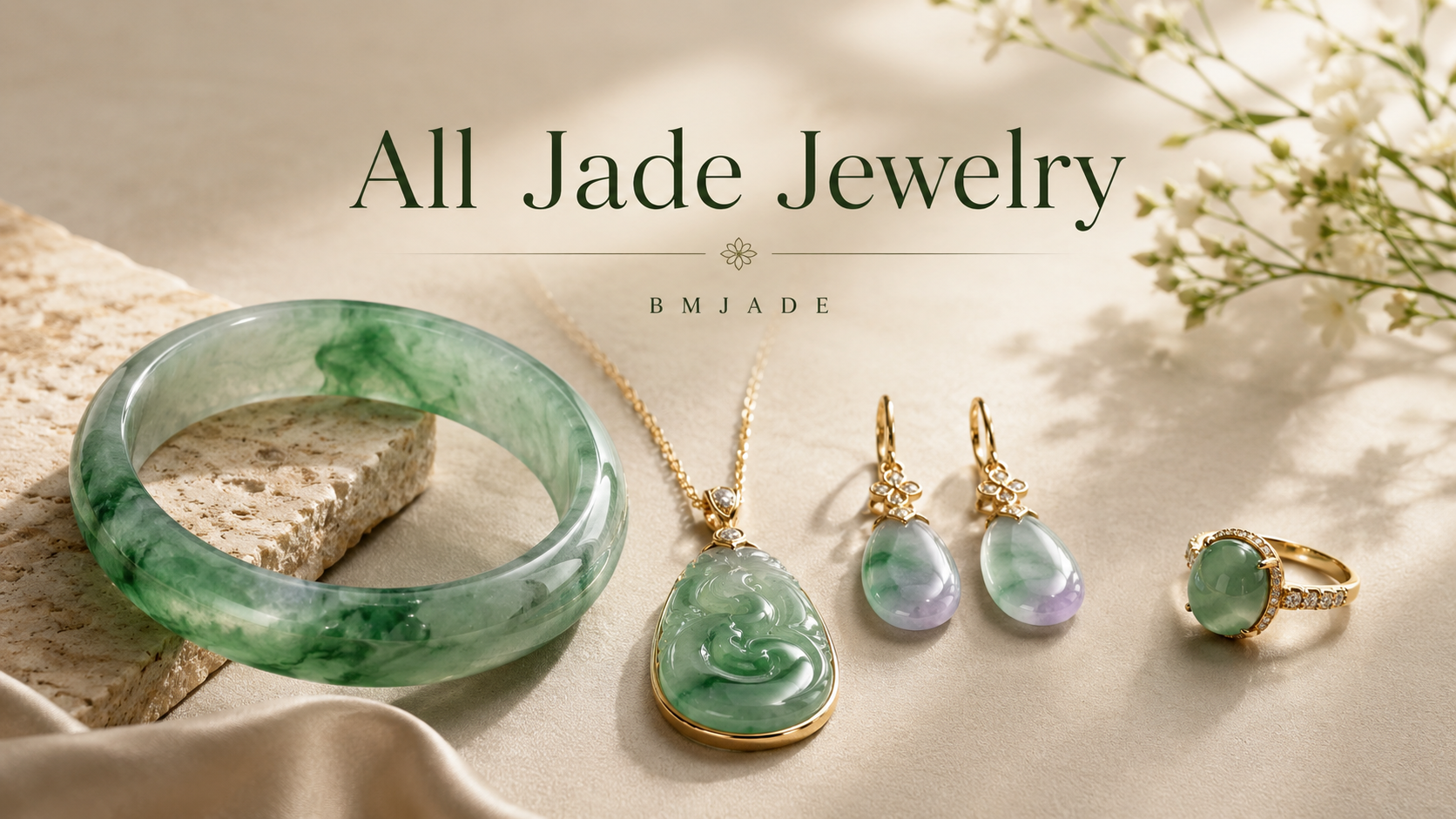
For most people, the word jade brings to mind a single image — a piece of polished green stone, probably Chinese, probably old. That image is right in spirit, but it hides a more interesting truth.
Jade is not one stone. It is a name shared by two entirely different minerals: jadeite and nephrite. They look similar to the eye, behave similarly on the wrist, and have been called by the same name for so long that even gem traders sometimes blur them — but they form differently in the earth, come from different places, and carry different weight in the market.
What unites them is something rarer than chemistry. For roughly 8,000 years, across at least three continents, civilizations have treated jade as more than ornament. In China, it has been called the Stone of Heaven — buried with emperors, carved into ritual objects, written into Confucian moral philosophy. In Mesoamerica, the Maya and Olmec valued it above gold. In New Zealand, the Māori still treat pounamu (their name for nephrite) as a living object passed between generations.
I'm Hong, the founder of BMjade. Since 2016 I've sourced Burmese jadeite at the Hpakant market and worked with craftsmen in Kunming, Yunnan, to shape it into the pieces our customers wear today. After nearly a decade in this trade, I've learned that almost every confusion buyers run into — what's real, what's worth it, why two pieces that look similar cost so differently — traces back to the same starting point: most people have never been told clearly what jade actually is.
This guide is that starting point. By the end you'll understand what mineralogists mean when they say jade, why China and the West historically meant different things by the word, how the stone is judged for value, and what to look for if you ever buy a piece. The deeper guides — on color, on price, on individual carvings — branch off from here.

What jade actually is — the modern definition
The simplest accurate answer is this: jade is the trade name for two distinct silicate minerals — jadeite and nephrite — both of which form as dense, interlocking aggregates of tiny crystals. That interlocking structure is what gives jade its famous toughness. It is what allows a stone with only middling hardness to survive being carved, drilled, polished, and worn daily for centuries.
The Gemological Institute of America (GIA), the world's most cited gemological authority, defines jade this way:
"Jade is a generic term for nephrite, jadeite, and under certain conditions green omphacite."
That omphacite inclusion is recent and reflects rare cases of a third pyroxene mineral being indistinguishable from jadeite by the eye or under standard tests. For practical buying purposes, every meaningful jade conversation comes down to two materials.
Jadeite
Jadeite is a sodium-aluminum silicate in the pyroxene mineral family, with the chemical formula NaAlSi₂O₆. It is rarer than nephrite, harder (around 6.5 to 7 on the Mohs scale), and capable of a much wider color range — from the famous Imperial green through lavender, icy white, apple green, yellow, red, black, and even pale blue.
Jadeite forms only under extreme conditions: high pressure combined with relatively low temperature, the kind of environment you find at subduction zones where one tectonic plate dives under another. Because those geological conditions are unusual, gem-quality jadeite is geographically concentrated. Roughly 70 percent of the world's jadeite comes from a single region in northern Myanmar, around the town of Hpakant in Kachin State. Smaller deposits exist in Guatemala, Russia, and Japan. This origin matters: when you read about top-grade jadeite at auction, you are almost always reading about Burmese material.
In China, jadeite has its own traditional name: fei cui (翡翠). The word predates Western mineralogical terminology by several centuries. The Hong Kong and mainland markets still use fei cui in everyday speech, even when the certificate underneath says "jadeite."
Nephrite
Nephrite is a calcium-magnesium silicate from the amphibole mineral family — chemically it sits in the tremolite-actinolite series, with the formula approximately Ca₂(Mg,Fe)₅Si₈O₂₂(OH)₂. It is slightly softer than jadeite (around 6 to 6.5 on the Mohs scale) but, surprisingly, even tougher: nephrite's fibrous, interwoven crystal structure makes it one of the most fracture-resistant gem materials known.
Nephrite is the original "jade" in Chinese culture. For thousands of years — well before jadeite entered Chinese markets from Burma in the 18th century — every piece of jade in Imperial China was nephrite, almost all of it from the Khotan and Yarkand regions of what is now Xinjiang Province. Hetian jade (和田玉), the most prized variety of Chinese nephrite, comes from this lineage. Its signature is the "mutton-fat white" body color and a soft, oily luster.
Outside China, nephrite also occurs in New Zealand (where the Māori call it pounamu), Siberia, Canada (British Columbia), Australia, Wyoming, and Taiwan. The colors are typically more restrained than jadeite — most often shades of green, grey, white, brown, or black.
Why the two were ever confused
Here is the historical accident at the root of all jade confusion: until 1863, the Western world thought jade was one material. The mineralogist Alexis Damour, working in Paris, was the first to chemically prove that what Europe and China both called "jade" was actually two unrelated minerals. Until that point, every traveler, trader, jeweler, and museum had grouped them under a single name based purely on appearance and behavior.
The Chinese had distinguished the two materials in practice — they used the word yu (玉) for nephrite and fei cui (翡翠) for the brighter Burmese material that began arriving in the late 1700s — but the word jade, used in English, French, and Spanish, made no such distinction. Damour's discovery resolved the science, but the trade name stuck.
This is why, today, you can buy a "jade necklace" that is jadeite, a "jade pendant" that is nephrite, and a "jade bangle" that is neither — without any of the labels technically being wrong by traditional usage. For a buyer, the takeaway is simple: always ask which material a piece is made from before judging its value.

How jade forms — the geology in plain language
Both jadeite and nephrite are metamorphic rocks, which means they formed when other rocks were transformed by heat, pressure, and chemically reactive fluids deep inside the earth. But the two minerals require very different conditions, and that difference is why they end up in different parts of the world.
Jadeite forms under what geologists call high-pressure, low-temperature conditions. Picture an oceanic tectonic plate sliding under a continental plate at a subduction zone, dragging seawater and minerals down with it. As the plate descends, sodium-rich and aluminum-rich materials get squeezed under enormous pressure while the temperature stays relatively cool — and jadeite crystallizes. Because subduction zones with the right chemistry are uncommon, jadeite deposits are uncommon. Myanmar's Hpakant region sits along an ancient suture between the Indian and Eurasian plates and produces the world's largest concentration of gem-grade jadeite.
Nephrite forms in a wider range of environments, typically where serpentinite or dolomitic marble has been altered by silica-rich fluids. The chemistry is less restrictive, the geology more common — which is why nephrite shows up across many continents while jadeite is geographically scarce.
The fibrous interlocking crystal structure of nephrite, and the granular interlocking structure of jadeite, both produce gems that are tough even when not particularly hard. In gemology, hardness is resistance to scratching, while toughness is resistance to breaking. Diamond is the hardest natural material on earth, but it is brittle along certain planes — you can chip a diamond with a sharp blow. Jade resists chipping in a way diamond cannot. That is why Neolithic societies used it to make axe heads and chisels long before they used it as jewelry. The same property is why jade jewelry can survive being worn daily for generations.
For deeper reference on the underlying mineralogy, the GIA's jade description and the Wikipedia jade entry both lay out the chemistry in full.

An 8,000-year story: jade across human history
What makes jade unique among gemstones is not its rarity or color but its continuity. No other gem has been continuously valued by major civilizations for as long as jade has. Three traditions stand out.
China — from Neolithic ritual to Qing emperors
The earliest known worked jade objects in China date to roughly 6000 BCE, during the Houli culture in what is now Shandong Province. By 3500 BCE, the Hongshan culture of northeastern China and the Liangzhu culture of the southeast were producing astonishingly sophisticated nephrite ritual objects — pig-dragons, cloud pendants, the famous bi discs that symbolized heaven, and cong tubes that symbolized earth.
These were not decorative trinkets. As the Metropolitan Museum of Art's chronology of early China notes, Neolithic jade objects "are thought to have played a ceremonial role" — placed in tombs of high-status individuals, used by shamans as media between the human and divine worlds. Some archaeologists argue that the social organization required to mine, transport, and carve jade contributed directly to the rise of stratified Chinese society itself. The period from roughly 3500 to 2000 BCE has been proposed by scholars as a distinct Jade Age in Chinese prehistory, sitting between the Stone Age and the Bronze Age.
By the time of Confucius (551–479 BCE), jade had moved from ritual object to moral metaphor. Confucius wrote that jade embodied the qualities of a noble person: gentle to touch, firm in structure, clear in sound, faithful in its consistency. The phrase "a gentleman compares his virtue to jade" (君子比德于玉) became foundational to Chinese moral philosophy. Han Dynasty emperors were buried in jade burial suits — thousands of small plaques stitched together with gold or silver wire — in the belief that jade preserved the body and soul.
Burmese jadeite entered the Chinese market in significant volume only in the mid-18th century, during the late Qing Dynasty. The Empress Dowager Cixi developed a famous passion for fei cui jadeite, and from that moment Burmese material — particularly Imperial green — became the prestige jade of Chinese fine jewelry. This is the lineage that today's high-end jadeite market continues. If you want to understand how the older nephrite tradition relates to the newer jadeite one, our overview of Chinese jade varieties walks through the differences in detail.
Mesoamerica — the green stone of the Olmec and Maya
Long before Europeans encountered Chinese jade, the Olmec, Maya, and Aztec civilizations of Central America were carving jadeite from the Motagua River Valley in present-day Guatemala. They valued it above gold — a fact that genuinely surprised the Spanish conquistadors of the 16th century. Olmec jade masks dated to around 1000 BCE rank among the most refined stone carvings ever made by any ancient society. The Maya carried jade as a status object, used it in burial rituals, and associated it with the maize god, water, and life itself.
The Spanish gave us the modern word jade. Observing indigenous Americans pressing the stone against their sides to treat kidney and abdominal ailments, the Spanish called it piedra de ijada — "stone of the loins." A French mistranslation later shortened the phrase to l'éjade, then simply jade, and that is the name that traveled into English.
Other traditions
Māori culture in New Zealand treats pounamu (nephrite) as a sacred ancestral material, carved into pendants, weapons, and tools that are still passed down through families today. Korean and Japanese cultures both used jade in royal regalia and Shinto ritual objects. Stone-age peoples across Europe and the Pacific worked nephrite into tools when local deposits allowed.
The pattern is unmistakable: wherever humans found jade, they treated it as something more than a pretty rock. No other gemstone has that record.

What gives jade its value — the five quality factors
If you've ever wondered why two pieces of jade that look similar can differ in price by a factor of ten — or a hundred — the answer comes down to five quality factors that gemologists use to evaluate every piece. Understanding these factors will help any conversation with a seller. Our complete jade price guide walks through how these translate into market prices; here we'll focus on the factors themselves.
Color. The most important value driver. For jadeite, the hierarchy traditionally runs Imperial green at the top, followed by lavender, then apple green, yellow, red, and white. For nephrite, the highest grade is the warm, slightly translucent "mutton-fat white" of fine Hetian jade. Within each color, even saturation and absence of muddy or grey undertones matter as much as the hue itself. A vivid even green outranks a stronger but patchy green every time.
Translucency. Jade is judged by how light interacts with the stone, not by transparency. Top jadeite is semi-translucent — light penetrates a few millimeters into the stone before diffusing, giving the piece a soft inner glow. Chinese traders describe the highest translucency grade as glass jade (玻璃种) and the next grade as icy jade (冰种). Completely opaque stones are still real jade, but they sit at the lower end of the quality scale. We cover these tier names in our imperial vs icy vs apple green jadeite guide.
Texture. Under magnification, fine jade shows tightly packed, fine-grained crystals with no visible coarse particles. The trade describes this as fine texture or "old material" (老种). Coarser texture, where individual crystals are visible to the naked eye, indicates lower-grade material that will not take a high polish.
Clarity. Like other gems, jade is valued more highly with fewer visible flaws — cracks, dark inclusions, "cotton" (white wispy patches), and color zoning all reduce value when prominent. That said, jade is not expected to be flawless the way diamonds are. Small, well-placed inclusions are tolerated and sometimes even valued for the character they add.
Cut and craftsmanship. Because jade is most often carved rather than faceted, the skill of the carver matters enormously. A well-proportioned cabochon, a symmetrical bangle cut from a single piece of rough, or a master-carved Pixiu or Guan Yin figure can multiply the value of the underlying material. Conversely, beautiful rough cut poorly is a frequent way to lose value.
A sixth, hidden factor sits above all five of these: treatment status. Untreated jade (called Type A) holds value; treated jade (Type B, C, or B+C) does not.

Type A, B, and C — the most important thing to understand before buying
Because color and translucency drive jade prices so heavily, the jewelry trade developed chemical treatments to "improve" lower-grade material — sometimes disclosed honestly, sometimes not. Modern jadeite is classified into three trade categories that every buyer should know.
Type A is natural, untreated jadeite. The piece may have been cut, polished, and given a light wax coating during finishing (this is standard and accepted), but the color and structure of the stone are 100% natural. Only Type A jadeite holds long-term value and is considered acceptable for fine jewelry.
Type B is jadeite that has been acid-bleached and impregnated with polymer resin. The acid bath strips out brown or grey impurities, opening up the stone's structure; clear epoxy resin is then forced into the resulting microscopic cavities to restore stability and improve translucency. The result can look stunning — brighter, more translucent, more visually impressive than the original rough deserved — but the stone is now structurally weakened, the polymer will yellow and degrade over a span of years to decades, and the material is worth a small fraction of Type A.
Type C is dyed jadeite, where artificial coloring has been introduced. Dyes fade over time and rarely match the depth of natural color.
Type B+C combines both treatments — acid bleach plus polymer plus dye — and is the most heavily processed category.
A trustworthy seller will state Type A explicitly and back it with a certificate from a recognized lab. Anything ambiguous — "genuine jade," "natural color" — without the Type A designation should prompt you to ask more questions. We've written a dedicated piece on why home tests aren't enough to verify jade and what lab certification actually proves, which goes deeper on this.
For Burmese jadeite specifically — the dominant material in international fine-jade trade — the certificate most often used in Asia is issued by China's NGTC (National Gem Testing Center). NGTC is a state-affiliated laboratory whose Type A certifications carry weight at Hong Kong auction houses and across mainland Chinese retail. If you'd like the full background on why NGTC is the lab of record for jade rather than GIA, see our piece on NGTC versus GIA as Asia's jade authority.

Where the jade you can buy actually comes from
Jade is sourced from a small number of regions, and which region a stone comes from tells you a lot about its character.
Myanmar (Burma). The dominant source of gem-grade jadeite worldwide — roughly 70% of global supply, by the most cited estimates. The mining region centers on Hpakant in Kachin State, where rough is extracted from alluvial deposits along the Uru River. Burmese jadeite ranges across the full color spectrum and includes nearly all of the world's Imperial green material. Almost every fine-jewelry-grade jadeite piece on the market traces back here. (Our piece on why Myanmar jade still rules the gemstone world covers the supply chain in depth.)
Xinjiang, China. The historical source of Hetian nephrite, mined from the Kunlun Mountains and the rivers flowing north into the Taklamakan Desert. This is the original Chinese imperial jade. Modern Hetian production includes both mountain-source ("shan liao") and water-tumbled ("zi liao") nephrite, with the river-rolled stones typically commanding the highest prices.
Guatemala. The world's other major jadeite source, producing the material used by ancient Olmec and Maya civilizations. Guatemalan jadeite tends toward darker, more opaque greens with some unusual colors like lilac and "Olmec blue" not common in Burmese material.
Russia (Siberia). A significant source of nephrite, particularly the green and spinach-green varieties.
Canada (British Columbia). Major modern producer of nephrite, much of it green, supplying both jewelry and carving markets.
New Zealand. Source of pounamu, the nephrite revered in Māori culture.
Smaller sources include Wyoming and Alaska (USA), Australia, Taiwan, South Korea, and Japan.
When a piece is sold without an origin statement, you can usually infer the source from the material type and quality tier: top-grade translucent jadeite is almost certainly Burmese, "mutton fat white" nephrite is almost certainly Hetian, and so on.

How to recognize real jade — three quick reality checks
A complete authentication walkthrough deserves its own guide, and we have a category-specific one for bracelets, necklaces, rings, and earrings. Here, three general principles that apply to every form.
It should feel cold to the skin, and stay cold. Jade has unusually high thermal conductivity for its weight. Press a piece against your wrist or cheek — it should feel notably cool and warm only slowly. Plastic and resin warm almost immediately. Glass cools more quickly than plastic but still warms faster than jade. This test alone won't prove a stone is jadeite versus nephrite (or even versus some other natural mineral), but it instantly rules out the most common cheap fakes.
It should be heavier than it looks. Jadeite has a specific gravity of about 3.30 to 3.38, nephrite around 2.95 to 3.05. Both feel noticeably denser than glass (around 2.5) or plastic (around 1.2). Hold a bangle in your palm: real jade has a substantial weight that surprises people who haven't held it before.
Polished jade has a depth that imitations lack. Look at the surface under good light. Real jade reflects light from inside the stone as well as from the surface — there's a sense of depth, of structure visible a millimeter or two beneath the polish. Glass reflects only from its surface. Dyed quartzite shows color that sits on the stone rather than in it. This is the hardest test to describe in words but the easiest to feel after handling a few real pieces.
These are screening tools. They are not a substitute for a certificate from a recognized lab when significant money is involved.

Frequently asked questions
Is jade a precious stone?
By traditional Western gem categories, jade is classified as a semi-precious stone — a category that includes garnet, amethyst, opal, and turquoise. The only stones called precious in that old system are diamond, ruby, sapphire, and emerald. But the system is outdated and misleading: top-grade Imperial jadeite at auction routinely sells for more per carat than fine emeralds, and the historical and cultural depth of jade is greater than any of the four "precious" stones. In Chinese tradition, jade has always been the most valued gem, period.
Is jade rarer than diamond?
By raw geological abundance, gem-grade diamond is produced on a much larger industrial scale than gem-grade jadeite. The world's diamond supply is measured in tons; the world's Imperial green jadeite supply is measured in kilograms. So yes — for the top grades, jade is meaningfully rarer than diamond.
What's the difference between jade and jadeite?
Jade is the umbrella name for two minerals: jadeite and nephrite. Jadeite is specifically one of those two — the harder, rarer, more colorful one, the source of all Imperial green stones, and what most modern fine-jewelry "jade" pieces are made from.
What color is real jade?
Any of many. The famous color is Imperial green, but real jadeite naturally occurs in lavender, white, yellow, red, black, and pale blue. Real nephrite occurs in green, white (mutton fat), grey, brown, and black. Color alone never tells you whether a stone is real or treated; that requires a certificate.
Why is jade so important in Chinese culture?
Three reasons compound: it's been continuously valued in China for 8,000 years, longer than any other material; Confucian moral philosophy explicitly linked the qualities of jade to the qualities of human virtue; and the toughness of the stone made it the natural choice for objects meant to outlast their owners — ritual implements, burial regalia, family heirlooms. No equivalent material occupies the same cultural role anywhere else in the world.
Is jade good for everyday wear?
Yes — jade's toughness makes it one of the most wearable gem materials for daily use, particularly for bracelets and rings. The main risk isn't scratching but impact; jade can crack if struck against hard surfaces. The traditional Chinese practice of wearing jade on the left (non-dominant) hand evolved partly to reduce this risk.
How can I tell if my old family jade is real?
Three steps. First, run the cold-touch and weight tests above. Second, examine the piece in good light for depth and structure beneath the polish. Third, for any piece with significant sentimental or monetary value, take it to a gemological lab for testing — refractive index, specific gravity, and FTIR spectroscopy can confirm not just whether a piece is jade, but which type, and whether it has been treated. The fee is usually modest compared to the value of certainty.
Conclusion
Jade has lasted 8,000 years because it earns its way into people's lives — quietly, patiently, growing more personal with each year worn. Whatever brought you to the search, I hope this guide gave you a clearer foundation. If you have a specific question I haven't answered, email me directly at jadeworldchina@outlook.com — Hong.