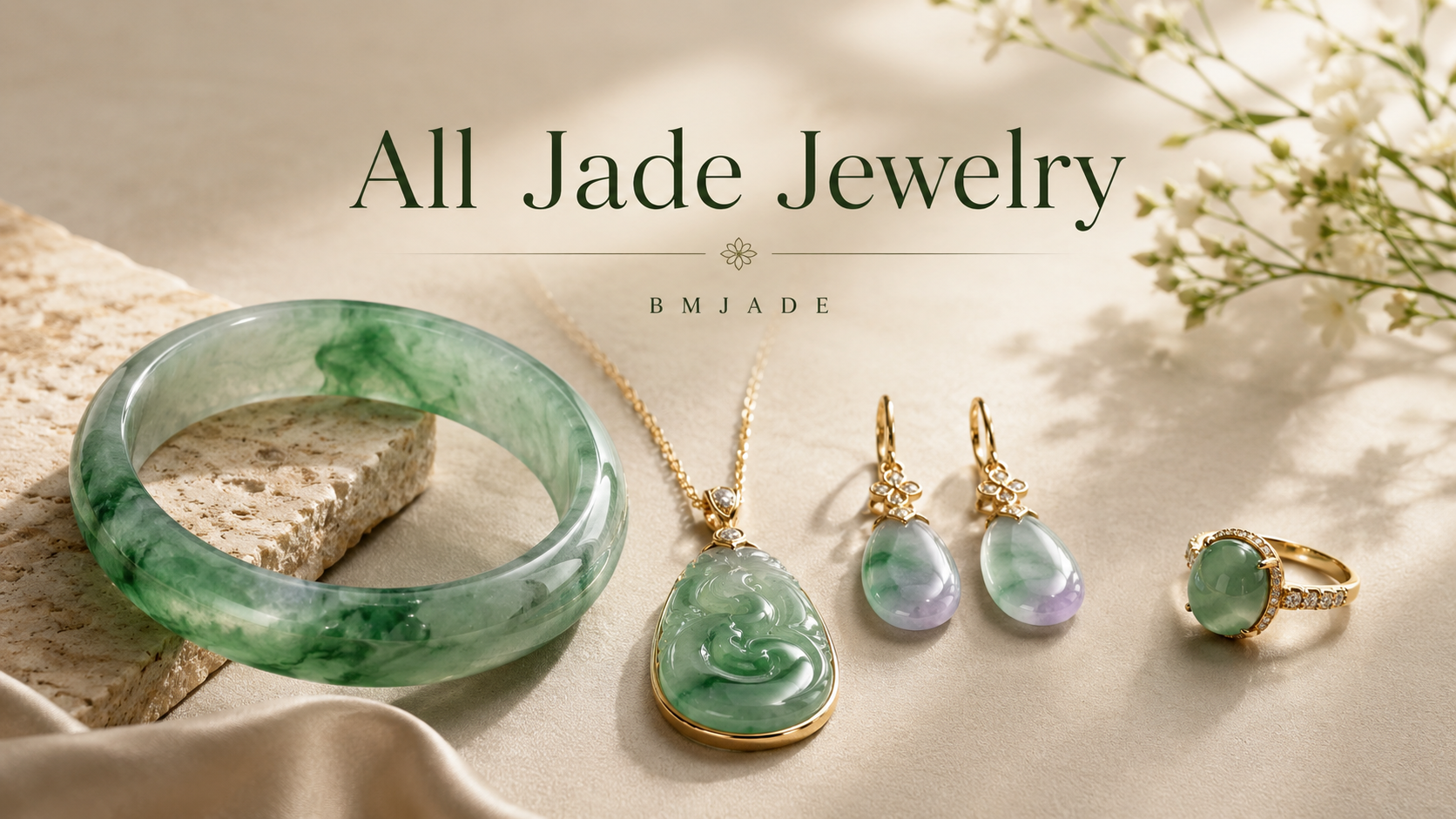
Chinese jade culture is much broader than one single green stone. When people outside China hear the word “jade,” they often think of bright green jadeite bangles. But in Chinese history, the word “yu” has included many beautiful stones used for carving, ritual objects, jewelry, seals, pendants, and heirlooms.
This is why Chinese jade can be confusing for modern buyers. Jadeite, Hetian jade, Dushan jade, and Xiuyan jade are all discussed in Chinese jade culture, but they are not the same material, value level, or jewelry category.
In modern gemology, “jade” mainly refers to jadeite and nephrite. In Chinese cultural and market language, however, “yu” can refer to a wider family of jade-like stones with beauty, carving tradition, and symbolic meaning.
This guide explains the main Chinese jade varieties, how jadeite differs from Hetian jade, where Dushan jade and Xiuyan jade fit, and what buyers should check before purchasing Chinese jade jewelry.
At BMjade, our primary focus is certified Type A jadeite jewelry. We also educate buyers about other Chinese jade traditions so they can understand what they are buying and how different jade materials compare.
Quick Answer: What Are the Main Types of Chinese Jade?
The most important Chinese jade varieties include:
| Jade Variety | Common Chinese Name | Material Category | Best Known For |
|---|---|---|---|
| Jadeite | Fei Cui / 翡翠 | True jade | Vivid green, icy translucency, high-value jewelry |
| Hetian Jade | He Tian Yu / 和田玉 | Nephrite, true jade | Warm texture, oily luster, classical Chinese jade culture |
| Dushan Jade | Du Shan Yu / 独山玉 | Jade-like carving stone | Multi-color patterns and decorative carvings |
| Xiuyan Jade | Xiu Yu / 岫玉 | Often serpentine or nephrite-related varieties | Affordable carvings, bangles, and entry-level jade pieces |
For international buyers, the most important distinction is this:
Jadeite and nephrite are true jade in modern gemology. Dushan jade and Xiuyan jade are important in Chinese jade culture, but they should not be confused with high-value jadeite unless a certificate clearly identifies the material.
Chinese “Yu” vs Gemological Jade
One reason jade terminology is confusing is that Chinese “yu” and Western gemological “jade” do not always mean the same thing.
In Chinese culture, “yu” traditionally describes stones admired for beauty, smoothness, texture, polish, and symbolic meaning. These stones were carved into ritual objects, ornaments, seals, pendants, and jewelry long before modern mineral classification existed.
In modern gemology, jade is more narrowly defined. The two main materials recognized as jade are:
- Jadeite
- Nephrite
This does not mean Dushan jade or Xiuyan jade are unimportant. They have long histories and real cultural value. But for jewelry buyers, especially online buyers, the material must be clearly identified.
A bracelet described only as “Chinese jade” may be jadeite, nephrite, serpentine, Dushan jade, Xiuyan jade, or another jade-like material. That is why certificates, material names, and treatment disclosure matter.
Jadeite: The Most Valuable Jade in Modern Jewelry
Jadeite is the jade variety most closely associated with high-value modern jade jewelry. Fine jadeite can appear in rich emerald green, icy white, lavender, yellow, black, and multicolor forms. The most desirable jadeite often combines strong color, fine texture, good translucency, and natural untreated status.
In the Chinese jewelry market, jadeite is commonly called Fei Cui. Although China has a deep jade culture, the most important high-quality jadeite used in modern jewelry has historically been associated with Myanmar, especially Burmese jadeite. China became one of the most important cultural, carving, trading, and collecting centers for jadeite jewelry.
Jadeite is especially popular for:
- Jade bangles
- Jade bracelets
- Jade pendants
- Jade rings
- Jade earrings
- High-value collector jewelry
The most important buying point for jadeite is treatment status. Type A jadeite means natural jadeite that has not been chemically bleached, dyed, or polymer-filled. Type B jadeite has been acid-bleached and polymer-impregnated. Type C jadeite has been dyed. B+C jadeite is both treated and dyed.
For buyers, this matters because two jadeite bracelets can look similar in photos but have completely different value and long-term trust.
At BMjade, we focus on certified Type A jadeite bracelets because natural untreated jadeite is the most desirable standard for serious jade jewelry buyers.
Hetian Jade: China’s Classic Nephrite Tradition
Hetian jade, or He Tian Yu, is one of the most important jade traditions in Chinese history. It is a form of nephrite, which means it is true jade in modern gemology.
While jadeite became extremely important in the later Chinese jewelry market, nephrite has a much longer place in classical Chinese jade culture. Hetian jade is especially admired for its warm texture, soft glow, fine structure, and “oily” luster.
The most famous Hetian jade colors include:
- White
- Mutton-fat white
- Celadon
- Yellow
- Green
- Black
- Brown skin or russet skin
Unlike jadeite, which is often judged heavily by vivid color and translucency, Hetian jade is often valued for subtlety. A fine Hetian jade piece may not be bright green or highly transparent. Instead, its beauty comes from texture, warmth, polish, density, and quiet elegance.
Many collectors believe fine Hetian jade appears warmer and glossier with long-term handling, partly because of its naturally fine texture, surface polish, and contact with the skin.
Hetian jade is commonly used for:
- Carved pendants
- Bangles
- Beads
- Seals
- Scholar objects
- Religious and symbolic carvings
For buyers, the main risk is origin and quality confusion. Not every “Hetian jade” in the market comes from Xinjiang Hetian, and not every white nephrite is top-grade mutton-fat jade. A trustworthy seller should describe material, quality, and origin carefully rather than relying only on the name “Hetian.”
Dushan Jade: The Multi-Colored Stone from Henan
Dushan jade, or Du Shan Yu, is a famous Chinese jade-like material from Henan province. It is known for its colorful appearance, often combining green, white, purple, yellow, brown, and other tones in one stone.
Dushan jade has a long carving tradition and is especially valued for decorative objects, carvings, ornaments, and artistic pieces. Its mixed colors can create dramatic visual patterns, making it attractive for sculptural work.
However, Dushan jade should not be confused with jadeite. It is culturally important in China, but it is not the same as Type A jadeite jewelry.
Dushan jade is often used for:
- Decorative carvings
- Figurines
- Pendants
- Beads
- Display objects
For buyers, the key is accurate naming. If a piece is Dushan jade, it should be sold as Dushan jade, not as jadeite. It can be beautiful and collectible in its own category, but its value should be judged differently from high-grade jadeite.
Xiuyan Jade: Affordable Ancient Jade from Liaoning
Xiuyan jade, often called Xiu Yu, is another famous Chinese jade variety. It is associated with Liaoning province and has been used for carvings, bangles, ornaments, and decorative objects.
The term Xiuyan jade can be broad. Some materials sold as Xiuyan jade are serpentine-based, while some may be related to tremolite or nephrite-like material. This is why certificates and material identification are useful, especially for higher-priced pieces.
Xiuyan jade is often more affordable than fine jadeite or high-grade Hetian jade. It can be a good entry point for buyers who enjoy Chinese jade culture but do not want to pay jadeite-level prices.
Xiuyan jade is commonly used for:
- Bangles
- Beads
- Carvings
- Decorative objects
- Beginner jade collections
The main buyer warning is that softer serpentine-type Xiuyan jade may scratch or wear more easily than jadeite or high-quality nephrite. It should be priced and described accordingly.
Jadeite vs Hetian Jade: Key Differences
Jadeite and Hetian jade are both important, but they appeal to different buyers.
| Feature | Jadeite | Hetian Jade |
|---|---|---|
| Gemological Type | Jadeite | Nephrite |
| Chinese Name | Fei Cui | He Tian Yu |
| Most Famous Colors | Green, icy white, lavender, yellow, black | White, mutton-fat white, celadon, yellow, black |
| Main Beauty Standard | Color, translucency, texture | Warmth, oiliness, texture, purity |
| Jewelry Use | Bangles, bracelets, rings, pendants, earrings | Bangles, pendants, carvings, beads |
| Market Risk | Treated Type B/C jadeite | Origin and quality mislabeling |
| Best For | Buyers seeking vivid color and high-value jadeite jewelry | Buyers who love classical Chinese jade culture |
Neither is automatically “better” in every situation. Jadeite is often more valuable in the modern jewelry market, especially in fine Type A quality. Hetian jade carries deep classical Chinese cultural meaning and is admired for its softness, restraint, and warmth.
The best choice depends on your purpose: daily jewelry, investment, cultural collecting, gifting, or personal style.

Which Chinese Jade Is Best for Bracelets?
For bracelets and bangles, jadeite and nephrite are the strongest choices.
Jadeite Bracelets
Jadeite bracelets are ideal for buyers who want vivid color, icy texture, lavender tones, green jadeite, or modern high-value jade jewelry. A certified Type A jadeite bracelet is especially desirable because it confirms that the jade has not been bleached, dyed, or polymer-filled.
Jadeite is the best choice for buyers who care about:
- Type A certification
- Strong color
- Translucency
- Modern jade jewelry value
- Burmese jadeite tradition
- Fine bangles and bracelets
Hetian Jade Bracelets
Hetian jade bracelets are ideal for buyers who prefer a softer, warmer, more classical jade look. They are often less visually dramatic than vivid green jadeite but can feel deeply elegant and traditional.
Hetian jade is the best choice for buyers who care about:
- Classical Chinese jade culture
- Warm oily texture
- White or celadon jade
- Subtle beauty
- Carved pendants or traditional bangles
Dushan and Xiuyan Jade Bracelets
Dushan and Xiuyan jade bracelets can be attractive and affordable, but they should be purchased with correct expectations. They are usually not substitutes for certified Type A jadeite bracelets. Their value depends on material, carving, appearance, and honest labeling.
For BMjade customers, we generally recommend Type A jadeite for long-term wearable jewelry because it combines beauty, durability, cultural meaning, and clearer market recognition.
How to Authenticate Chinese Jade Varieties
Authentication depends on what type of jade is being sold.
For Jadeite
Ask whether the jadeite is Type A, Type B, Type C, or B+C. For valuable jadeite, a certificate should confirm natural jadeite and treatment status.
Home tests such as cold touch, sound, flashlight inspection, or UV light can help screen obvious fakes, but they cannot reliably prove Type A jadeite. Lab testing is the safest method for valuable jade.
For Hetian Jade
Ask whether the material is nephrite. Also be cautious about origin claims. The term “Hetian jade” is sometimes used broadly in the market, so quality, texture, density, and certificate details are important.
For Dushan Jade
Make sure it is clearly sold as Dushan jade, not jadeite. Dushan jade can be beautiful, especially in multi-color carvings, but it belongs to a different category.
For Xiuyan Jade
Ask what material the seller means by Xiuyan jade. If the piece is expensive, a certificate can help clarify whether it is serpentine, nephrite-related material, or another stone.
A good seller should not hide behind vague words like “natural Chinese jade” without explaining the material clearly.
Buying Checklist for Chinese Jade Jewelry
Before buying Chinese jade jewelry online, check these points:
- Is the jade variety clearly named?
- Is it jadeite, nephrite, Dushan jade, Xiuyan jade, or another material?
- If it is jadeite, is it Type A?
- Is there a certificate for valuable jade?
- Does the certificate match the product?
- Are treatment status and material disclosed?
- Are photos natural and clear?
- Is the price realistic for the claimed quality?
- Are measurements listed, especially for bangles?
- Are cracks, stone lines, or inclusions disclosed?
- Does the seller explain the difference between jadeite and other jade varieties?
- Is the return policy clear?
The more expensive the jade, the more important certification becomes.

BMjade’s Position on Chinese Jade
BMjade is built around certified Type A jadeite jewelry. Our focus is not to sell every kind of Chinese jade, but to help buyers understand jade clearly and choose natural jadeite with confidence.
Chinese jade culture includes many materials and traditions. Hetian jade, Dushan jade, and Xiuyan jade all have their own place. But when a customer is buying a jade bracelet, jade necklace, jade ring, or jade earrings from BMjade, our main standard is Type A natural jadeite.
We believe buyers deserve clear language. Jadeite should be called jadeite. Nephrite should be called nephrite. Dushan jade and Xiuyan jade should be described honestly. Treated jade should not be presented as natural Type A jadeite.
If you are looking for natural jadeite jewelry for daily wear or meaningful gifting, you can explore BMjade’s jade bracelet collection and compare certified Type A jadeite pieces by color, size, and style.
FAQ About Chinese Jade Varieties
What are the main types of Chinese jade?
The main Chinese jade varieties include jadeite, Hetian jade, Dushan jade, and Xiuyan jade. In modern gemology, jade mainly refers to jadeite and nephrite.
Is Chinese jade jadeite or nephrite?
It can be either. Chinese jade culture includes nephrite traditions such as Hetian jade and later jadeite jewelry traditions such as Fei Cui. The term can also be used more broadly in Chinese markets.
Is Hetian jade the same as jadeite?
No. Hetian jade is nephrite, while jadeite is a different mineral. Both are true jade, but they have different textures, colors, values, and cultural roles.
Which is more valuable, jadeite or Hetian jade?
Fine jadeite, especially certified Type A jadeite with strong color and translucency, can be extremely valuable. High-quality Hetian jade can also be valuable, especially fine white or mutton-fat nephrite. Value depends on quality, rarity, authenticity, and market demand.
Is Dushan jade real jade?
Dushan jade is an important Chinese jade-like material with a long carving tradition, but it is not the same as jadeite or nephrite in modern gemological classification.
Is Xiuyan jade real jade?
Xiuyan jade is a traditional Chinese jade category, but the material can vary. Some Xiuyan jade is serpentine-based, while some may be nephrite-related. Buyers should check material identification.
What is Fei Cui?
Fei Cui is the Chinese term commonly used for jadeite jade. In modern jewelry, high-quality Type A Fei Cui is highly desirable.
What is He Tian Yu?
He Tian Yu means Hetian jade, a famous nephrite jade tradition associated with classical Chinese jade culture.
Which Chinese jade is best for bracelets?
For fine jewelry, jadeite and nephrite are usually the strongest choices. BMjade focuses on Type A jadeite bracelets because they are natural, beautiful, wearable, and widely recognized in the modern jade jewelry market.
Why is Burmese jadeite important in Chinese jade culture?
Myanmar has been historically important for high-quality jadeite rough, while China has been central to jadeite carving, trading, collecting, and cultural appreciation.
How do I know if Chinese jade is real?
Start by identifying the material clearly: jadeite, nephrite, Dushan jade, Xiuyan jade, or another stone. For valuable jadeite, request a certificate that confirms material and treatment status.
Is Type A jadeite better than treated jade?
Yes, for serious jewelry buyers. Type A jadeite is natural and untreated, while Type B, Type C, and B+C jadeite have been chemically treated or dyed, which affects value and trust.
Final Thoughts
Chinese jade is not one single material. It is a cultural world that includes jadeite, Hetian nephrite, Dushan jade, Xiuyan jade, and other jade-like stones admired across history.
For buyers, the most important step is clarity. Do not buy only because a piece is called “Chinese jade.” Ask what material it is, whether it is treated, whether it has a certificate, and whether the price matches the quality.
Jadeite is the most important material for modern high-value jade jewelry, especially when it is certified Type A. Hetian jade represents the classical warmth of Chinese nephrite culture. Dushan jade and Xiuyan jade have their own beauty, especially in carving and decorative traditions, but they should be understood in the right category.
At BMjade, our focus is certified Type A jadeite jewelry. We respect the wider world of Chinese jade, but we believe buyers should know exactly what they are choosing. When jade is honestly named and properly understood, it becomes more than a beautiful stone. It becomes a meaningful piece of culture, craftsmanship, and personal connection.