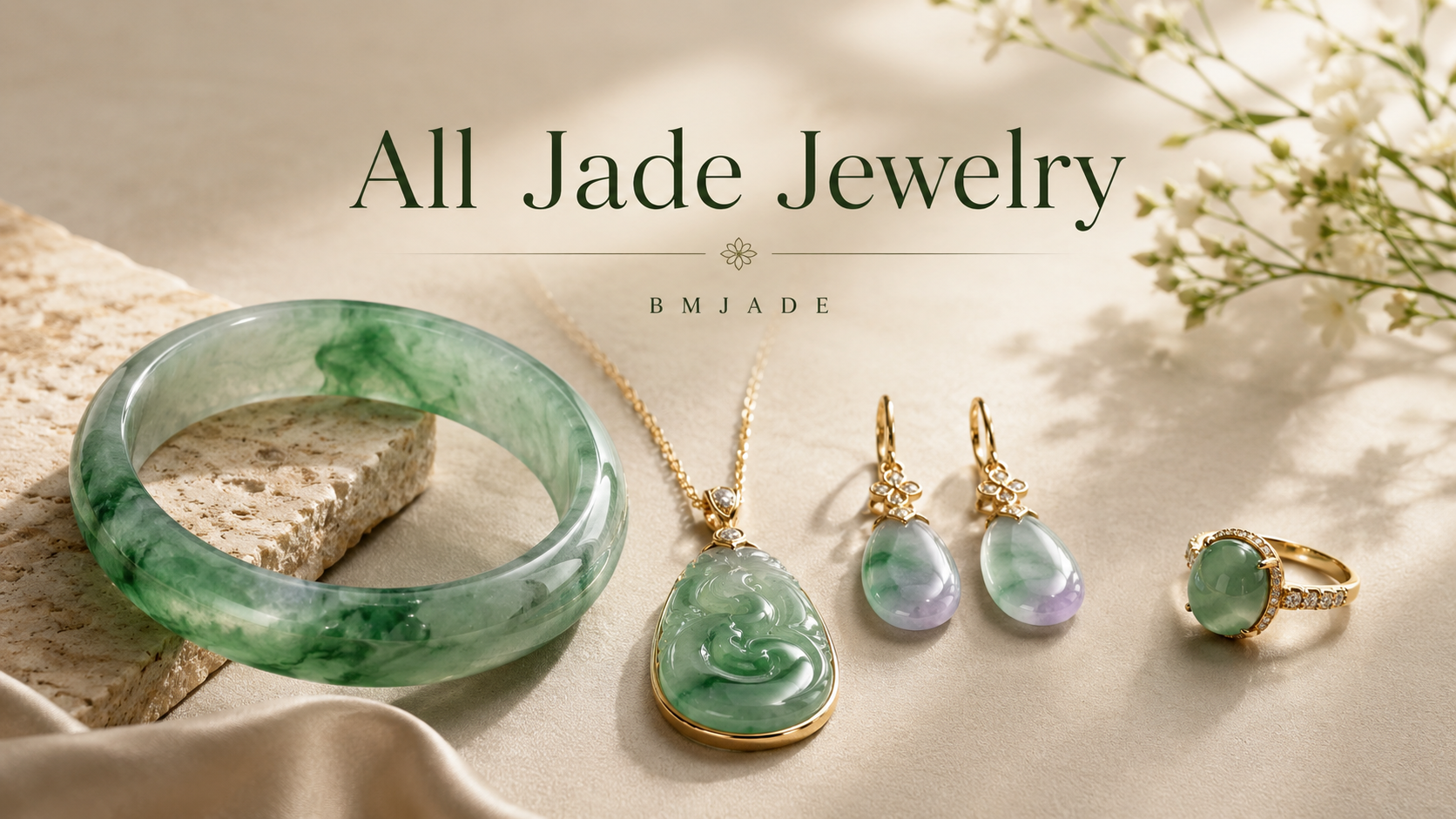
A jade bangle is the one piece of jade jewelry that cannot hide. No setting, no glue, no metal, no backing — one solid, continuous ring of stone, every millimeter of it open to your torch and your loupe. That is why this guide can promise something the mushier corners of the internet will not: verdicts. Not "this may suggest," but if you see this, conclude that. The bangle is also, not coincidentally, the format where fakery pays best — it carries the highest per-piece prices in jade, which is why acid-bleached, polymer-filled Type B bangles are the trade's most famous scandal. High stakes, full visibility, real tests. Every piece in our jade bracelets and bangles collection goes through the gauntlet below before it ships; here is how to run the same one on any bangle in front of you.

Quick Answer: How Can You Tell If a Jade Bracelet Is Real?
Four decisive checks, in this order.
Light — backlight the full circumference. One round bubble means glass. A spiderweb of etch lines in the surface reflection means acid-treated Type B. Color pooled into a web of cracks means dyed Type C.
Sound — suspend the bangle and tap it gently. Natural jadeite rings clear and sustained; a damaged or filled structure answers with a dull thud.
Weight — a bangle is the easiest jade item to weigh in water, and specific gravity separates jadeite from every common imitation cleanly.
The fingernail — a line that catches your nail or flashes a flat mirror plane is a crack; one that does neither is a harmless stone line.
Then let a certificate whose measurements match the bangle to the millimeter make it official.
What "Real" Means — Two Minerals and Four Grades
"Jade" covers two genuine minerals: jadeite and nephrite. Both are real jade. Most fine bangles are Natural Jadeite Jade, though Natural Nephrite Jade bangles — especially Hetian nephrite — are a serious category in their own right.
At bangle prices the more common problem is not a different mineral. It is real jadeite presented dishonestly:
- Type A — natural. No bleaching, no polymer, no dye. This is what you want, and it is a treatment status, not a quality grade.
- Type B — acid-bleached to remove staining, then impregnated with polymer to restore the look. Real jadeite, structurally compromised, worth a fraction.
- Type C — dyed.
- Type B+C — both.
Everything below is the bangle's own evidence. For how laboratories actually make these calls — FTIR, Raman, and what a report can and cannot conclude — see how labs test jade.
The Verdict Table
Each row is a conclusion, not a mood.
| What you see, hear or measure | Verdict | Action |
|---|---|---|
| One clean round bubble under transmitted light | Glass, not jade | End the exam |
| Spiderweb etch lines / orange-peel texture in the surface reflection | Type B (acid-bleached, polymer-filled) | No sale unless a lab proves otherwise |
| Color pooled in a web of cracks, like ink into paper | Type C (dyed) | Same |
| Dull, short thud when suspended and tapped | Damaged structure — treated or cracked; a lab decides which | No deal on the spot |
| Specific gravity around 2.6 | Quartzite, serpentine or glass | Not jade. Walk |
| Specific gravity around 3.3 | Consistent with jadeite | Continue the remaining checks |
| A line that catches a fingernail, or flashes a flat mirror plane | A crack — structural risk, price collapses | Negotiate as damaged, or walk |
| A line that neither catches nor flashes | A stone line — character, not damage | Normal. Carry on |
| Frost-fleck internal glints under rotating angled light (翠性) | Consistent with natural jadeite | Good sign |
| Certificate dimensions don't match your calipers | The certificate belongs to a different bangle | Walk |
The Light Sweep: 360 Degrees, Nowhere to Hide
The bangle's structural honesty is your first weapon: it is the only jade format you can backlight around its entire circumference. Press a strong torch against the band and walk it slowly around the full ring, watching from the opposite side.
Bubbles. One clean round sphere ends the exam. Jade's inclusions are always irregular — clouds, fibers, ragged specks. A perfect sphere is trapped air, and trapped air means it was once molten.
The internal weather. Natural jadeite transmits unevenly, in clouds and fibrous drifts that shift as the light moves. GIA notes that jadeite's <a href="https://www.gia.edu/jade-description" target="_blank" rel="noopener">color is often unevenly distributed</a> — that unevenness is the material's signature. A band that glows with dead, even uniformity all the way round has been standardized by something, and nature does not standardize stone.
The flash. Switch to a side light at 45 degrees and rotate the bangle slowly, watching for 翠性 — the frost-fleck glints thrown by jadeite's interlocking crystal grains. Present: consistent with natural. Absent on a high-gloss band: consistent with glass, or with material whose grain acid destroyed.
The etch web. Bring the loupe to the surface reflection and sweep for spiderweb lines or orange-peel dimpling. This is what acid bleaching leaves behind and polish cannot fully bury. Find it anywhere on the band and the whole bangle is Type B — treatment is never local.
The Ring Test: The One Place It Actually Works
Elsewhere on this site we tell you the tap-and-listen test is useless. On rings and earrings it is, because a small stone clamped in metal cannot resonate. The bangle is where the test was born and where it works, for a physical reason: a long, continuous, solid piece of dense stone is a resonator, like a bell or a xylophone bar.
How. Suspend the bangle — on a loop of string, or balanced on one fingertip through the center, touching nothing else — and tap the outer band with the edge of a coin, an agate rod, or another bangle. Gently. This is a tap, not a strike.
What you hear. Natural, structurally intact jadeite answers with a clear, high, sustained chime — a note that hangs for a beat. Acid-treated Type B answers with a dull, short thud: the acid shattered the grain structure and the polymer damps the resonance like a cracked bell wrapped in tape.
The honest limits, stated plainly so the verdict stays trustworthy:
- A dull sound convicts the structure, not the paperwork. A natural bangle with a serious internal crack also thuds. Dull means disqualified pending a lab, not diagnosed by ear.
- A clear chime is consistent with natural but is not proof of Type A on its own.
- Band thickness shifts pitch — thick bangles ring lower. Compare tone quality (clear and sustained versus dead and short), never pitch.
Screening, not certification. But as screenings go none is faster: three seconds, and the worst bangles in the room disqualify themselves.

The Weight Test: Why It Is Easier on a Bangle Than on Anything Else
Specific gravity is the most decisive non-destructive test a buyer can run at home, and almost nobody runs it — because on set jewelry you cannot, since the metal and the stone weigh together. A bangle is bare stone. Nothing to subtract.
The method. You need a kitchen scale that reads to 0.01 g and a cup of water.
- Weigh the bangle dry. Call it W1.
- Suspend it fully underwater on a thin thread so it touches nothing, and weigh it again. Call it W2.
- Specific gravity = W1 ÷ (W1 − W2).
What the number means:
| Material | Specific gravity |
|---|---|
| Jadeite | 3.30 – 3.36 |
| Nephrite | 2.90 – 3.03 |
| Dolomite marble (sold as "Afghan jade") | ~2.7 |
| Quartzite (dyed, sold as "Malaysia jade") | ~2.65 |
| Serpentine (sold as "new mountain jade") | 2.5 – 2.6 |
| Glass | 2.4 – 2.6 |
| Plastic / resin | 1.2 – 1.5 |
The gap between jadeite at 3.3 and every common imitation at 2.6 or below is enormous — far larger than any measurement error you are likely to make with a kitchen scale. This one number will not distinguish Type A from Type B, because both are jadeite. But it will tell you within two minutes whether you are holding jade at all.
Know Your Imposters
It helps to know what is actually being sold to you, because each one gives itself away differently.
Glass. The commonest outright fake. Bubbles, a glassy conchoidal chip at any nick, no 翠性, and a specific gravity around 2.5. Often warmer to the touch than stone.
Dyed quartzite — traded as "Malaysia jade." Very common in cheap green bangles. Grainy, sugary texture under a loupe; dye follows the grain boundaries; specific gravity around 2.65.
Serpentine — traded as "new mountain jade" or "Korean jade." Softer, waxier, often with a slightly greasy look. A fingernail will not mark it but a steel blade will.
Dolomite marble — traded as "Afghan jade." Usually white, sometimes dyed. Fine sugary structure, no fibrous interlock.
Reconstituted or "resin jade." Powdered stone bound in polymer. Feels light, sounds dead, and specific gravity gives it away immediately.
Real jadeite, Type B or C. The most expensive mistake, because it is real jade — and the only one of these that a specific gravity test will not catch. This is what the light sweep and the ring test are for.
The Tests That Do Not Work — and Two That Will Damage Your Bangle
Search results are full of tests that sound decisive and are not. Three are simply useless. Two will harm the piece.
The scratch test — don't. The claim is that real jade cannot be scratched by a steel blade. Jadeite sits at roughly 6.5–7 on the Mohs scale and nephrite at 6–6.5, while a steel knife is around 5.5, so steel will not mark either. But steel will not reliably mark quartzite (7) or glass (5.5) either — the test cannot distinguish jade from its two commonest imitations, which is the entire job you needed it to do. What it will do is leave a permanent mark on a piece you may end up buying.
The hot needle test — don't, and be careful. Heating a needle and pressing it to the stone is used to detect plastic. It risks burns to your hand, it permanently scars any resin-bound material, and it tells you nothing about Type B jadeite, where the polymer is impregnated through the stone rather than sitting on the surface. Specific gravity answers the same question in two minutes with nothing hot involved.
The hair-burning test — no. The claim that a hair wrapped around real jade will not burn has no basis. It involves an open flame next to your fingers and the piece. Skip it.
The water-droplet test. A drop of water is supposed to bead and hold on real jade. What it actually tests is surface polish and whether the stone has been oiled — which is why sellers sometimes mist a bangle before showing it. No diagnostic value.
The cold-to-the-touch test. Jade does conduct heat well and does feel cool. So do glass, quartzite, marble, and most other stones you might be shown. It tells you the item is not plastic. That is the whole of it.
If you want a fast, non-destructive screen, the four in the quick answer are the ones that earn their place.
Nephrite Bangles: Different Tells
Nearly every online guide assumes jadeite. If your bangle is Natural Nephrite Jade — Hetian white, spinach green, or black — some of the verdicts change:
- No 翠性. Nephrite's structure is fibrous rather than granular, so it does not throw the frost-fleck glints jadeite does. Their absence is normal, not suspicious.
- Different luster. Nephrite reads waxy to oily where jadeite reads glassy. A nephrite bangle polished to a hard glassy shine is worth a second look.
- Different specific gravity. 2.90–3.03, not 3.3. Still comfortably above quartzite and serpentine.
- The ring test still works, and nephrite — the toughest natural gem material known — usually rings very well.
- Type A/B/C language does not apply. That vocabulary belongs to jadeite. Nephrite is dyed sometimes, but the acid-and-polymer treatment that Type B describes is a jadeite problem.
Material differences in full: Chinese jade varieties, Hetian vs jadeite.
Bead Bracelets: The One-Paragraph Verdict
Elastic bead bracelets are the bangle's cheap cousin and the volume zone for dyed quartzite. The two decisive checks transfer whole: read the beads as a population — natural beads vary like siblings, and twenty identical twins were standardized by dye or by molds — and put the loupe on the drill holes, where dye pools in telltale halos. Full bead methodology, including the twenty-witness rule, is in our jade necklace authentication guide.
Buying Online: The Five Photos to Ask For
You cannot suspend and tap a bangle through a screen. But you can make the seller produce the evidence, and what they refuse is itself a result.
- The full circumference, dry, under plain light. Not one flattering angle. If color sits in a band, you need to see the other 270 degrees. Wet or oiled stone deepens color and hides etch marks — insist on dry.
- Backlit, torch pressed against the band. This is the single most informative jade photograph that exists, and it takes ten seconds to shoot.
- A loupe or macro shot of the surface reflection. Etch web and orange peel show here or nowhere.
- The certificate, readable, with the report number visible — not a stock image of "a certificate."
- Calipers on the stone, or at minimum the inner diameter, band width and band thickness stated in millimeters so you can check them against the report when it arrives.
A seller with genuine Type A stock finds these easy. A seller who deflects — "professional photos only," "the lighting doesn't do it justice," "all our jade is grade A" — has answered you.
The Certificate: Dimensions Decide
Bangles have the most standardized certificates in the jade trade, and that standard is your final verdict tool. A proper report states the bangle's inner diameter, band width and band thickness in millimeters, alongside the material and treatment findings and a photo.
So the check is arithmetic, not faith. Verify the report number on the issuing laboratory's own website — whichever lab issued it — then put calipers on the bangle and match every dimension. Match, plus "jadeite, natural" or "Type A / no treatment detected" in the findings: the question is settled. Any dimension off by more than measurement error means that certificate belongs to a different bangle, and the listing has just told you everything.
How to read and verify reports in detail: NGTC vs GIA.
Red Flags Before Any Test
The bangle trade has its own theater. Recognize the props.
- The wet stone. Bangles shown oiled or freshly misted. Water and oil deepen color and hide etch marks. Ask to see it dry.
- The story premium. "Old family jade" substituting provenance for paperwork.
- The impossible price. Vivid, translucent, full size — at a price that could not buy the rough.
- Vague material language. "Grade A jade," "natural jade stone," "jade color" with no species named and no report.
- The test refusal. A seller who will not let you suspend and tap a bangle, or will not photograph a listing piece dry under plain light, has completed your screening for you.
One flag raises a question. Three convict.
How We Handle This at BMjade
The gauntlet above is our intake, not just your checklist. Every bangle is backlit around its circumference, rung and listened to, and checked line by line with nail and lamp, then certified by NGTC with a verifiable serial number and dimensions on the paper that match calipers on the stone. If any accredited laboratory ever rules otherwise, we refund the purchase price plus the lab fee plus return shipping, for the life of the piece.
Our jade bracelets and bangles collection is open to exactly this inspection — and if you want to run the checks above on a piece you already own, send us photographs and we will tell you what we see.
FAQ
What is the most reliable home test for a jade bangle?
The combination, in order: the 360-degree light sweep, the suspended ring test, a specific gravity measurement, and the fingernail-and-light ruling on any visible line. Together they screen out glass, imitation stone, most Type B, and structural cracks in under fifteen minutes. A dimension-matched laboratory report then makes it official.
How do I do the ring test correctly?
Suspend the bangle on a string or one fingertip so nothing damps it, and tap the outer band gently with a coin edge. Clear, high, sustained chime: structure intact, consistent with natural. Dull, short thud: fractured or filled — disqualified pending a lab. Compare tone quality, not pitch, since thicker bangles ring lower.
Does a dull sound always mean fake?
It always means disqualified as-is. Either the bangle is acid-treated or it has an internal crack, and you should not pay natural-and-sound prices for either. Which of the two it is, only a laboratory can say.
Can I test jade with a knife or a scratch?
You can, but you should not. Steel is softer than both jadeite and nephrite, so it will not mark either — but it also will not reliably mark quartzite or glass, which are exactly the materials you were trying to rule out. The test cannot do the job and it permanently marks the piece.
Is the hot needle test safe?
No, and it is not useful here either. It risks burns, permanently scars resin-bound material, and cannot detect Type B jadeite, where polymer is impregnated through the stone rather than sitting on the surface. A specific gravity measurement answers the same question without heat.
How do I tell a crack from a stone line?
A crack catches a fingernail drawn across it and flashes a flat mirror plane under angled light. A stone line does neither. A crack is structural risk on a bangle and the price should fall accordingly. A stone line is natural character, and some of the finest bangles carry them.
Do air bubbles always mean glass?
Yes. One clean round bubble under transmitted light ends the question. Jade's inclusions are always irregular — clouds, fibers, ragged specks — never a perfect sphere.
What specific gravity should a real jade bangle have?
Jadeite measures 3.30–3.36 and nephrite 2.90–3.03. Common imitations sit at 2.65 or below — quartzite around 2.65, serpentine and glass around 2.5. The gap is wide enough that a kitchen scale and a cup of water will settle it.
The price seems too good for the color. Should I worry?
That instinct is a test result. Vivid, translucent, full-size bangles cost serious money as rough stone. A price that could not buy the rough is telling you where the color came from.
How do I verify a bangle's certificate?
Look the report number up on the issuing laboratory's own website — not on a third-party page and not on the seller's site. Then measure the bangle's inner diameter, band width and band thickness and match every figure to the paper. Dimensions match plus a natural or Type A finding: settled. Any mismatch: walk.
Can I check a jade bangle if I bought it online and already have it?
Yes — every test above except the seller-facing ones. Run the light sweep, the ring test, and the specific gravity measurement, then check the certificate number on the issuing lab's site and the dimensions with a ruler. If the results conflict with the listing, that is your evidence for a return claim, and most platforms treat a lab finding as decisive.
The Bottom Line
A bangle offers what no other jade does: total visibility and a working bell. Use both without apology. Sweep the light around the whole ring, hang it and listen, weigh it in water, rule on every line with a nail and a lamp, and close the case with a certificate whose millimeters match your calipers. Every row of the verdict table ends in an action because the bangle has earned that clarity — it is one honest piece of stone, and it rewards an honest, decisive buyer.
Sources
- GIA — Jade overview
- GIA — Jade description and gemmological properties
- GIA — Jadeite quality factors