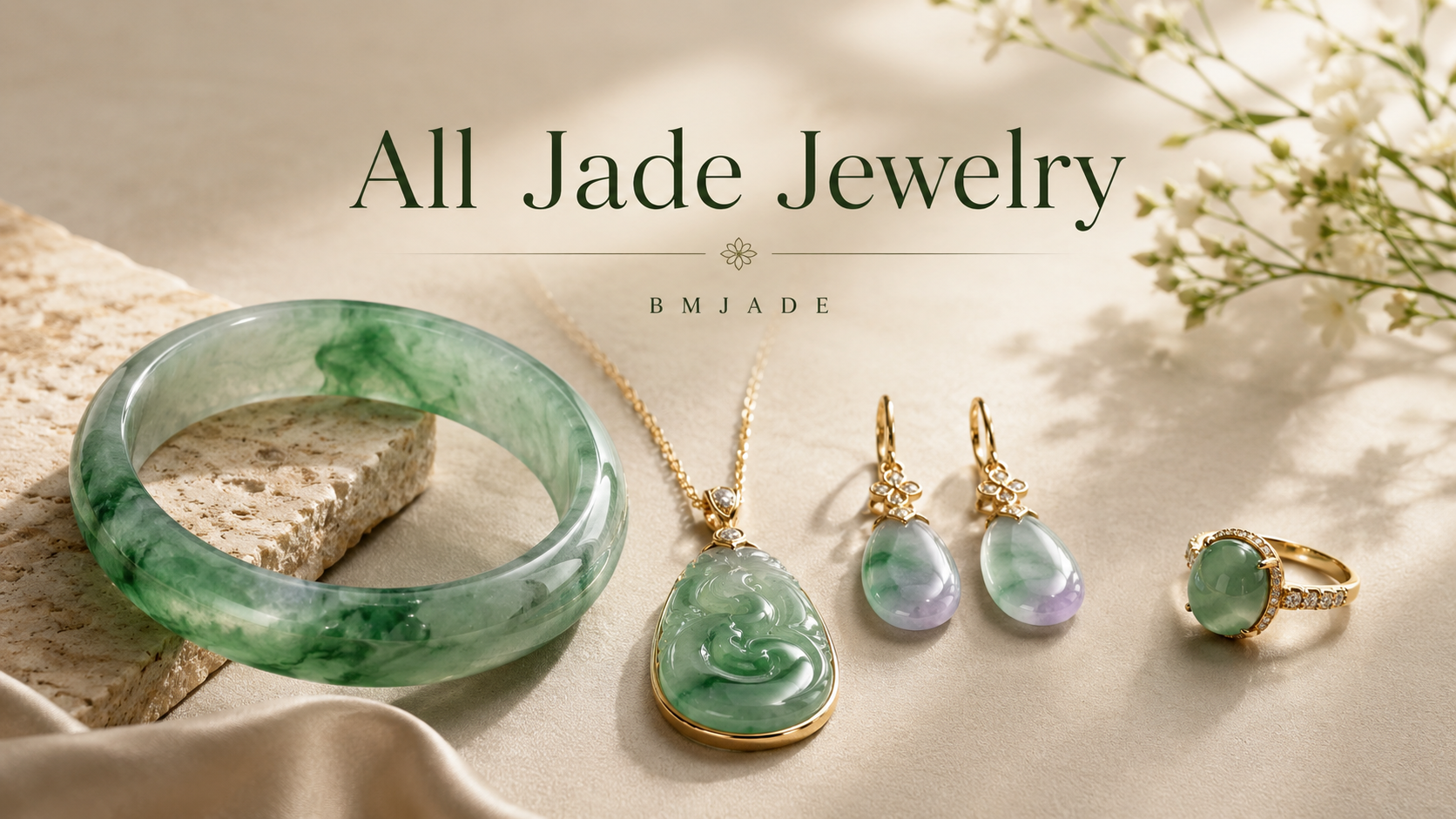
I've been buying Burmese jadeite at the Hpakant market since 2016. Across nine years and dozens of sourcing trips, I've watched the jadeite market shift through three distinct cycles — the pre-2017 traditional trade, the 2018–2021 e-commerce explosion, and now what I'd call the 2024–2026 bifurcation phase, where top-grade pieces and mid-tier pieces are moving in opposite directions for the first time in modern memory.
This post is my honest read on the 2026 jadeite market: where the data points, what's actually happening at the markets, and what it means for anyone considering a real Type A jadeite purchase this year. I'll share the numbers, the auction records, and — for what it's worth — what I'd tell a friend who asked whether 2026 is a good year to buy jade.
The 2026 Jadeite Market in Numbers
Different research firms use different definitions of "jadeite market," so it's worth grounding this discussion in actual reported data rather than vague claims about "growing demand."
The most consistent figures across Industry Research's 2025 jadeite market report, Business Research Insights' 2026 update, and Verified Market Research's coverage suggest the following picture:
- Global jadeite market value, 2026: Estimates range from US$680 million (narrow gemstone definition) to US$5 billion (broader jadeite jewelry definition)
- Projected CAGR 2026–2035: ~6.5% to 6.7% across multiple reports
- Asia-Pacific dominance: ~85% of total demand, driven by China, Hong Kong, and Taiwan
- Myanmar's share of rough supply: ~70–90% of the world's gem-quality rough output
- Type A premium share: Over 72% of 2024 jadeite sales were attributed to certified Type A untreated material
- China retail jade jewelry market 2024: RMB98 billion (~US$13.6 billion), making jade the second-largest jewelry category in China behind gold, according to the 2024 China Jewelry Industry Development Report from the Gems and Jewelry Trade Association of China and reported by JNA Jewellery News Asia
- China jewelry e-commerce 2024: RMB298.26 billion (~US$41 billion), up 16.4% year-over-year, with livestreaming as the primary growth driver
These numbers tell a story of a market that's growing in aggregate while transforming structurally. But the aggregate hides the most important thing happening in 2026: the gap between top-grade and mid-grade jadeite is widening sharply.

The 2025 Auction Year — Top-Grade Held, Mid-Grade Wobbled
Auction records are imperfect indicators (they reflect what's offered for sale rather than the entire market), but they're the most public and verifiable data we have on top-end pricing.
Here's what 2025's major auction calendar told us:
Sotheby's Hong Kong, November 2025
A jadeite necklace of 43 highly translucent emerald-green beads (approximately 630 total carats, with a brilliant-cut and baguette diamond clasp) became the top lot of the Magnificent Jewels sale, selling for US$8.1 million. This was reported by National Jeweler.
Poly Auction Hong Kong, November 2025
A 43-jadeite-bead necklace with a ruby and diamond clasp sold for HK$36 million (US$4.6 million) — slightly below its high estimate but well within the trophy-piece range, ranking among the top 10 jewelry sales of the year, according to Rapaport's 2025 auction roundup.
Withdrawn lots tell the other half of the story
At the same Sotheby's November 2025 sale, a jadeite bracelet expected to fetch up to US$3.4 million was withdrawn before bidding — reportedly because pre-sale interest didn't meet the reserve.
The pattern is consistent with what JNA's 2025 industry coverage reported: prices of top-quality jadeite increased around 20% on average over the past few years, even through periods when broader luxury markets contracted. According to Stanley Chu, vice chairman of the Hong Kong Jade Association, demand for premium-quality jadeite remains "firm" while mid-tier interest has weakened.
The historical context matters here. The Hutton-Mdivani Necklace — the still-standing world record for jade jewelry at US$27.4 million in 2014 — appreciated from approximately US$2 million when it sold in 1988 to US$4.2 million in 1994 to US$27.4 million in 2014. That's roughly a 13.7x appreciation over 26 years, almost entirely driven by top-grade scarcity rather than market timing.
For the auction details on the Hutton-Mdivani sale, see Sotheby's official lot description and the Guinness World Records entry.

The Mid-Tier Collapse — How Livestreaming Changed Everything
The auction data tells the top-end story. The bottom-end story is happening on Douyin, Taobao Live, RedNote, and Kuaishou — and it's reshaping the jadeite market more profoundly than anything else in 2026.
A 2025 academic paper published in Wiley's Economic Anthropology journal — "From Rare to Common: The Live Streaming Industry of Jadeite Trade in Ruili in the China–Myanmar Borderlands" — documents this shift with hard numbers from Ruili, the Chinese border city where most Burmese jadeite enters the Chinese market.
Key findings from the paper:
- Pre-2017 (traditional trade era): Ruili's jadeite trade was dominated by face-to-face deals between long-term trading specialists. Average transaction prices for finished pieces typically ranged from a few thousand to tens of thousands of yuan.
- 2017–2019 (livestream emergence): At one major Ruili livestream base (Duo Bao Zhi Cheng), more than 1,100 vendors registered. Daily sales volume reached 40,000–50,000 items, peaking at 75,000 items per day. Approximately 75% of sales were medium-to-low priced jadeite under 3,000 yuan (~US$420).
- 2022–2023 (post-pandemic compression): 90% of jadeite sold on Douyin was priced below 1,000 yuan (~US$140). One Ruili retailer with 10 years of experience told the paper's author: "It's nearly impossible to sell jadeite for more than 1,000 yuan online. The prices are too low."
Read that again: 90% of online jadeite is now sold for under US$140.
The implications for the global jadeite market are significant:
1. Mid-tier price ceiling collapsed. Pieces that retailers previously sold for 3,000–10,000 yuan in physical stores are now priced at 500–1,000 yuan online to compete with livestream volume. Retailers I know in Yunnan have either shrunk dramatically (one shop went from 55 employees in 2019 to fewer than 20 today) or pivoted entirely to livestream.
2. Type B and Type C flood mid-tier inventory. Aggressive livestream pricing forced many small operators to source treated material to maintain margins. According to the 2024 China Jewelry Industry Development Report, demand for certified jadeite pieces increased 28% year-over-year specifically because buyers became more concerned about authenticity in a market saturated with treated material.
3. Top-grade material moved upward. As mid-tier collapsed, serious buyers chasing investment-grade pieces redirected demand toward higher-translucency, better-color, NGTC- or GIA-certified pieces — exactly the opposite end of the market. This is the "flight to quality" pattern visible in every collectible category during downturns.
4. The bifurcation became structural. The middle-tier compression isn't a cyclical dip — it's a structural change driven by the underlying economics of livestream commerce. It's not coming back to where it was in 2018.

What the Bifurcation Looks Like at My Markets
Numbers from research papers are abstract. Here's what bifurcation looks like when I'm actually buying.
At Hpakant in Myanmar: Top-grade rough has gotten consistently harder to find. Mining permits are tighter than they were before 2021. According to a 2019 International Growth Centre report — still the best independent overview of Myanmar's jade production structure — there were nearly 12,000 acres of jade-mining concessions across over 5,300 private permits and 190 joint-venture blocks as of April 2018. The permit framework has tightened since. When I find a high-translucency, high-color rough at Hpakant in 2026, I'm typically paying 30–50% more for the same quality I'd have paid in 2019. And I see fewer of these stones each trip than I did five years ago.
At Ruili (Yunnan, the China-Myanmar border): This is where the bifurcation is visible by the hour. The traditional cash markets feel emptier than they did before 2020. Many longtime dealers have closed their physical operations and moved to livestream studios in the Jiegao livestream base. The remaining physical-trade dealers focus almost exclusively on top-grade pieces priced for collectors — because mid-tier no longer profits in physical retail.
At my own workshop in Kunming: Customer questions have changed. In 2018, most customers asked about price. In 2026, the questions are about certification, provenance, and translucency — the markers of top-grade material. Customers buying at the higher end of our collection are increasingly willing to pay for documented quality rather than hunt for "deals." Customers buying at the entry level are more cautious than ever, often asking specifically how they can verify a piece independently.
This is what bifurcation feels like on the ground: the top is healthy, the middle is gone, and the bottom is dominated by livestream and unverifiable inventory.

Color and Quality Premiums in 2026
For buyers who want a sense of where 2026 prices actually sit, here's how the major jadeite categories are pricing across the global certified-Type-A market:
| Category | Per-Gram Range (USD, 2026) | 2024 → 2026 Trend |
|---|---|---|
| Imperial Green (high translucency, even saturation) | $1,750 – $3,200+ | ↑ Up 15–25% |
| Lavender / Smoky Purple (high translucency) | Comparable to Imperial green at top grades | ↑ Up 25–40% (fastest-rising color) |
| Icy / Bing Zhong (translucent, near-colorless) | $400 – $1,500 | ↑ Up 10–15% |
| Apple Green / Burmese Green (mid-saturation) | $50 – $400 | → Flat or slight downward |
| Dark Spinach Green / Bean Variety (opaque) | $10 – $80 | ↓ Down 5–10% |
| Hetian Mutton-Fat White (nephrite, for comparison) | $250 – $500+ | ↑ Steadily rising |
The pattern is clear: the higher the quality factor (translucency × color saturation × even distribution × Type A certification), the stronger the appreciation. Lower-grade material is increasingly substitutable by livestream inventory and is trending flat to negative.
For the underlying quality framework, see the Gemological Institute of America's jade quality factors page — the international standard reference for evaluating color, transparency, and texture.

What's Driving the Top End — The Five Forces
Five distinct forces are pushing top-grade jadeite prices higher even as mid-tier collapses:
1. Constrained supply from Hpakant. Mining permits, geopolitical complications, environmental degradation at mature sites, and tighter government controls have all reduced new top-grade rough entering the market. According to Wikipedia's overview of the jade trade in Myanmar, legitimate documented exports have declined since 2021 even as estimated total production remained stable — meaning more material is exiting through informal channels and less is entering certified retail supply chains.
2. Investment-grade demand from a younger Asian generation. The 2024 China Jadeite Industry Development White Paper, jointly released by the Gems and Jewelry Trade Association of China and reported by JNA, found that younger Chinese buyers (under 35) increasingly view top-grade jadeite as an alternative asset comparable to fine art — not as a fashion category. This is a significant cultural shift from a decade ago.
3. Institutional and family-office buying. Investment-grade jadeite increasingly appears in family-office allocation discussions in Hong Kong, Singapore, and Taipei. According to the Industry Research jadeite report, auction sales of investment-grade jadeite rose 46% between 2023 and 2025. This isn't retail demand — it's wealth-preservation demand operating at a different timescale.
4. Authentication infrastructure improvement. As NGTC, HKJSL, and SSEF certification has become more accessible globally, top-grade pieces with verified documentation have become more liquid. The result: serious buyers can buy with confidence at higher prices because they can verify and resell. The certified Type A premium has grown rapidly — Industry Research reported a 28% year-over-year increase in demand for certified pieces in 2024.
5. Substitute scarcity. Top-grade emerald, fine ruby, and the highest-tier diamonds have all gotten more expensive since 2020. For buyers seeking high-value gemstone investments, jadeite increasingly competes within the same portfolio category — and at the very top end, jadeite still offers more cultural and historical depth than most alternatives.
What This Means for Buyers in 2026
If you're considering buying jadeite this year, the bifurcation has practical implications.
If You're Buying for Daily Wear ($50–$300)
The mid-tier compression is mostly good news. You can find perfectly nice Type A jadeite bead bracelets, small pendants, and adjustable rings at lower prices than five years ago — provided you buy from a reputable seller with NGTC or GIA certification. The risk is not price. The risk is buying treated material disguised as Type A in a market where livestream operators dominate inventory.
What to do: insist on certificates with verifiable serial numbers, and ignore "imperial green" claims at low prices. They're either treated (Type B/C) or not what they're labeled.
If You're Buying for Gifting or Heirloom ($300–$2,000)
This is the segment most affected by mid-tier compression. Pieces that genuinely belong here are rarer than they were in 2018 because many sellers have either moved upmarket or downmarket. Spend more time on certification and craftsmanship than on chasing color.
What to do: focus on solid certified Type A material with good translucency, even if the color is more modest. Apple green and Burmese green pieces with strong translucency often outperform "imperial green" claims at this price point.
If You're Buying for Investment ($2,000+)
Top-grade material continues to appreciate, but the entry bar is rising. Pieces that would have been "investment-grade" in 2018 may not qualify today as the top end has moved upward.
What to do: prioritize NGTC + secondary lab certification (NGTC + GIA, or NGTC + HKJSL). For pieces above US$10,000, get independent appraisals before purchase. Focus on top-translucency, even-color pieces — Imperial Green, high-translucency Lavender, or top icy material — and accept that you may need to wait months for the right piece.
For broader context on how to evaluate quality, my complete guide to authenticating jade jewelry covers Type A/B/C identification in detail.
The Forecast — Where the 2026–2030 Market Goes
I won't pretend to predict the market with precision. But based on what I'm seeing at Hpakant and Ruili, plus the published forecasts from Industry Research, Business Research Insights, and the China Jewelry Industry Development Report, here's how I read the 2026–2030 trajectory:
Probable continuations:
- Top-grade Burmese Imperial Green and high-translucency Lavender will continue appreciating at 5–15% annually
- The "certified Type A" premium will continue widening over uncertified material
- Hetian nephrite ("mutton fat white") will continue its quieter but steady rise — particularly among collectors who care more about cultural depth than commercial drama
- Mid-tier livestream pricing will stabilize but won't recover to 2018 levels
Possible developments:
- A significant supply shock from Myanmar (further mining permit restrictions, geopolitical escalation, or environmental disasters at Hpakant) could push top-grade prices much higher in compressed timeframes
- AI-assisted authentication tools entering consumer hands could dramatically reshape mid-tier trust dynamics
- The CIBJO Fei Cui Guide — being developed by the World Jewellery Confederation as reported by JNA — could establish unified international nomenclature and trade standards by 2026 or 2027, potentially professionalizing the global market further
Less likely:
- A return to undifferentiated "jade" pricing where mid-tier and top-tier move together
- Significant new top-grade source emerging outside Myanmar at scale
The Bottom Line
The 2026 jadeite market is more bifurcated than at any point in the last twenty years. Top-grade certified Type A Burmese pieces are appreciating because of structural scarcity and quality-flight demand. Mid-tier pieces are compressing because of livestream commerce and substitutability. Bottom-tier and treated material is being commoditized faster than most buyers realize.
For ordinary buyers, this is mostly good news with one important caveat: certification matters more than ever. The market rewards documented authenticity and punishes ambiguity.
I'll keep traveling to Hpakant, keep buying from the dealers I've known for years, and keep sending every piece to NGTC. That's how we navigated the last decade. It's how we'll navigate the next.
— Hong

Frequently Asked Questions About the 2026 Jadeite Market
How big is the global jadeite market in 2026?
Estimates vary significantly by definition. Narrow gemstone-only definitions place the global jadeite market at roughly US$680 million in 2026, growing at ~6.5% CAGR through 2035. Broader jade jewelry market definitions (including all jadeite and nephrite jewelry) range from US$5–8 billion, growing at similar rates. China is the dominant consumer at approximately 85% of global demand, with Hong Kong, Taiwan, and Singapore representing significant secondary markets.
Is now a good time to buy jadeite?
For top-grade certified Type A pieces, yes — supply is tightening faster than demand, supporting continued appreciation. For mid-tier and entry-level pieces, prices are flat or slightly declining due to livestream commerce, so there's no urgency. The most important factor at any price point is certification: 2026 is a great year to buy verified Type A material, and a terrible year to buy untraceable jadeite hoping it's authentic.
Why are top-grade jadeite prices rising while mid-tier falls?
Several forces overlap: tightening supply of top-grade Burmese rough from Hpakant, growing investment demand from younger Asian buyers and family offices, certification infrastructure making top-grade pieces more liquid, and substitute scarcity in other top gemstones. Meanwhile mid-tier has been compressed by livestream commerce, where 90% of online jadeite now sells under 1,000 yuan (US$140).
What's the most expensive jadeite ever sold?
The Hutton-Mdivani Jadeite Necklace remains the world record at US$27.44 million, sold at Sotheby's Hong Kong in 2014. The 27 graduated jadeite beads (15.4–19.2mm) are believed to date to the Qing Imperial Court, with a Cartier clasp. The piece appreciated approximately 13.7x from US$2 million in 1988 to US$27.4 million in 2014.
Is Burmese jadeite really 90% of world supply?
According to multiple market research reports and academic sources, Myanmar accounts for approximately 70–90% of the world's gem-quality rough jadeite supply, with the great majority concentrated in the Hpakant region of Kachin State. For top-grade material specifically (Imperial green, high-translucency lavender, icy varieties), the Burmese share approaches 95%.
Is investing in jadeite riskier than gold or diamonds?
Jadeite is a less liquid market than gold or diamonds — selling a top-grade piece can take weeks or months versus minutes for gold. However, top-grade certified Type A jadeite has historically shown strong appreciation comparable to fine art rather than commodity gold. The Hutton-Mdivani's 13.7x appreciation over 26 years outperformed both gold (~6x in the same period) and diamonds (~3-5x). Risk is concentrated at the mid-tier and below, where authentication and resale are harder.
Has Chinese demand for jadeite recovered after the 2022–2023 slowdown?
Yes, with structural changes. Total Chinese jewelry e-commerce reached RMB298 billion in 2024 (up 16.4% YoY), with jade as the second-largest category behind gold. However, the recovery has been bifurcated: top-grade has fully recovered and exceeded pre-slowdown levels, while mid-tier remains compressed. The 2024 China Jewelry Industry Development Report confirmed certified Type A pieces specifically grew 28% YoY due to rising authentication concerns.
How does livestreaming affect jadeite pricing?
Livestreaming on Douyin, Taobao, and RedNote has compressed mid-tier and entry-level jadeite pricing significantly — 90% of jadeite sold online in China is priced under 1,000 yuan (~US$140), versus typical 3,000+ yuan prices in physical retail before 2017. This has had the secondary effect of pushing serious buyers toward certified top-grade material and creating concerns about treated material flooding online inventories. The structural change appears permanent.
Will the CIBJO Fei Cui Guide affect jadeite pricing?
The World Jewellery Confederation's Fei Cui Guide — under development as of 2025 — aims to establish unified international nomenclature, trading standards, and disclosure requirements for jadeite, omphacite, and kosmochlor materials. Once published (expected late 2026), it should improve global market transparency, reduce mid-tier ambiguity, and likely reinforce the certified-Type-A premium. Most existing certified material from NGTC, GIA, and SSEF should remain compliant with the new standards.
Related Reading
- Why Burmese Jade Still Rules the Gemstone World — A 2026 Sourcer's Perspective
- The Ultimate Guide to Authenticating Jade Jewelry
- The Ultimate Guide to Chinese Jade Varieties
Browse BMjade Certified Collections
- Authentic Jade Bracelets & Jadeite Bangles
- Authentic Jade Necklaces & Jadeite Pendants
- Authentic Jade Earrings & Jadeite Studs
- Authentic Jade Rings & Adjustable Jadeite Rings
About the Author
Hong is the founder of BMjade and has been sourcing Burmese jadeite at the Hpakant market since 2016. Based in Kunming, Yunnan, he travels to Myanmar multiple times each year to select rough stones for the BMjade collection. Every piece he selects is independently certified by NGTC. Read more about Hong and BMjade →