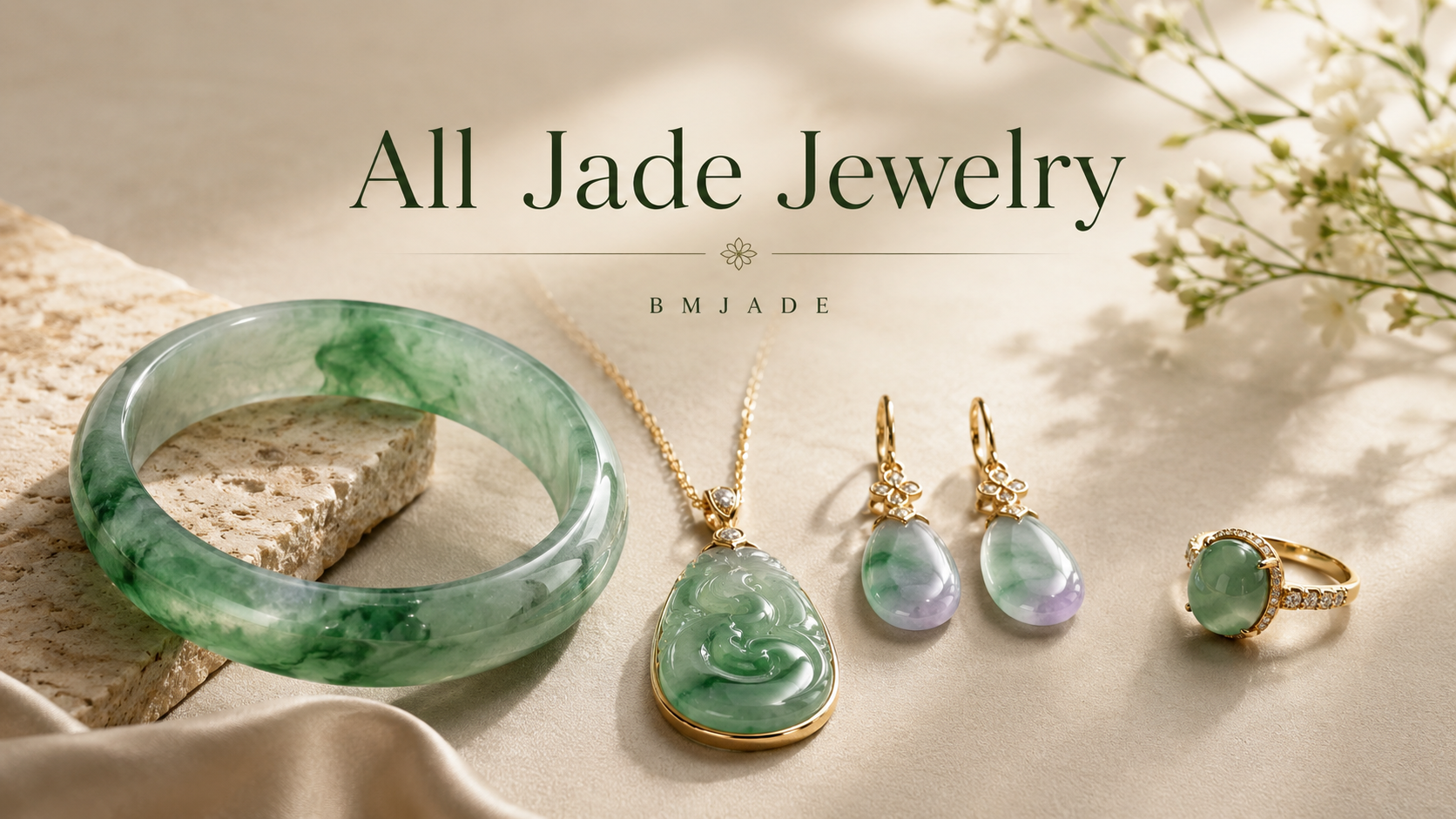
Two great green gemstones, two completely different stories. Emerald is the Western luxury standard — the gemstone of European royalty, Hollywood glamour, and high-end Western jewelry tradition. Jade is the Eastern equivalent — the imperial gemstone of Chinese civilization for over 8,000 years, the material that has carried more cultural weight across human history than any other gemstone. Both are deeply, distinctively green. Both command serious prices at the top of their markets. Both have devoted collectors who would never consider switching to the other.
But choosing between them is not just an aesthetic decision. Jade and emerald differ in nearly every important dimension — composition (one is a silicate beryl crystal, the other is two completely different minerals), durability (counterintuitively, the softer jade is actually tougher), pricing logic (one priced per carat, the other priced per piece), cultural meaning (Western luxury vs. Eastern philosophy), and ideal use case (occasional fine jewelry vs. daily-wear heirloom). A buyer choosing between them without understanding these differences is essentially guessing.
I'm Hong, the founder of BMjade. Over nearly a decade between the Hpakant market in Myanmar and our Kunming workshop, I've worked with customers who arrived knowing only one of these two stones and left understanding both — and crucially, understanding which one was right for their specific situation. This guide is for the buyer making that decision now: someone deciding between an emerald ring and a jade pendant for a meaningful gift, choosing between an emerald and jade engagement ring, or simply trying to understand whether the premium for emerald is justified for their use case.
This article gives you the complete framework. We'll walk through: what each stone actually is at the mineral level, the durability paradox (hardness vs. toughness), the pricing logic for each (per-carat vs. per-piece economics), cultural and symbolic differences, what each stone is best for (and worst for), the buyer profiles each suits, treatment and certification differences, and how to choose between them for specific use cases. By the end, you'll know whether you should be looking at emerald, jade, or both — and you'll be able to make the choice with confidence.
For the broader jade foundation underneath this comparison, see our complete primer on jade as a material. For the cultural depth that distinguishes jade as a category, see our complete guide to jade meaning across civilizations.

What each stone actually is
The fundamental difference starts at the mineral level. This isn't trivial detail — it determines everything that follows.
Emerald
Emerald is a single mineral: a variety of the gemstone beryl (chemical formula Be₃Al₂Si₆O₁₈), colored green by trace amounts of chromium and sometimes vanadium. The crystal structure is hexagonal — long prismatic crystals that grow in pegmatite veins and hydrothermal formations.
The mineral beryl itself can produce other colored stones: aquamarine (blue beryl), morganite (pink beryl), heliodor (yellow beryl), and red beryl. What makes a beryl crystal specifically an "emerald" is the presence of chromium creating the characteristic deep green color.
Where emerald comes from: Colombia produces the most prized emeralds in the world — and according to industry data, Colombia supplies between 60% and 80% of the global colored emerald market. Other significant sources include Zambia (known for slightly bluer-green tones), Brazil, Ethiopia (an emerging source with high-quality material discovered in 2016), Russia, and Afghanistan.

Jade
"Jade" is the umbrella name for two completely different minerals that look superficially similar:
Jadeite (chemical formula NaAlSi₂O₆) belongs to the pyroxene mineral group. It forms under high-pressure, low-temperature conditions in subduction zones where one tectonic plate dives beneath another. Jadeite has a monoclinic crystal structure with blocky interlocking crystals. Imperial jadeite — the most prized variety — shows intense emerald-green color with semi-translucency.
Nephrite (chemical formula Ca₂(Mg,Fe)₅Si₈O₂₂(OH)₂) is a variety of the amphibole minerals tremolite and actinolite. It forms in serpentinite and metamorphosed limestones. Nephrite has a monoclinic crystal structure with fibrous interlocking crystals, creating its famous toughness.
Where jade comes from: Approximately 95% of gem-quality jadeite comes from the Hpakant region in Kachin State, Myanmar (Burma). Significant nephrite deposits exist in China (Hetian region of Xinjiang, the source of the most prestigious historical Chinese jade), Russia, New Zealand (where Māori cultures call it pounamu), Canada, and the United States. The two materials, jadeite and nephrite, weren't even recognized as different minerals until 1863, when French mineralogist Alexis Damour published the distinction.
For the deeper background on jade's geological formation and origins, see our comprehensive guide to what jade actually is.

The durability paradox — hardness vs. toughness
This is the most counterintuitive and important comparison between the two stones. Understanding it requires distinguishing two separate physical properties.
Mohs hardness (resistance to scratching)
Emerald: 7.5-8 on the Mohs scale
Jadeite: 6.5-7 on the Mohs scale
Nephrite: 6-6.5 on the Mohs scale
By this measure, emerald is harder. It is more resistant to surface scratches, which means an emerald ring worn for 25 years will show less visible scratching on its surface than a jade ring worn for the same period (with similar handling).
Toughness (resistance to breaking, chipping, fracturing)
Emerald: Poor to Fair
Jadeite: Exceptional
Nephrite: Exceptional (highest toughness of any gem material)
By this measure, jade dramatically wins. The reason: emerald's hexagonal crystal structure has imperfect cleavage and most emeralds contain natural inclusions (called jardin — French for "garden") and surface-reaching fractures. These structural weaknesses make emerald prone to chipping and fracturing under impact. According to The Natural Emerald Company, emeralds "often contain inclusions which can make them more prone to chipping and fractures under stress."
Jade's interlocking crystal structure — blocky in jadeite, fibrous in nephrite — distributes impact across many connected crystals rather than allowing fractures to propagate. Nephrite specifically has the highest toughness of any natural gem material, making it the historical favorite for carved weapons (Māori mere pounamu war clubs) and ritual objects (Chinese Neolithic bi discs).
What this means in practice
The Natural Emerald Company and the International Gem Society both arrive at the same practical conclusion: emeralds are best suited for earrings, pendants, and occasional-wear rings. Protective settings (bezels, halos) are recommended for emerald rings. Jade is ideal for bangles, bracelets, and daily-wear pieces — including the constant-wear bangles that have been the classical Chinese woman's jewelry for centuries.
A 30-year-old emerald engagement ring worn daily by an active wearer will likely show damage to the stone — chips, fractures, surface marks. A 30-year-old jade bangle worn daily by an active wearer will likely show a beautiful patina, with the stone itself intact. The toughness difference is real and significant.
For an emerald engagement ring, this means: choose a protective setting and remove the ring for activities involving impact. For a jade ring or bangle, daily wear is the historical norm and the piece will accumulate beauty rather than damage across decades.

Pricing logic — completely different systems
The pricing structures of emerald and jade are not just different in amount; they're different in type. Understanding this matters when comparing piece values.
Emerald pricing — per carat, highly standardized
Emerald is priced per carat using standardized 4Cs grading (cut, color, clarity, carat weight), similar to the diamond system. The most important factor for emerald is color — specifically the saturation, tone, and pure green hue.
According to current industry data:
Commercial-grade emerald: $50-500 per carat
Good-quality emerald: $500-3,000 per carat
Fine-quality emerald: $3,000-15,000 per carat
Investment-grade emerald: $15,000-50,000+ per carat
Top Colombian (vivid green, high clarity): Up to $100,000+ per carat
Record top emeralds: $300,000+ per carat for exceptional Colombian "Muzo green" pieces
A 5-carat fine emerald can carry a price tag of $15,000-75,000 depending on quality. Pricing is reasonably predictable within grade categories.
Jade pricing — per piece, with seven multiplicative factors
Jade pricing is fundamentally different. Jade is priced per finished piece, not per carat, with pricing determined by seven multiplying factors: material type (Type A vs treated), color saturation, translucency, texture, carving quality, size, and rarity. Two pieces of the same weight can differ in price by 100x or more depending on these factors.
For comparable green gemstone material:
Commercial-grade jadeite (small pendants, modest material): $50-500 per piece
Good-quality apple green jadeite (pendants, smaller bangles): $500-3,000 per piece
Fine-quality imperial-tinged jadeite (master carvings, bangles): $3,000-15,000 per piece
Imperial green jadeite (top color, fine translucency): $15,000-100,000 per piece
Top imperial green (museum-quality, master-carved): $100,000-3,000,000+ per piece
Record top jadeite: Up to $3,000,000+ per carat equivalent for exceptional Burmese imperial pieces
The Hutton-Mdivani Necklace — sold at Sotheby's Hong Kong in 2014 for US$27.4 million — illustrates the top of the jade market. At its weight, this works out to approximately $3,000,000 per carat-equivalent, exceeding all but the very rarest emeralds.
Bottom-line pricing comparison
For typical retail purchases ($1,000-$10,000 budget), emerald usually delivers more "stone size" per dollar than fine jade. A $5,000 emerald pendant typically features a larger center stone than a $5,000 jade pendant of comparable visual prestige.
For top-tier purchases ($50,000+), the comparison flips. Top imperial jadeite can rival or exceed the per-carat prices of top emeralds, sometimes dramatically. The Hutton-Mdivani sale shows that the very top of the jade market has structurally exceeded most of the emerald market.
For pricing context specifically on jade across every quality tier, see our complete 2026 jade pricing framework. For the seven factors that drive jade's pricing complexity, see the complete analysis of why jade commands its prices.

Cultural and symbolic differences
Beyond physical and economic factors, jade and emerald carry vastly different cultural weight. This dimension is often the most important for buyers choosing a meaningful piece.
Emerald's cultural framework
Emerald has been valued across multiple civilizations — ancient Egypt (Cleopatra famously favored emeralds), the Roman Empire, Mughal India, and modern Colombia. In Western tradition, emerald carries symbolism of:
- Rebirth and renewal (associated with spring and youth)
- Love and loyalty (traditional gift for the 20th and 35th wedding anniversaries)
- Wisdom and intuition (connected to Mercury in Vedic astrology)
- The May birthstone — formally on the modern Western birthstone chart since 1912
Emerald is one of the "big four" precious gemstones along with diamond, ruby, and sapphire. It carries the prestige of Western royalty (notable in royal jewelry collections from the British Crown Jewels to the Cartier and Bulgari archives) and Hollywood glamour (Elizabeth Taylor's emerald collection is legendary).
The cultural depth is real and significant, but emerald's continuous prominence is largely a Western tradition, with Mughal Indian and South American Indigenous contributions.
Jade's cultural framework
Jade carries a fundamentally different and more extensive cultural framework. The depth is hard to overstate:
- 8,000+ years of continuous Chinese veneration — from Neolithic ritual objects (Liangzhu and Hongshan culture bi discs and cong tubes, dated to 3,500 BCE) through every Chinese dynasty to today
- Confucian symbolism — Confucius (551-479 BCE) explicitly compared the qualities of a gentleman to the qualities of jade in his classical commentary
- Imperial Chinese authority — for over 2,000 years, the imperial seal was carved from jade
- Mesoamerican civilization — Maya, Olmec, and Aztec civilizations independently developed jade traditions; jade was more valuable than gold to these civilizations
- Māori New Zealand — pounamu (jade) has been the most precious material in Māori culture for centuries
- Buddhist symbolism — across Chinese, Japanese, Korean, and Southeast Asian Buddhist traditions, jade carries protective and spiritual meaning
Symbolically, jade represents:
- The Five Cardinal Virtues in Confucian tradition (benevolence, righteousness, wisdom, courage, integrity)
- Yin-yang harmony — perfect balance of complementary forces
- Protection — believed to absorb misfortune that would otherwise strike the wearer
- Longevity and cross-generational continuity — the gemstone most often passed across generations
- Spiritual cultivation — the material that "improves with wearing"
For comprehensive cultural background, see our master guide to jade meaning across civilizations.
What this difference means practically
Choose emerald when you want a stone with prestigious Western jewelry tradition and recognized luxury cultural weight — particularly meaningful for May birthdays, 20th or 35th wedding anniversaries, or pieces that will be integrated into a Western jewelry collection.
Choose jade when you want a stone with the deepest possible human cultural continuity — particularly meaningful for cross-cultural gifting, heirloom pieces intended to pass across generations, or buyers drawn to the philosophical and symbolic depth that has accumulated across 8,000 years.
Both are valid. The cultural difference is real, and the choice should reflect which framework genuinely resonates with you and the intended recipient.

What each stone is best for
The differences above translate into different optimal use cases. Match the stone to the use, and you'll choose well.
Where emerald excels
Engagement rings (with caveats). Emerald is harder than jade, making it more scratch-resistant for daily wear. The combination of beauty, hardness, and Western tradition makes it an established alternative to diamond. Caveat: emerald's poor toughness requires protective settings (bezels or halos) and removal during impact activities. For the broader engagement ring discussion, see our complete jade engagement ring guide which contrasts these factors directly.
Statement pendants for formal wear. Emerald's brilliance and color saturation make it visually dramatic in pendant settings for formal occasions.
Earrings. The frame-the-face position of earrings showcases emerald's brilliance. Lower impact risk than rings makes durability less of a concern.
Investment-grade pieces in established Western collections. For buyers building investment-grade Western jewelry collections, top Colombian emerald has clear market liquidity through Western auction houses and dealers.
The May birthstone tradition. For someone born in May, emerald carries the formal birthstone tradition with all its accumulated cultural weight.
Where jade excels
Daily-wear bangles and bracelets. Jade's exceptional toughness makes it the historical champion of daily-wear jewelry. A jade bangle worn for 50 years often looks more beautiful than the day it was first received.
Heirloom pieces intended for cross-generational passing. Jade's traditional role across thousands of years has made it the gemstone most often passed from grandmother to mother to daughter. The patina developed across decades adds to the value rather than detracting from it.
Carved figurative pendants and statement pieces. Jade's toughness allows for intricate carving impossible in more brittle gemstones — the master-carved Pixiu, Buddha, Guan Yin, and dragon figures that anchor our 12 pendant carvings master guide cannot be replicated in emerald.
Men's jewelry. Jade's cultural acceptance in men's jewelry (covered in our complete men's jade jewelry guide) is far broader than emerald's. Men's jade bracelets, pendants, rings, and cufflinks have continuous historical tradition; men's emerald jewelry is largely limited to cufflinks and tie pins.
Cultural and spiritual symbolism. For buyers who want a stone whose primary value is symbolic depth rather than Western luxury prestige, jade is the clear choice.
Anniversary jade specifically. Jade is the modern gemstone for the 12th wedding anniversary (alongside pearl) and the 35th anniversary (alongside coral). For these milestones, see our complete jade anniversary gift guide.
When the choice is ambiguous
For some use cases, both stones work equally well and the choice comes down to personal aesthetic preference and cultural resonance:
- Pendants worn occasionally for formal occasions
- Earrings for any context
- Statement rings worn carefully
- Gift pieces where the recipient hasn't expressed strong preferences
In these cases, the decision often reduces to: do you want Western luxury prestige (emerald) or Eastern cultural depth (jade)? Both are legitimate and beautiful.

Treatment and authentication differences
Both emerald and jade face significant treatment issues in the market. Understanding these differences helps you avoid problematic purchases.
Emerald treatments
Most emeralds undergo treatment to improve appearance. The most common is oiling — filling natural surface-reaching fractures with colorless oil (cedar oil, palm oil, or synthetic resins) to reduce their visibility and improve clarity. This treatment is so universal that emeralds without any treatment are explicitly labeled "no oil" and command price premiums.
Treatment categories for emerald (based on GIA guidance):
- No oil / Insignificant treatment — most prestigious, command 20-50% price premiums
- Minor treatment — light oil enhancement
- Moderate treatment — meaningful oil/resin enhancement, common in commercial pieces
- Significant treatment — heavy enhancement, lowest tier
Emerald treatment is disclosed and graded by GIA in standard certification. Properly oiled emerald with full disclosure is considered legitimate; undisclosed heavy treatment is not.
Jade treatments
Jade treatment categories are completely different and arguably more problematic:
Type A — natural untreated jadeite. The only category that holds value and the only one BMjade sells.
Type B — acid-bleached and polymer-impregnated. The treatment dramatically improves appearance but the polymer degrades over years to decades, with the stone visibly yellowing and developing structural problems.
Type C — dyed. The dye fades over months to years, with the piece losing color steadily.
Type B+C — both treatments combined. Both degradation problems compound.
The key difference: emerald treatment (oiling) is reversible and primarily affects appearance, while jade Type B and C treatments are irreversible and progressively damage the stone over time. A treated emerald looks similar in 20 years; a Type B jade visibly degrades.
This makes jade treatment more consequential. For an investment piece or heirloom-intent purchase, untreated emerald and Type A jade are essential standards; treated emerald is acceptable with disclosure, while treated jade is generally not acceptable for serious purchase.
Certification standards
Emerald: GIA (Gemological Institute of America) is the global standard for emerald certification. AGL (American Gemological Laboratories) and SSEF (Switzerland) are also highly respected for emerald origin and treatment grading.
Jade: NGTC (National Gem Testing Center) is the global standard for jadeite specifically, with deeper expertise than GIA in this material category. GIA also certifies jadeite, but NGTC is the Asian market standard. For the complete comparison, see our analysis of NGTC and GIA as jade authentication authorities.
For any serious purchase of either gemstone, insist on certification from these authoritative laboratories with verifiable serial numbers.

Buyer profiles — which stone for whom
Based on the comparisons above, here are the buyer profiles for each stone:
You should probably choose emerald if...
- You're building a Western luxury jewelry collection alongside diamonds, rubies, and sapphires
- You want a stone with formal modern Western birthstone tradition (May)
- You prefer per-carat pricing transparency for investment evaluation
- You're focused on engagement rings or earrings specifically
- You appreciate the Western royal and Hollywood luxury association
- You're celebrating a 20th or 55th wedding anniversary (emerald's traditional years)
- You want a stone with strong global liquidity through established Western markets
You should probably choose jade if...
- You want a stone with the deepest possible cultural and philosophical tradition (8,000+ years)
- You're choosing for daily-wear pieces (especially bangles, bracelets)
- You appreciate the idea of a stone that improves with wearing
- You're interested in carved figurative jewelry (Pixiu, Buddha, dragon, etc.)
- You're buying for a Chinese, Asian, or Asian-American recipient (or self)
- You want cross-generational heirloom potential with strong tradition
- You're celebrating a 12th or 35th wedding anniversary (jade's modern gemstone years)
- You want gender-neutral or men's jewelry with strong cultural tradition
- You're drawn to the March mystical birthstone tradition (jade is the mystical birthstone for March)
When both work equally well
For occasional-wear formal pendants, earrings, and gift pieces without specific cultural framing, both stones are excellent choices. Choose based on:
- Which color appeals more to you visually
- Which cultural tradition resonates more
- Which price logic fits your budget approach
- Which recipient profile matches better
There's no universally "better" stone — emerald and jade are simply different choices serving different needs.

Mixing jade and emerald in jewelry collections
For collectors building serious jewelry collections, the question often isn't "jade or emerald" but rather "how do they fit together?" Several approaches work:
Building a complete green-gemstone collection. Some collectors actively acquire both — one emerald engagement ring with one jade wedding band, for instance, or jade everyday jewelry alongside emerald statement pieces. This approach honors both traditions without choosing between them.
Cross-cultural marriage jewelry. For couples blending Asian and Western family traditions, sometimes the engagement ring is emerald (per Western tradition) while the wedding bands or anniversary pieces incorporate jade (per Asian tradition). This works beautifully and signals both cultural respects.
Different stones for different life stages. Some buyers choose emerald for youth and prestige-focused life phases, then move toward jade as they age into the deeper cultural and philosophical resonance jade carries. Both stones genuinely serve different psychological moments well.
Avoiding stone competition. When wearing both stones simultaneously, separate the pieces (emerald earrings + jade pendant rather than emerald earrings + emerald pendant + jade bracelet). The two stones can compete visually if placed too close together; separated, they complement.

Common buyer questions and concerns
"Is emerald really worth the higher price?"
It depends on the comparison. For top-tier pieces, emerald often does cost more than equivalent-quality jade per carat — but jade's value proposition includes daily-wear toughness, cultural depth, and the unique improvement-with-wearing property that emerald doesn't share. "Worth it" depends entirely on your priorities.
For most retail purchases ($1,000-10,000), emerald typically delivers more visible "stone" per dollar; jade typically delivers more accumulated cultural and symbolic value per dollar. Neither is universally "worth more."
"If jade is so much more durable, why is emerald more famous in the West?"
Three reasons combine:
- Western marketing dominance — emerald's prominence in Western royalty, Hollywood, and luxury marketing has shaped Western awareness
- Cultural-historical accident — Western trade routes connected to Colombian emerald deposits earlier and more reliably than to Burmese jade
- Different display preferences — emerald's brilliance shows well in faceted Western settings; jade's depth shows best in cabochon and carved forms that Western jewelry tradition incorporates less
In Asian markets, the perception is reversed — fine jade often commands more cultural prestige than equivalent emerald. The "Western perception that emerald is more prestigious" is genuinely Western, not universal.
"Which stone is better for a long-term investment?"
Both stones can appreciate at the top tier. Top Colombian emerald has well-established Western auction-market liquidity through Christie's, Sotheby's, and other major houses. Top imperial jadeite has equally established Asian auction-market liquidity, with Hong Kong Sotheby's and Christie's representing the major channels.
Historically, top imperial jadeite has appreciated faster than equivalent emerald over the past 30 years, driven by growing Asian wealth and continued cultural demand. The Hutton-Mdivani sale's 26-year appreciation curve illustrates this. But both markets can fluctuate. For serious investment, both require authentic top-grade material with rigorous certification — not mid-tier material that doesn't enter investment-grade categories.
"Are lab-created emeralds an alternative to jade?"
Lab-created emeralds exist (companies like BIRON Gems produce them at significantly lower prices than mined emerald) and are chemically identical to natural emerald. They are excellent affordable alternatives to natural emerald.
However, lab-created emeralds are not an alternative to jade. They are still emerald — same color category but completely different cultural framework and material properties from jade. If you want jade specifically (for its cultural meaning, daily-wear properties, or carving traditions), lab-created emerald doesn't substitute.
"Can I just have both?"
Absolutely, and many collectors do. The choice between jade and emerald often becomes "which first" or "which now" rather than "either/or." Building a jewelry collection that includes both honors both traditions and gives you the right stone for different occasions and pieces.
Frequently asked questions
Is jade or emerald more valuable?
Depends on the specific pieces being compared. Mid-tier emerald typically costs more per carat than equivalent mid-tier jade. Top imperial jadeite can rival or exceed top Colombian emerald per carat — the Hutton-Mdivani Necklace's $27.4 million sale demonstrates jade's top-tier value structure. Bottom line: at the very top of both markets, jade can be more valuable; in typical retail purchases, emerald usually costs more.
Which is harder, jade or emerald?
Emerald is harder (7.5-8 on Mohs scale) than jadeite (6.5-7) or nephrite (6-6.5). However, jade is significantly tougher — more resistant to breaking and chipping despite being softer. This means jade is better for daily-wear pieces (bangles, bracelets) while emerald is more scratch-resistant for formal occasions.
Is jade or emerald the May birthstone?
Emerald is the modern Western May birthstone, formally on the National Association of Jewellers chart since 1912. Jade is not on the standard Western birthstone chart. However, jade is the mystical birthstone for March in the older Tibetan-derived tradition. For the complete birthstone framework, see our piece on whether jade is a birthstone.
Can I wear jade and emerald together?
Yes, with thoughtful styling. Both are green gemstones, so wearing them together requires deliberate composition — typically separating them across different jewelry pieces (emerald earrings with a jade pendant, for example) rather than combining them in close visual proximity. Cross-cultural and Asian-Western jewelry collections frequently combine both stones effectively.
Which stone is better for an engagement ring — jade or emerald?
Both work, with different trade-offs. Emerald offers more scratch resistance and stronger Western engagement-ring tradition. Jade offers more toughness for daily wear, deeper cultural symbolism, and genuine uniqueness (every jade stone is one-of-one). For couples drawn to Western tradition, emerald is the natural choice; for couples drawn to cultural depth and distinctiveness, jade. For the complete framework specifically on jade engagement rings, see our jade engagement ring guide.
Why is jade so important in Asian culture but emerald isn't?
Historical and geographical reasons. Jade's primary source (Hpakant, Myanmar, and historical Hetian, China) is in Asia, creating millennia of continuous cultural integration with Chinese civilization. Emerald's primary sources (Colombia, Zambia, Brazil) are in the Americas and Africa, with European trade routes connecting these sources to Western markets primarily. The cultural depth of each stone is rooted in where it was originally accessible. Both stones now exist in global markets, but their cultural roots remain regionally specific.
Can a non-Asian buyer wear jade meaningfully?
Yes, with awareness. Jade has been valued across multiple civilizations (Chinese, Mesoamerican, Māori, and others) and is increasingly worn globally. What matters is approaching the stone with respect for its cultural meaning rather than treating it as exotic decoration. For the complete framework on cross-cultural jade wearing, see our jade jewelry for men guide which addresses cultural respect directly.
Are lab-created versions of both stones available?
Yes for emerald (extensively, including BIRON Gems and others producing chemically-identical lab-created emerald at significantly lower prices). For jade, "lab-created jadeite" exists in limited form but is not widely available and doesn't carry the same cultural traditions as natural Type A jadeite. For cultural and symbolic purposes, natural Type A jade is what carries meaning; for cost-conscious emerald purchases, lab-created emerald is a legitimate option.
Which stone holds value better over decades?
Both top-grade stones (top Colombian emerald and top imperial jadeite) hold value well over decades, with both having strong auction market liquidity. Historical appreciation data over the past 30 years shows top imperial jadeite has appreciated faster than equivalent emerald (driven by growing Asian wealth and demand), but both categories can fluctuate. For mid-tier and entry-level pieces, both stones maintain value reasonably well but don't dramatically appreciate.
Where can I find authentic Type A jade?
For authentic Type A Burmese jadeite jewelry, NGTC certified and hand-finished in our Kunming workshop, see the BMjade collection. For evaluating any jade seller (including BMjade), see our complete buyer's guide to authentic jade online.
Conclusion
Both jade and emerald deserve respect as extraordinary green gemstones, and the right choice depends entirely on your priorities. If you've worked through this guide and concluded jade is right for you, I'd be honored to help you find the right piece. Email me directly at jadeworldchina@outlook.com — Hong.