Is Jade a Good Investment in 2026? An Honest Sourcer's Read

|Hong

In nine years of buying jadeite at the Hpakant market in Myanmar, I've watched the same conversation play out hundreds of times. A new buyer arrives, having read somewhere that "jade is a great investment," and asks me which piece will appreciate the most. I tell them the truth that most jade-jewelry websites don't:

Most jade is a poor investment. A small fraction of jade is an extraordinary investment. The difference between the two is enormous, and it's not what most buyers think it is.

This post is my honest read on whether jade belongs in your portfolio in 2026 — based on auction data, my Hpakant sourcing experience, and the asymmetric returns I've watched unfold over the past decade. I'll share what's worked historically, what's working now, what's likely to keep working, and — most importantly — what to avoid even when it looks tempting.

Investment-grade Burmese jadeite pieces — Imperial Green, Lavender, and Icy varieties with NGTC certification

The Track Record — How Top-Grade Jade Has Actually Performed

When evaluating any investment thesis, start with verifiable data. For top-grade jadeite, the auction record provides the cleanest dataset, since auction prices are publicly documented and the same pieces sometimes resurface decades later.

The Hutton-Mdivani Necklace — A 13.7x Appreciation Over 26 Years

The most-cited data point in jade investment is the Hutton-Mdivani Jadeite Necklace — 27 graduated jadeite beads with a Cartier ruby-and-diamond clasp, originally sourced from Burmese Imperial Court material in the 1930s. The piece has been sold publicly three times:

  • 1988: Approximately US$2 million (Sotheby's Hong Kong)
  • 1994: Approximately US$4.2 million (Christie's)
  • 2014: US$27.4 million at Sotheby's Hong Kong, the world auction record for any jade jewelry — still standing as of 2026, listed in Guinness World Records.
27-bead Imperial Green jadeite necklace similar to the record-setting Hutton-Mdivani Necklace at Sotheby's 2014

That's a 13.7x appreciation over 26 years (~10.4% compound annual return), achieved with zero leverage, zero income reinvestment, and no operational complexity beyond storage and insurance.

For context, gold appreciated approximately 6x in the same 1988–2014 window. The S&P 500 returned approximately 10x including dividends. Top-grade jade tracked the equity-market-with-dividends performance — using a single physical asset that required no active management.

The 2020 Imperial Green Necklace — Recent Top-End Activity

2020 Sotheby's Hong Kong Imperial Green jadeite bead and diamond necklace, sold for US$10.4 million

Sotheby's Hong Kong April 2020 auction sold an Imperial Green jadeite bead and diamond necklace for HK$80.7 million (US$10.4 million) after a bidding war between five phone bidders. Eight months earlier, Sotheby's October 2020 sale featured another Imperial Green jadeite bead and diamond necklace at HK$63 million (US$8.12 million). The pandemic year was supposed to be terrible for luxury markets — and yet the very top of the jade market kept moving.

The 2025 Auction Year

In November 2025, Sotheby's Hong Kong sold a 43-bead Imperial Green jadeite necklace (Type A, ~630 carats total) for US$8.1 million, becoming the top lot of the Magnificent Jewels season. Poly Auction Hong Kong sold a separate jadeite-and-ruby bead necklace for HK$36 million (US$4.6 million) in the same window.

For full 2025 market context, see our Jadeite Market 2026 analysis.

Sotheby's Own Position

Sotheby's, which has more skin in the game than any external commentator, has stated publicly that "in the nearly four decades since the landmark November 1985 Hong Kong sale that saw jadeite jewellery catalogued and sold separately from Chinese Works of Art for the first time at Sotheby's, demand for jadeite jewellery has grown remarkably." See their official jade collector's guide.

This is the institutional view from the auction house that handles the largest share of investment-grade jade transactions globally. They wouldn't write that if the evidence didn't support it.


But Most Jade Has Performed Terribly — And Will Continue To

The data above tells the top-end story. Here's the part most "jade is a great investment" articles leave out: the same data that vindicates top-grade jade exposes the rest of the market as a poor investment.

Why Mid-Tier Jade Doesn't Appreciate

A jadeite bracelet bought in 2015 for US$500 from a typical retail store is, in 2026, worth approximately... US$500. Maybe slightly less. Sometimes slightly more, depending on whether the original retailer marked up beyond market value.

Mid-tier jadeite bracelet — beautiful for daily wear but not investment-grade material

Three forces explain this:

1. The mid-tier supply is plentiful. While top-grade Burmese rough is genuinely scarce, mid-grade material is abundant. Hpakant produces large quantities of acceptable-but-unremarkable rough every year. Supply at this tier supports broad availability, not appreciation.

2. Livestream commerce has compressed prices. As documented in academic research from Wiley's Economic Anthropology journal, 90% of jadeite sold on Chinese livestream platforms now goes for under US$140. This pricing has pulled down the mid-tier comparable market dramatically since 2019.

3. Authentication friction kills resale. Even if a mid-tier piece holds value gemologically, the friction of selling it (finding a buyer, providing certification, negotiating price) often costs 20–40% of the piece's value. A piece that "appreciated 20% on paper" can lose net value once you factor in resale costs.

What "Investment-Grade" Actually Means

When auction houses talk about investment-grade jade, they mean a specific subset that meets strict criteria. The accounting framework documented in industry analysis clarifies this: jadeite ranges from approximately US$20 to over US$30,000 per carat. The pieces that appreciate aren't found at the lower end of that range.

Investment-grade jade typically requires:

  • Top color — Imperial Green, high-saturation Lavender, or icy-translucent material
  • Top translucency — Light should pass through and create visible internal glow
  • Type A only — Untreated jadeite verified by accredited lab (NGTC, GIA, HKJSL, SSEF, etc.)
  • Significant size — Investment pieces usually feature stone faces ≥10mm, often ≥15mm
  • Clean workmanship — Hand-finished, well-proportioned, no visible machine marks
  • Provenance documentation — Ideally previous ownership history, especially for resale

In Hpakant terms, this might be 0.5–2% of the total rough that comes out of the market in any given year. Most of the rest is fine for jewelry — just not for investment.


The 2026 Investment Thesis — Why Top-Grade Jade Is Still Attractive

I'm not here to tell you that jade is the best alternative investment in 2026. Stocks have performed better in absolute terms over the past 15 years. Real estate offers leverage and income that jade doesn't. Bitcoin has appreciated faster (with dramatically higher volatility).

Comparison of investment-grade Type A jadeite versus mid-tier material — color, translucency, and texture differences

But for a specific portfolio role — long-duration, inflation-resistant, low-correlation, passion-asset allocation — top-grade jade has five characteristics that work in 2026:

1. Genuine Supply Constraints

Mining permits in Myanmar's Hpakant region have tightened since 2021. Major mines have faced operational disruptions, environmental challenges, and political complications. The 2019 International Growth Centre report documented permit-area expansion through 2018, but the trend since has reversed. Top-grade rough has become demonstrably harder to source — and I see this firsthand on every Hpakant trip.

When top-grade supply tightens while demand grows, prices for the genuinely top tier rise. This is what I observe in the market every quarter.

Hong selecting top-grade jadeite rough at the Hpakant market — investment-grade material has tightened in 2026

2. Asian Wealth Demographics

China's high-net-worth population continues to grow. Hong Kong, Singapore, and Taiwan family offices increasingly view top-grade jadeite as part of multi-generational wealth preservation — analogous to how Western family offices view fine art or rare wine. The 2024 China Jewelry Industry Development Report (referenced in JNA Jewellery News Asia) confirms certified Type A pieces specifically grew 28% year-over-year in 2024.

Critically, this demand isn't generational. Younger Asian buyers under 35 increasingly view top-grade jade as investment, not just decoration. The buyer base is widening, not narrowing.

3. Inflation Resistance Through Tangible Scarcity

Like fine art, classic cars, and rare coins, top-grade jade derives value from physical scarcity rather than monetary measurement. According to the Knight Frank Luxury Investment Index 2025, passion assets including investment jewelry continue to attract substantial capital. Jadeite isn't featured in Knight Frank's index by name, but it shares the structural characteristics of the alternative asset categories that are.

4. Low Correlation with Public Markets

The auction data above shows top-grade jade appreciating through 2008–2009 (financial crisis), 2020 (pandemic), and 2022–2023 (Chinese property slowdown). The piece sold by Sotheby's for US$10.4 million in April 2020, in the depths of pandemic uncertainty, demonstrates that top-grade jadeite isn't behaving like traditional risk assets. For a portfolio role focused on diversification, low correlation matters more than absolute return.

5. The Authentication Infrastructure Has Matured

As I covered in our NGTC vs GIA article, independent lab certification (NGTC, GIA, HKJSL, SSEF) has become both more accessible and more trusted. Investment-grade pieces with verifiable certification are dramatically more liquid in 2026 than they were in 2010 — buyers can verify, sellers can prove, and the friction of high-value transactions has fallen.

This matters because illiquid investments must offer higher returns to compensate for liquidity risk. As jade liquidity improves, the required return premium falls, supporting price appreciation in the certified top tier.


Jade vs Gold vs Diamonds vs Equities — Honest Trade-offs

Asset class comparison — jade vs gold vs diamonds vs equities for portfolio allocation

For buyers actively considering portfolio allocation, here's how top-grade jade compares to common alternatives:

Asset Historical Annual Return Liquidity Storage Cost Tax Treatment (US) Typical Hold
Top-grade jade ~7–12% (selected pieces, 30 years) Low–Medium (auction or specialist) Low (small object, easy storage) 28% collectibles rate 10+ years
Gold (physical) ~7–10% since 1971 High (global market) 0.5–1% annually 28% collectibles rate Variable
Investment diamonds ~3–5% (lower than expected) Medium (specialist market) Low 28% collectibles rate 10+ years
S&P 500 ~10.5% with dividends Very High Negligible 0–20% capital gains 5–20+ years
Real estate ~7–9% with leverage Low 1–3% annually + maintenance Various 7+ years
Fine art (Sotheby's index) ~6–8% top-tier Very Low 1–3% annually 28% collectibles rate 10+ years

The key insights:

Jade is comparable to gold on returns — not better, not worse, with similar tax treatment but worse liquidity. The diversification value comes from the low correlation, not from beating gold's absolute returns.

Jade is competitive with fine art on returns but requires less specialized storage (a small jewelry safe is sufficient, whereas fine art often needs climate control). Jade also has the advantage of being wearable while held — providing aesthetic and personal value alongside potential financial appreciation.

Jade is meaningfully behind public equities for pure return-seeking. Anyone whose primary goal is maximizing wealth growth should weight equities first. Jade's role is portfolio diversification and passion-asset allocation, not primary wealth building.


The Five Rules I Tell Friends Who Ask About Jade Investment

Investment-grade jadeite with NGTC certification — the documentation that preserves value at resale

After nine years of watching this market, here's what I tell people who ask whether to allocate portfolio dollars to jade:

Rule 1: Below US$2,000 Per Piece, Don't Think of It as Investment

At entry-level prices, you're buying jewelry — and you should buy jewelry you love, that fits well, that you'll wear. The aesthetic value is real; the appreciation is roughly zero. This is fine. Just don't tell yourself you're investing.

Rule 2: Only Top-Grade Material Appreciates Meaningfully

Investment-grade means top color (Imperial Green, vivid Lavender, icy translucent), top translucency, Type A only, and significant size. Mid-grade pieces can be beautiful and worth buying — they just don't appreciate the way top-grade does. Don't pay top-grade prices for mid-grade material expecting top-grade returns.

Rule 3: Certification Is Not Optional

For any piece above US$2,000, demand independent NGTC, GIA, or equivalent certification. For pieces above US$10,000, consider dual certification (NGTC + GIA, or NGTC + HKJSL). Without verified documentation, resale is functionally impossible at fair value. The cost of certification is a tiny fraction of the value preservation it enables.

Rule 4: Plan to Hold for 10+ Years

Jade is not a flip. Bid-ask spreads are wide. Auction commissions are 15–25% of hammer price. Specialist private sales involve 10–20% margins. A piece that appreciates 50% on paper over 5 years may net you nothing after transaction costs. Top-grade jade rewards multi-decade holding, similar to fine art and rare coins.

Rule 5: Buy What You'd Be Happy to Wear, Not Just to Sell

This is the rule that has saved more people from buying mistakes than any other. Top-grade jade, even held as investment, should be objectively beautiful — because the same factors that make it beautiful (color, translucency, craftsmanship) are exactly what makes it appreciate. If you're not personally drawn to the piece, you're probably not buying investment-grade material — you're buying speculation dressed as investment.


What to Watch Out For — The Common Investment Mistakes

Six failure modes I've seen repeatedly:

1. Buying treated material as "investment." Type B and Type C jade do not appreciate. They depreciate as they age (resin yellowing in Type B, dye fading in Type C). For complete coverage, see our authentication guide.

2. Trusting "investment-grade" labeling without certification. Sellers throw the term around freely. Without lab verification of Type A status and quality factors, the label is meaningless. See our home tests vs lab certification analysis.

3. Buying at retail markups expecting auction-house returns. A piece bought at retail typically requires 30–50% appreciation just to break even on resale through specialist channels. Auction-comparable returns require auction-comparable purchase prices, which usually means buying at auction or directly from sourcers — not from retail markup.

4. Ignoring transaction friction. As noted: auction commissions (15–25%), insurance during holding (small but non-zero), specialist resale margins (10–20%), and time-cost of finding buyers all eat into returns. A 100% paper appreciation might be 50% net after costs.

5. Falling for "rare red jade" or other novelty claims. Imperial Green, high-translucency Lavender, and certain icy/ glassy varieties have established value histories. Novelty colors and unusual carvings sometimes spike in price short-term but rarely sustain across multi-decade timeframes. Stick to colors with auction history.

6. Buying without provenance documentation. For ultra-high-end pieces (US$50,000+), provenance — previous ownership, exhibition history, original certificates — adds 20–40% to value at resale. Pieces without documented chain of custody trade at meaningful discounts.


The 2026 Forecast — Where Does Top-Grade Jade Go from Here?

I'll be honest about prediction limits: nobody knows what asset prices do over 5–10 year horizons. But based on what I'm seeing at Hpakant, the published market reports, and the auction trajectory, here's my read:

Probable continuations through 2030:

  • Top-grade Burmese Imperial Green and high-translucency Lavender continue appreciating at 5–15% annually
  • The "certified Type A" premium continues widening over uncertified material
  • Hetian Mutton-Fat White nephrite — an underappreciated category in Western markets — continues steady appreciation, particularly for documented Qing-era pieces (a 2023 Hetian mutton fat carving sold for over RMB 5 million at Beijing auction, with per-gram prices exceeding RMB 30,000)
  • Mid-tier jadeite remains compressed with no clear recovery path
Hetian mutton-fat white nephrite — an underappreciated investment category in Western markets

Possible accelerators:

  • Significant supply shock from Myanmar (further mining restrictions, geopolitical escalation) compressing top-grade supply faster than current trajectory
  • Major auction record breaking the Hutton-Mdivani US$27.4M ceiling, validating multi-decade appreciation thesis
  • CIBJO Fei Cui Guide finalization (expected late 2026) standardizing international jade standards and improving cross-border liquidity

Risk factors:

  • Severe and sustained Chinese economic contraction reducing high-net-worth demand at the margin
  • Improved synthetic jade technology approaching natural Type A appearance (currently distant but worth monitoring)
  • Generational shift in Asian luxury preferences away from traditional jade (currently the opposite is observed, but always possible)

Net assessment: top-grade jade has a credible case for continued real-positive returns through 2030, especially relative to the broader collectibles category. Mid-tier and entry-level jade does not.


The Bottom Line — A Sourcer's Honest Recommendation

Should you invest in jade in 2026? It depends entirely on what you mean by "invest."

If you mean "allocate portfolio capital with the goal of compounding wealth," the honest answer is: only at the very top tier, only with proper certification, only with a 10+ year holding horizon, and only as a small portion of a diversified alternative-asset allocation. For most investors, equities and real estate will remain higher-priority capital deployments.

If you mean "allocate passion-asset capital toward something you'll enjoy owning, that has a credible appreciation story, that diversifies away from public markets, and that connects you to 8,000 years of human aesthetic tradition" — then yes, top-grade certified jade has a strong case in 2026.

The mistake is conflating these two. Jade investment makes sense as part of a passion-asset allocation. It rarely makes sense as a primary wealth-building strategy. Anyone selling you the latter version is selling you something I wouldn't sell.

I source jade because I love it. I send every piece to NGTC because authentication matters. I write articles like this one because the difference between buying jade well and buying jade badly is the difference between owning something that compounds in value and something that compounds in regret.

Buy what you'd love to wear. Demand the certification. Hold for a decade. The pieces that meet those criteria will mostly take care of the rest.

— Hong


Frequently Asked Questions About Jade Investment

Has jade really outperformed gold over time?

Top-grade certified Type A jadeite has shown strong long-term appreciation — the Hutton-Mdivani Necklace appreciated 13.7x over 26 years (1988–2014), comparable to gold's ~6x in the same period when accounting for the fact that jade's appreciation came on a single static asset. However, this comparison applies only to top-grade material. Mid-grade and entry-level jade typically does not match gold's performance.

What's the minimum investment for "investment-grade" jade?

Realistically, US$2,000 is the practical minimum for a piece that has any meaningful appreciation potential. Below that, you're buying jewelry — which is fine, but not investment. Pieces in the US$5,000–$50,000 range represent the practical entry point for serious passion-asset jade allocation. Beyond US$50,000, you're entering auction-grade and museum-grade territory.

How does jade compare to investing in fine art?

Returns are roughly comparable for top-grade material. Jade has advantages in storage simplicity (small physical footprint, no climate control requirements) and the ability to wear it during ownership. Fine art has advantages in international acceptance and broader specialist markets. Both are illiquid passion assets requiring multi-decade holding for meaningful returns.

What's the most expensive jade ever sold at auction?

The Hutton-Mdivani Jadeite Necklace at US$27.4 million, sold by Sotheby's Hong Kong in April 2014. The 27 graduated jadeite beads (15.4–19.2mm) were sourced from Burmese Imperial Court material in the 1930s by Cartier. The piece is now part of the Cartier Heritage Collection and remains the world auction record as of 2026.

Is buying jade a good way to hedge against inflation?

Top-grade tangible assets like jade have historically maintained value through inflationary periods, similar to gold and fine art. The mechanism is physical scarcity rather than monetary measurement. However, jade is significantly less liquid than gold, so it serves inflation-hedge purposes only over multi-year horizons — not for short-term inflation reactions.

Why doesn't middle-tier jade appreciate?

Mid-grade jade supply is plentiful, livestream commerce has compressed prices since 2017, and authentication friction creates resale costs that often eat through paper appreciation. Only the top 1–2% of jade by quality has the supply scarcity needed to generate meaningful appreciation. Mid-grade pieces are best understood as wearable items with stable value, not appreciating investments.

Should I buy jade rough as an investment?

Generally, no — for retail buyers. Hpakant rough purchases are a specialist business requiring expertise to evaluate stones before they're cut, opened, or polished. The "windowing" process I do at the market is itself a learned skill. Most retail buyers should buy finished, certified pieces rather than rough, where evaluation requires geological judgment beyond casual investment.

What are the costs of holding jade as an investment?

Substantially lower than fine art or real estate. A small jewelry safe (~US$200–500) handles most pieces. Insurance varies but is typically 0.5–1% annually for valuable pieces. Compare that to fine art's 1–3% annual storage and climate control. The main "cost" is opportunity cost — capital tied up in jade isn't earning returns elsewhere — and resale friction when eventually selling.

How do I sell jade I bought as an investment?

Three paths: auction houses (Sotheby's, Christie's, Bonhams, Poly) for pieces above US$10,000+ with provenance; specialist dealers for pieces in the US$5,000–50,000 range; and direct private sale through collector networks. All paths require certification and reasonable provenance documentation. Plan for 6–18 months from listing to sale completion at fair price.

Does BMjade help customers with investment-grade pieces?

Yes. For customers specifically interested in pieces with appreciation potential, we curate a selection of higher-grade pieces and provide additional documentation including detailed translucency photography, color comparison under multiple lighting conditions, and dual NGTC + secondary lab certification on request. Email Hong directly at jadeworldchina@outlook.com to discuss specific investment criteria and budget.


Related Reading

Browse BMjade Investment-Grade Pieces

Every BMjade piece ships with original NGTC certification. For higher-grade selections suitable for long-term holding:

For investment-grade inquiries above US$5,000, contact Hong directly at jadeworldchina@outlook.com.

About the Author

Hong is the founder of BMjade and has been sourcing Burmese jadeite at the Hpakant market since 2016. Based in Kunming, Yunnan, he travels to Myanmar multiple times each year to select rough stones for the BMjade collection. Every piece he selects is independently certified by NGTC. Read more about Hong and BMjade →

Shop by collection

Authentic Jade Bracelets & Jadeite Bangles

Authentic Jade Bracelets & Jadeite Bangles

Authentic Jade Earrings & Jadeite Studs
Real Jade Earrings & Jadeite Studs – S925 Silver, 14K & 18K Gold

Authentic Jade Earrings & Jadeite Studs

Authentic Jade Jewelry — Real Type A Jadeite, NGTC Certified

Authentic Jade Jewelry — Real Type A Jadeite, NGTC Certified

Authentic Jade Necklaces & Jadeite Pendants

Authentic Jade Necklaces & Jadeite Pendants

Authentic Jade Rings & Adjustable Jadeite Rings

Authentic Jade Rings & Adjustable Jadeite Rings

Expert Guides to Jade Jewelry

Jade Insights / News

Market news, auction records, investment analysis, authentication science, and stories from Hong's sourcing trips at Hpakant — for buyers who want to go deeper.

Handmade jade bracelet with linked circle charm and size details

Sizing, meaning, care, and authentication for jade bangles and bracelets. Includes the complete guide to Burmese jadeite varieties.

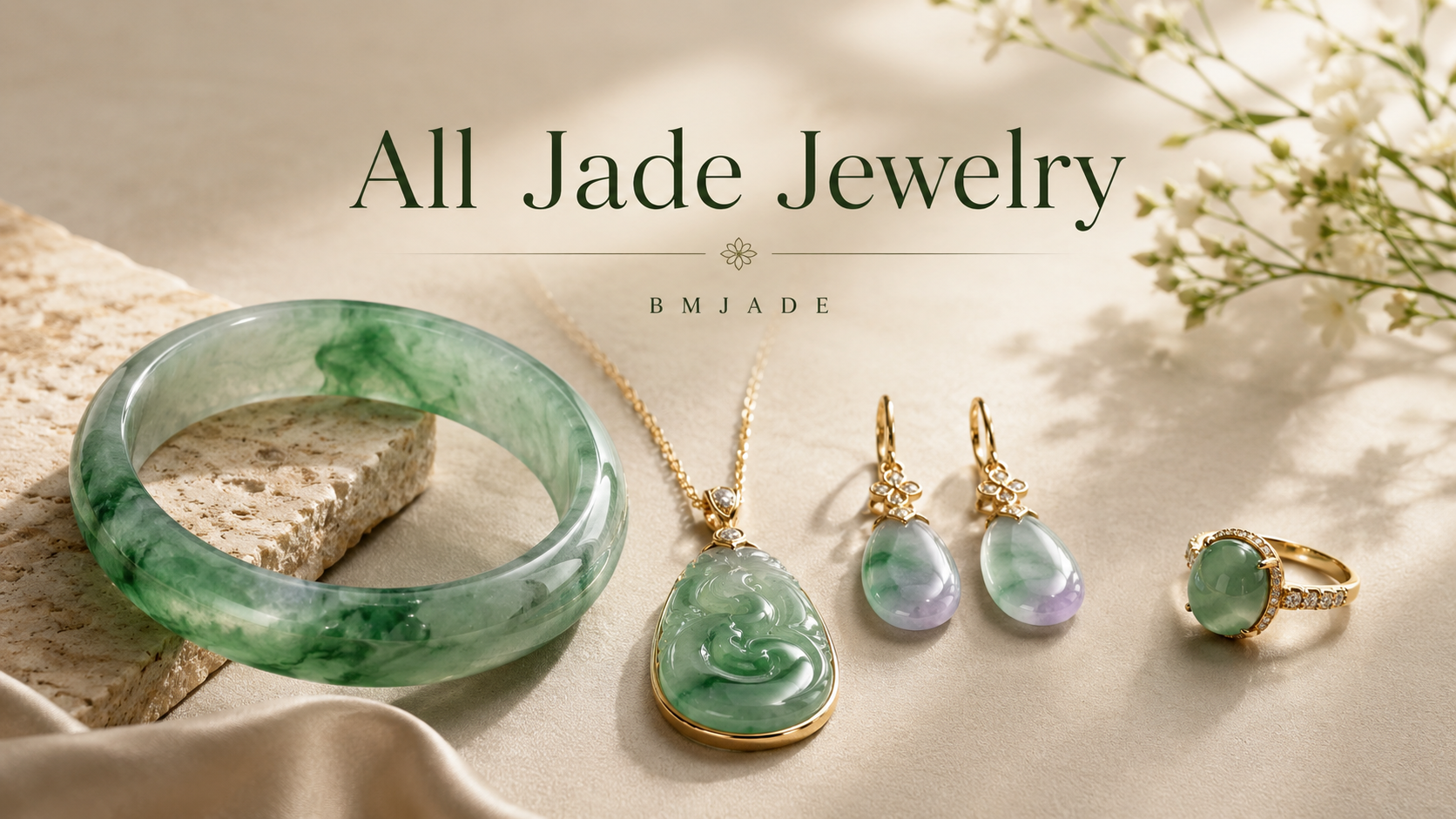
All Jade Jewelry

Style guides for studs, drops, and threaders. Includes hypoallergenic post information and care instructions.

Chain length guides, pendant symbolism, and how to choose between sterling silver and 18K gold settings.

Finger Fit, Ring Size, and Comfort Guide

Ring sizing, finger meaning, adjustable vs fixed-size comparisons, and 6 carving symbolisms explained.