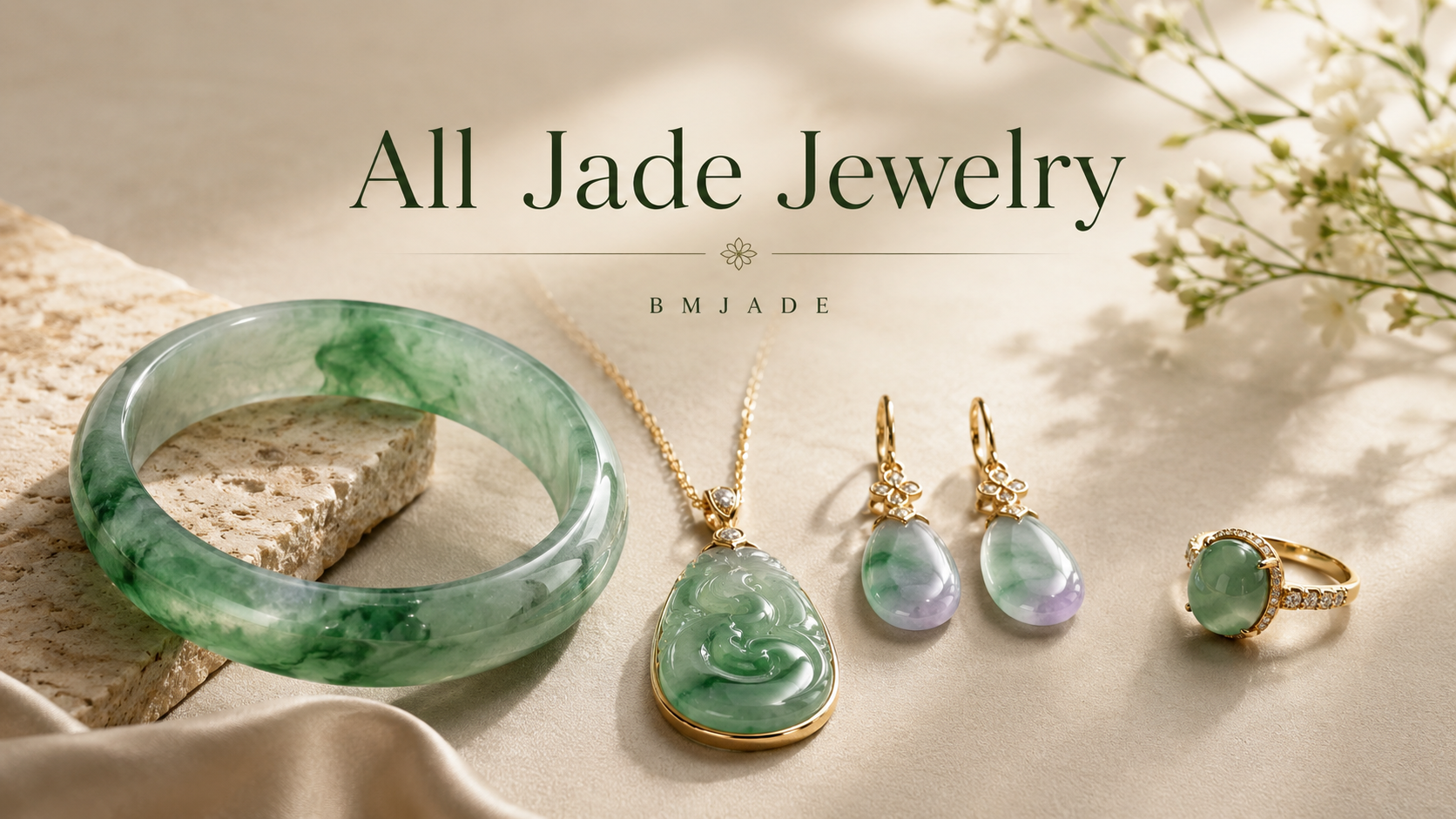
Most people picture jade as one color: a cool green bangle, quietly elegant, faintly translucent. Real jade is far wider than that. A single mine can produce lavender, icy white, honey yellow, near-black, misty blue-green, warm russet, and pieces where four of those colors drift through one stone. If you would like to see the range on actual pieces while you read, our jade bracelets and bangles collection is a useful reference alongside this guide.
The question we hear most often is simply: which color should I choose? Underneath it are usually four others. What does this color mean? Is it worth more or less than green? Will it suit me? And — increasingly, and rightly — is that color even natural?
This guide answers all four, specifically for bracelets. That distinction matters more than it sounds, and the next section explains why.

Color at a Glance
| Color | Traditionally associated with | Typical price position | What to watch for |
|---|---|---|---|
| Vivid green | Growth, prosperity, vitality | Highest | Dye; over-saturated evenness |
| Lavender | Calm, elegance, refinement | High when translucent | Dye pooling in fissures |
| Icy white / colorless | Purity, clarity | Mid to high on texture | Gray cast, dryness |
| Black | Grounding, resilience | Mid | May be very dark green, not true black |
| Yellow / russet | Warmth, abundance | Mid | Muddiness; heat treatment |
| Blue-green | Calm, clarity | Mid to high when clean | Dyed quartz sold as jade |
| Pink | Affection, gentleness | Varies widely | Frequently dyed or not jade at all |
| Multi-color | Balance, completeness | Depends entirely on harmony | Colors that look separated rather than blended |
For the mineralogy behind each hue — which trace elements cause which color, and the Chinese trade names — see our jade colors reference. This guide stays with what color means for a bracelet specifically.
Why Color Behaves Differently on a Bangle
This is the part almost no color guide covers, and it changes how you should shop.
A solid bangle is not cut like other jewelry. A pendant or a cabochon is cut from a piece of rough — the cutter finds the best color in the block and works around it. A bangle is a ring taken out of a slab, and the cutter has to accept whatever color happens to lie along that circle. You cannot move it, concentrate it, or crop it out.
As GIA notes, jadeite's color is often unevenly distributed, which is what gives the material its visual interest. On a flat carving that unevenness is an opportunity. On a bangle it is a constraint, and it produces three recognizable outcomes:
Even color all the way round. Rare, and priced accordingly. For a bangle to be evenly colored, the color has to run consistently through the entire slab the ring was taken from. This is the single biggest reason an evenly colored bangle costs multiples of a patchy one in the same hue.
A color band. Color occupies part of the circumference and fades out across the rest — a green band across a pale ground, for instance. This is extremely common and not a defect. A well-cut bangle positions the band so it sits on the outer face of the wrist, where it is seen.
Floating patches. Discrete drifts of green, blue-green, or lavender suspended in a paler, more translucent body. In the Chinese trade this is prized in its own right, valued on how the patches are distributed rather than on how much color there is.
Two practical consequences:
- Ask for a photo of the full circumference, not one angle. A single flattering photograph of a color band tells you nothing about the other 270 degrees. Any seller who will not show you the whole ring is telling you something.
- Two bangles cut from the same block can look completely different. Rough is often cut into concentric rings, and the color on the inner ring may be nothing like the outer. "Same material, same source" does not mean same appearance or same price.
Green Jade Bracelets
Green is the reference point every other color is priced against, and there is a reason beyond fashion. GIA lists jadeite's three most important qualities, in order of impact on market value, as color, transparency and texture — and among colors, an intense green called imperial sits at the top.
Meaning. Green is associated with growth, vitality, and prosperity — the wood element in Chinese five-element thinking. It is the default choice for a milestone gift, and the color most people mean when they say "a jade bangle."
Range. Green runs from pale, almost celadon tones through apple green and spinach green to the deep saturated color of imperial jadeite. On nephrite it tends toward the muted, oily spinach greens; on jadeite it can reach a vividness nephrite never does.
What actually raises the price. Not depth of color on its own. A dark, opaque green bangle can be worth far less than a paler one with real translucency. What buyers pay for is a green that is vivid and clear and evenly distributed — all three at once, which is why top green bangles are so scarce.
Watch for. Green is the most-dyed color in the trade precisely because it is the most valuable. A green that is uniformly saturated with no variation in tone anywhere around the circle deserves skepticism, not admiration.
Lavender Jade Bracelets
Meaning. Calm, refinement, and quiet elegance. Lavender carries the association of 紫氣東來 — "purple vapor from the east," a classical sign of something auspicious approaching. It reads as gentler and less traditional than green while staying firmly within jade culture.
On a bangle. Lavender is often paler and more diffuse than green, which means color banding shows less abruptly — lavender bangles frequently look more even than green ones at the same grade. Lavender combined with green in one piece (春帶彩) is a recognized and desirable combination.
Value. Very wide range. Pale, chalky lavender with little translucency is entry level. Fine lavender jadeite with saturated color and a glow through the body is one of the most expensive things in the market after top green.
Watch for. Lavender is the second most commonly dyed color. Dyed lavender tends to look flat and slightly gray-violet, and the color concentrates where the stone has fissures. Look at the inner surface of the bangle, which usually gets less polishing attention than the outside.

White and Icy Jade Bracelets
Meaning. Purity, clarity, and restraint. White is the easiest jade color to wear daily because it argues with nothing in a wardrobe.
The material question. "White jade bracelet" covers two different stones. Natural Nephrite Jade — especially Hetian nephrite from Xinjiang — is the white jade of classical Chinese tradition, admired for a warm, almost oily surface. White or near-colorless Natural Jadeite Jade is a different material with a glassier luster and, at high grades, remarkable transparency. Neither is better; they are different appetites. Our Chinese jade varieties guide sets out the differences properly.
Icy jadeite. A near-colorless, highly translucent jadeite bangle — 冰種, "ice type" — is one of the few cases where a bangle with almost no color commands a serious price. With nothing to look at but the material itself, texture and transparency have nowhere to hide.
Value. Judged almost entirely on texture and translucency. A gray, dry-looking white bangle is modest. A clean, glowing one is not.

Black Jade Bracelets
Meaning. Grounding, resilience, and restraint. It is also the easiest jade color for men and the most straightforwardly modern-looking option in the range.
What "black jade" actually is. The term is used loosely. A black bangle may be black jadeite, omphacite-rich material, very dark green jadeite, or black nephrite. The most interesting of these is 墨翠 — material that reads solid black in normal light but glows deep green when you shine a torch through it. That single test is the reason to insist on a backlit photograph: obsidian and dyed stone cannot do it.
Value. Generally mid-range, with fine 墨翠 sitting well above that. Because the color is dense, translucency is judged by transmission rather than by eye.
Styling. Pairs with silver, steel, leather, and dark clothing. Works in bead form and in bangles equally.

Yellow and Russet Jade Bracelets
Grouped together because they usually share an origin.
Meaning. Warmth, generosity, and abundance. Yellow reads as sunnier and less formal than green — a good choice for someone who finds classical jade a bit solemn.
Where the color comes from. In jadeite, yellow and russet tones very often come from iron staining in the outer skin of the boulder (皮壳), which means the color sits toward the surface rather than running through the stone. On a bangle this can be attractive — a warm russet edge against a paler body — but it is worth understanding that you are looking at a skin color, not a body color.
Value. Wide range. The best yellow jade has a honey-like glow; the weakest looks muddy or dry. Russet-and-white combinations are traditionally well regarded.
Watch for. Heat treatment is used to intensify russet tones. This is a treatment, and a certificate should disclose it.


Blue and Blue-Green Jade Bracelets
Meaning. Calm, clarity, and openness. Blue is the color people are most surprised to find in jade, which is a large part of its appeal.
What is realistic. Natural jadeite does produce blue and blue-green, but rarely as a saturated sapphire blue. What you will actually find is 藍水 — a soft, misty blue-green with good translucency and a cool cast. It is genuinely uncommon and genuinely lovely, and it looks nothing like the electric blue in some online listings.
On a bangle. Blue-green tends to be diffuse rather than banded, which suits a bangle well — the color reads consistently around the circle more often than green does.
Watch for. This is a high-risk color. Bright blue "jade" bracelets at low prices are frequently dyed quartz, dyed chalcedony, or dyed marble. Certification is not optional here.

Pink Jade Bracelets: Read This First
We would rather be blunt about this color than sell more of it.
Meaning. Affection, gentleness, and care. As a romantic or younger-recipient gift it is genuinely appealing.
The problem. Strong, attractive pink is not a common natural jadeite color. A large share of products sold as "pink jade" are dyed jadeite, dyed quartz, serpentine, marble, or rhodonite. Natural pink tones in jadeite lean toward pale mauve, blush, or a warm off-lavender — not bubblegum.
How to shop it safely. If a pink bangle is bright, perfectly even, and inexpensive, treat all three as a single warning rather than three separate ones. Ask specifically what the material is, and ask for a report. If the answer is vague — "pink jade stone," "natural pink gemstone" — that vagueness is the answer.
If you love the color, a pale natural lavender with a warm cast often gives you what you actually wanted, and it can be certified as jadeite without qualification.

Multi-Color Jade Bracelets and Fu Lu Shou
Meaning. Balance and completeness — several qualities held in one stone. Because a bangle is a closed circle, a multi-color bangle carries that idea more naturally than a multi-color pendant does.
Three-color jade. Green, russet and white in one piece is traditionally linked to 福祿壽 — blessing, prosperity, longevity. The association is real and old. It is also, in the current market, applied generously to any bangle with three visible colors. A genuine 福祿壽 bangle has three distinct, naturally formed, well-placed colors, not three vaguely different areas.
Value. Depends entirely on harmony, not on the number of colors. Colors should transition into one another the way they formed. Areas that look sharply bounded, as if applied, are a reason to look harder — sharp color boundaries are one of the more reliable signals of dyeing.
Why it suits some buyers. No two multi-color bangles are alike, which makes them appealing if you want something that is unmistakably one piece rather than one of a run. They also tend to offer more visual interest per dollar than a single-color piece of comparable quality.

What Actually Sets the Price
Color is the first thing you see and rarely the thing that decides value. Four factors do more work:
Translucency. How much light travels through the stone. This separates prices more sharply than color does — a pale translucent bangle regularly outprices a strongly colored opaque one.
Texture. How fine and compact the material is. Coarse texture looks dry and grainy under a light and cannot be polished away.
Color distribution. Covered above, and worth repeating: on bangles specifically, where the color is matters as much as what it is.
Treatment status. The largest single variable. Natural Jadeite Jade, Type A means no bleaching, no polymer impregnation, no dye. It is not a quality grade — a plain Type A bangle is still Type A. But a treated bangle is worth a fraction of an untreated one regardless of how it looks, and treated material can degrade over time.
Two bangles of the same color can differ in price by an order of magnitude on these four alone. This is why shopping by color name produces so much confusion: "lavender jade bracelet" is not a product category, it is a description of one variable out of five.
Full pricing breakdown: How much is jade worth.
How to Spot Dyed Color on a Bangle
A bangle is actually one of the easier jade forms to inspect, because you get a full circle plus an inner surface.
- Follow the fissures. Dye migrates into cracks and grain boundaries. If color is noticeably more concentrated along a line or a network of fine lines, that is where the dye went.
- Check the inside of the bangle. The inner surface usually gets less polishing attention than the outer. Color behaves more honestly there.
- Look for a boundary that has an edge. Natural color transitions. Applied color stops.
- Distrust perfect evenness in a strong color. Even color is the rarest and most expensive thing in a bangle. Even color at a low price is a contradiction.
- Backlight it. Especially for black and for anything claiming to be translucent. One torch photo settles more questions than a page of description.
- Read the wording. "Jade color stone," "natural jade type," "grade A jade" with no report — vague material language is itself information.
None of these is conclusive on its own. All of them together are usually enough to decide whether to ask for a certificate before you buy — and for any jadeite bangle at a meaningful price, you should ask regardless.
Testing in depth: how to tell if a jade bracelet is real.
Choosing Your Color
If it is a milestone gift — green or white. Both are unambiguous within the tradition and neither dates.
If it is for daily wear — white, icy, or pale lavender. They go with everything and show grime least.
If it is for a man — black, dark green, or blue-green, and consider bead form as well as a solid bangle.
If you want something no one else has — multi-color or floating-patch, where the piece is genuinely unrepeatable.
If your budget is the binding constraint — buy the best texture and translucency you can afford in a modest color, rather than the strongest color you can afford at poor texture. The first choice ages well. The second stops satisfying quickly.
If the meaning matters most, the color changes the register but not the substance: the symbolism of a jade bangle — protection, character, continuity — belongs to the stone and the circle, not to the hue. Our jade bracelet meaning guide covers that in full, including which wrist to wear it on.
Every BMjade bangle ships with an NGTC report carrying a verifiable serial number, in a gift box, and is covered by our lifetime material guarantee — if the material is ever shown not to match what we stated, we refund the purchase price plus the lab fee plus return shipping.
FAQ
What color jade bracelet is most valuable?
Vivid imperial green, when it also has strong translucency and fine texture. But color alone does not set price — a pale, highly translucent bangle regularly outprices a strongly colored opaque one, and any treated piece is worth a fraction of an untreated one in the same color.
What do the different jade bracelet colors mean?
Green for growth and prosperity, white for purity and clarity, lavender for calm and refinement, black for grounding, yellow and russet for warmth, blue-green for clarity, pink for affection, and multi-color for balance. These are cultural associations, not predicted outcomes.
Why isn't my jade bangle the same color all the way round?
Because a bangle is cut as a ring from a slab and takes whatever color lies along that circle. Uneven color is normal and expected; genuinely even color is rare and priced accordingly. A color band or floating patches are not faults.
Is pink jade real jade?
Sometimes, but strong pink is not a common natural jadeite color, and a large share of "pink jade" in the market is dyed or a different stone entirely. Natural pink tones in jadeite are pale and lean toward mauve or blush. Ask for a report before buying pink.
Is a black jade bracelet real jade?
It can be, but "black jade" is used loosely for several materials. The one worth seeking is 墨翠, which reads black in normal light and glows green when backlit — a test dyed stone and obsidian cannot pass. Ask for a backlit photograph.
Is blue jade natural?
Natural blue-green jadeite exists and is uncommon, but it is misty and soft rather than vivid. Bright, saturated blue bracelets at low prices are usually dyed quartz or chalcedony rather than jade.
Which jade bracelet color suits my skin tone?
Cool-toned wardrobes (gray, navy, silver, white) sit well with white, icy, lavender, and blue-green. Warm-toned wardrobes (beige, gold, brown, cream) suit yellow, russet, green, and multi-color. It is a preference, not a rule.
Is a multi-color jade bracelet worth more?
Not automatically. It is worth more when the colors are natural, well distributed, and blend into one another, and when the texture and translucency hold up. Sharply bounded color areas are a warning sign, not a feature.
What does Type A mean, and does it apply to colored jade?
Type A means natural jadeite with no bleaching, polymer impregnation, or dye. It matters most for colored jade, because color is exactly what dyeing is used to fake. It is a treatment status, not a quality grade — a plain Type A bangle is still Type A.