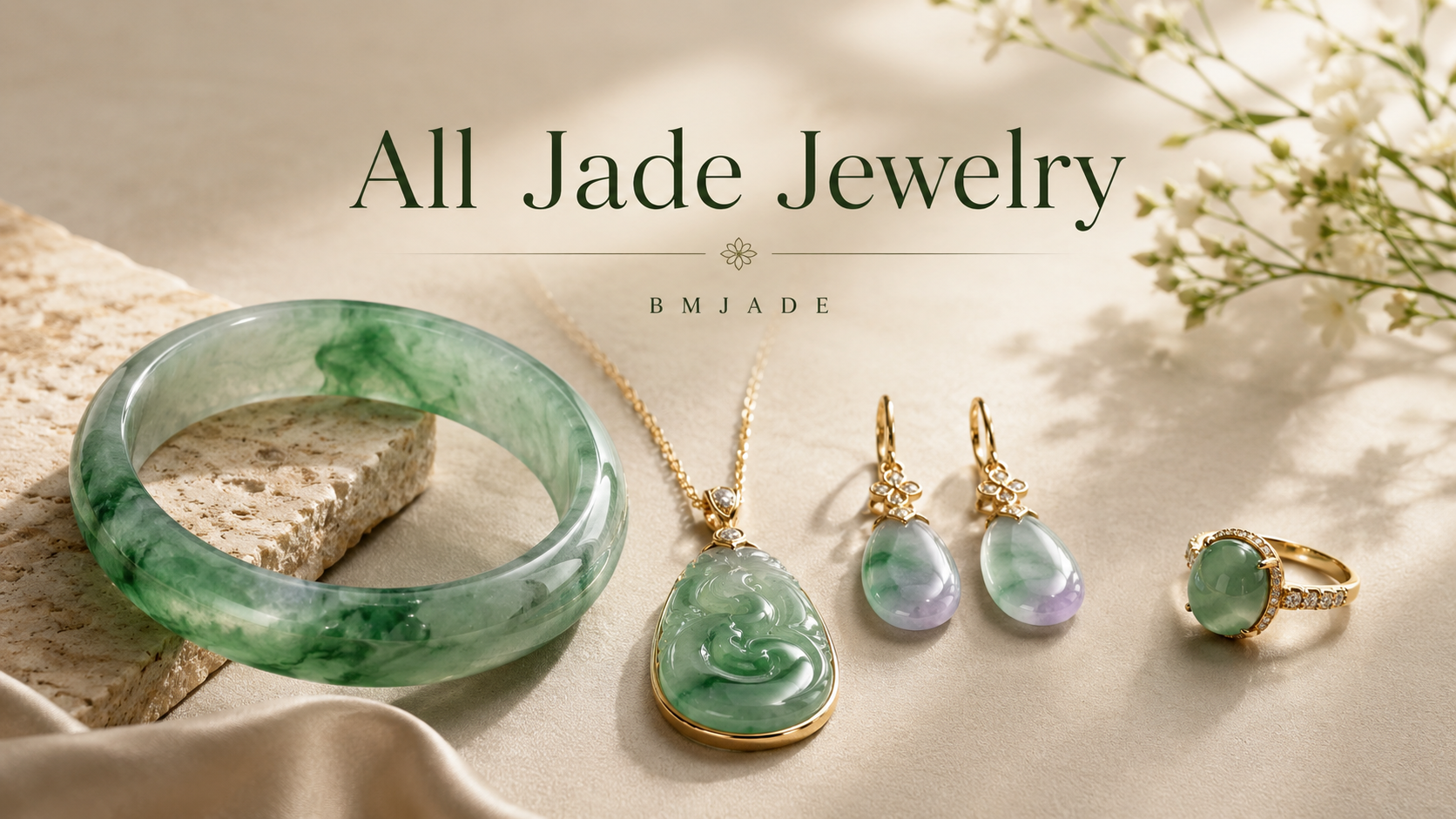
If you're shopping at the upper tiers of jadeite, three category names will keep appearing in product descriptions, auction catalogs, and dealer conversations: imperial green, icy jade, and apple green. These are the three premium categories of fine jadeite — the top of the market where serious buyers, collectors, and investors operate. Understanding the differences between them is essential for anyone considering a significant jade purchase, whether for a meaningful gift, a wedding piece, an investment-grade acquisition, or a collection-defining heirloom.
But these terms are widely misused. Sellers describe modestly-translucent green pieces as "imperial," apply "icy" to anything with visible translucency, and use "apple green" interchangeably for everything from genuine apple green to faded green tones. The result is buyer confusion — and significant price variation for pieces that may or may not actually belong to the category they're labeled in. A buyer paying $30,000 for what's described as "imperial green" should know with certainty what they're actually getting, because the difference between imperial and very-good apple green can mean $50,000 in real value.
I'm Hong, the founder of BMjade. Over nearly a decade between the Hpakant market in Myanmar and our Kunming workshop, I've sourced, evaluated, and worked with pieces across all three of these categories. The pattern in serious customers is consistent: they want precise category definitions, the visual identification criteria that distinguish each, the realistic price ranges, the formation mechanisms that make each category rare, and a framework for choosing between them based on their specific use case. This guide gives you all of that.
This article walks through everything: the precise gemological definitions of each category, the geological formation conditions that create each type, the visual identification criteria, the realistic 2026 pricing across each category, how each category fits different use cases and buyer profiles, the rarity hierarchy and investment implications, and the common misuses and scams to avoid. By the end, you'll be able to evaluate any "imperial," "icy," or "apple green" jade listing with confidence — knowing what you're actually being offered and what it should reasonably cost.
For the broader context of jade pricing and value structure, see our complete 2026 jade pricing framework and our deep dive into jade colors and their meanings. For the seven factors that drive jade pricing at the top tier, see the complete analysis of why jade commands its prices.

The three top-grade jadeite categories defined
Before comparing them, each category needs precise definition. The three are not arbitrary marketing terms; they describe specific gemological realities that determine both rarity and price.

Imperial green jadeite
Definition: The most valued color category in jadeite. According to GIA's official Jadeite Jade Quality Factors documentation, imperial jade is "the most valuable" jadeite color — defined by a specific combination of three properties that must all be present:
- Color — A pure, saturated, vivid green often described as "emerald green" or "Kelly green," with no gray, blue, or yellow undertones. The green must penetrate evenly through the stone rather than appearing as surface staining or color zoning.
- Translucency — Semi-transparent to nearly transparent, allowing light to penetrate several millimeters into the stone and create what's traditionally called a "gelatinous" or "glowing" appearance.
- Texture — Extremely fine-grained crystal structure producing a high luster and smooth, almost glassy finish after polishing.
All three properties together. A piece with vivid green color but poor translucency is not imperial green — it's vivid apple green or another category. A piece with high translucency but pale color is not imperial — it's icy. Imperial requires the full combination, and that combination is genuinely rare.
The Chinese terminology: In Chinese trade, imperial green is called 玻璃种翡翠 (bōli zhǒng fěicuì, "glass-grade jadeite") when the translucency is the highest tier, or 阳绿翡翠 (yáng lǜ fěicuì, "yang green jadeite") when emphasizing the saturated green color. Top imperial pieces meet both terminology criteria simultaneously.
Icy jade (冰种翡翠)
Definition: Jadeite characterized primarily by exceptional translucency, often with subtle or no green color. The defining quality is the transparency — pieces appear like clear ice with semi-translucent or fully translucent depth, allowing significant light penetration.
The Chinese term 冰种 (bīng zhǒng, "ice grade") describes this category specifically. Icy jade exists in multiple color subcategories:
- Icy white (冰种白) — Pure clear translucency with no color, the cleanest aesthetic
- Icy green (冰种绿) — Translucent with subtle green tones, often pale to medium green
- Icy lavender (冰种紫罗兰) — Translucent with subtle lavender hues
- Floating-flower icy (飘花冰种) — Icy base with green or other color "drifting" through the stone like ink in water
The very top tier of icy jade is called glass-grade (玻璃种), where the translucency reaches its maximum and the stone appears almost as transparent as glass. Glass-grade icy is rare even within the icy category and commands top-tier pricing comparable to imperial green.
Apple green jadeite
Definition: Jadeite with a vivid, fresh green color — lighter and brighter than imperial green's deep saturated tone, often with subtle yellow undertones that create the "apple" association (think of the bright green of a Granny Smith apple).
GIA explicitly distinguishes apple green from imperial: imperial is the deepest, most prestigious green; apple green is "an intense yellowish green" that is the next tier down. Apple green pieces typically show:
- Color — Lighter, brighter, fresher green than imperial; often with subtle yellow warmth
- Translucency — Variable, from opaque to semi-translucent; rarely matches imperial's translucency
- Texture — Variable, but quality apple green has fine-grained texture similar to imperial
The category includes pieces ranging from modest commercial-grade apple green (opaque, dull) to top-tier icy apple green (translucent, vibrant) that approaches the prestige of imperial. The most beautiful apple green pieces are often described in trade as "borderline imperial green" — meaning they almost cross the threshold into imperial but fall slightly short in saturation or evenness.
A crucial distinction: these categories can overlap
This matters significantly. The three categories are not mutually exclusive — a single piece can belong to multiple categories simultaneously:
- Icy apple green = a piece with both icy translucency AND apple green color
- Icy imperial green = the rarest category, with both maximum translucency AND imperial green color (essentially "glass-grade imperial")
- Borderline imperial apple green = a piece almost imperial but slightly apple-leaning in color
The overlap creates the most prestigious pieces in the market. A piece that is both icy and imperial is the absolute top of jadeite — what dealers call 玻璃种帝王绿 (glass-grade imperial green), and these are the pieces that sell at major auction houses for millions of dollars.

How each category forms — the geology
Understanding why each category is rare requires understanding the geological conditions that create each. The differences are precise and explain the price differences.
Imperial green formation
Imperial green jadeite requires three specific geological conditions to coincide:
-
Subduction zone metamorphism — high pressure, low temperature conditions where one tectonic plate dives beneath another. These conditions are necessary to form any jadeite at all (NaAlSi₂O₆ crystallizes only at high pressure).
-
Specific chromium content — the chromium that gives imperial green its color must be present in just the right concentration. Too little chromium produces pale or white jadeite; too much chromium prevents crystal formation entirely (chromium interferes with crystal growth at high concentrations). The "sweet spot" of chromium content that produces imperial green color is geologically narrow.
-
Fine-grained crystallization — the crystallization conditions must produce extremely small, evenly-distributed crystals that allow light transmission while maintaining color saturation. Most jadeite formations produce coarser-grained material; the fine-grained conditions necessary for imperial-grade transparency are exceptional.
All three conditions must coincide. This is why imperial green is genuinely rare — it requires a specific intersection of pressure, temperature, chemistry, and crystallization conditions that occurs in only a fraction of jadeite-forming deposits.
The primary source of imperial green is Hpakant in Kachin State, Myanmar (Burma), where the geological conditions historically aligned to produce the world's finest material. Other jadeite deposits (Guatemala, Russia, Japan, California) produce jadeite but rarely produce imperial green-quality material at meaningful volume.
Icy jade formation
Icy jade's defining property — exceptional translucency — comes from extremely fine and uniform crystal structure. The geological requirements:
- Sustained crystallization conditions — the jadeite must form under stable conditions allowing time for crystals to grow uniformly without major disruptions or inclusions
- Pure mineralogical environment — minimal contamination from other minerals that would create inclusions or color zones disrupting transparency
- Slow cooling — rapid cooling produces variable crystal sizes; slow cooling produces the uniform fine-grained texture needed for icy translucency
Icy jade can form across a wider range of color conditions than imperial — it doesn't require the specific chromium "sweet spot" of imperial. This means icy white, icy lavender, and icy pale green are all possible. But icy material in any color is still rare, because the sustained, pure, slow-cooling conditions needed for maximum translucency are themselves geological luxuries.

Apple green formation
Apple green requires sufficient chromium for vivid green color but less of the precise chromium concentration of imperial. Apple green is geologically more common than imperial — chromium-rich jadeite environments can produce apple green more readily than imperial — but quality apple green (fine-grained, evenly-colored, free of major flaws) still requires favorable conditions.
The geological hierarchy by rarity (from rarest to least rare):
- Glass-grade imperial green (the ultimate intersection — extremely rare)
- Imperial green (rare)
- Glass-grade icy (rare)
- Icy in any color (uncommon)
- Top-grade apple green / borderline imperial (uncommon)
- Standard apple green (more common)
This rarity hierarchy directly drives the price hierarchy discussed in the next section.

Realistic pricing for each category in 2026
The pricing differences between these categories are large — sometimes by orders of magnitude. Here's what to expect at realistic market pricing:
Imperial green pricing
Entry imperial green (smaller pieces, modest size):
- Small pendant or ring stone: $10,000-30,000
- Small earring pair: $15,000-40,000
Quality imperial green (substantial pieces, fine quality):
- Pendant cabochon (15-20mm): $30,000-150,000
- Bangle: $50,000-500,000
- Master-carved figure: $50,000-500,000
Top imperial green (museum-quality material):
- Pendant: $150,000-1,500,000
- Bangle: $500,000-5,000,000+
- Statement piece: $1,000,000-10,000,000+
Record imperial green pieces:
- Hutton-Mdivani Necklace (Sotheby's Hong Kong, 2014): $27.4 million for a 27-bead imperial green jadeite necklace
- Doubly Fortunate Necklace (Christie's Hong Kong, 2014): $10.5 million for 27 imperial green beads
- Various imperial green bangles have sold for $2-15 million in recent decade Hong Kong auctions
Imperial green is the price-maximum of the jade market and rivals the very top of any colored gemstone category globally.
Icy jade pricing
Entry icy (smaller pieces, lower-grade translucency):
- Pendant or ring stone: $500-3,000
- Bangle: $1,500-8,000
Quality icy (fine translucency, substantial pieces):
- Pendant cabochon: $3,000-25,000
- Bangle: $8,000-100,000
Glass-grade icy (top translucency):
- Pendant: $25,000-500,000
- Bangle: $100,000-2,000,000+
Icy imperial green (the rarest combination):
- Pricing combines both category premiums — typically $500,000-5,000,000+ for substantial pieces
Icy without imperial color pricing sits significantly below imperial pricing, but glass-grade icy approaches imperial-tier pricing because of its own rarity.
Apple green pricing
Entry apple green (modest pieces, basic quality):
- Small pendant or ring stone: $200-1,500
- Bangle: $800-5,000
Quality apple green (good color, fine-grained, semi-translucent):
- Pendant cabochon: $1,500-15,000
- Bangle: $5,000-50,000
Top apple green / borderline imperial:
- Pendant: $15,000-100,000
- Bangle: $50,000-500,000
Icy apple green (the apple green + icy combination):
- Adds 20-100% premium over standard apple green at equivalent size
- Top icy apple green bangles: $100,000-1,000,000
Apple green has the widest accessible price range of the three categories — from genuinely affordable entry pieces to investment-grade material that approaches imperial pricing.
For complete pricing context across all jade categories (not just these three), see our comprehensive 2026 jade price guide.

How to identify each category visually
Identification is the buyer's most useful skill. Here's what to look for in each category — and what disqualifies pieces from being labeled correctly.
Identifying imperial green
Look for:
- Deep, saturated, pure green — should look like top-quality emerald, no gray, no blue, no yellow undertones (a small amount of yellow shifts it toward apple green; a small amount of gray disqualifies it from imperial)
- Even color distribution — the green should be uniform throughout the stone, not concentrated in patches or surface zones
- Significant translucency — light should clearly penetrate the stone, not just illuminate its surface; in good lighting, the stone should "glow" from within
- Glassy luster after polishing — fine-grained texture produces a mirror-like surface
Disqualifying signs:
- Gray undertones (very common in mislabeled pieces)
- Patchy or uneven color distribution
- Color only visible at certain angles (suggests surface treatment or thin color layer)
- Opaque appearance (imperial is always at least semi-translucent)
- Texture visible as graininess on close inspection (top imperial appears smooth without crystal texture)
The "Kelly green" test: Industry shorthand for imperial green is that the color should match a high-quality Kelly green emerald in deepness and purity. If the green doesn't pass the "could this be a top emerald color" test, it's not imperial.

Identifying icy jade
Look for:
- Significant translucency — light should penetrate clearly through the stone; in optimal lighting, you should be able to see depth as if looking into clear water
- Fine-grained or extremely fine-grained texture — close inspection should show smooth uniform material without visible crystal structure
- Clean appearance — minimal inclusions, foreign mineral spots, or texture irregularities
Color is variable in icy — icy white, icy green, icy lavender, icy floating flower are all legitimate. The defining quality is the translucency, not the color.
Disqualifying signs:
- Opaque or only marginally translucent appearance
- Visible crystal texture or graininess
- Cloudy or milky interior (this is "waxy grade" 糯种, not icy)
- Heavy inclusions disrupting transparency
The "ice cube" test: Top icy jade should genuinely resemble a clear ice cube in transparency and depth perception. If you can't see significant depth into the stone, it's not glass-grade icy (though may still be quality icy at a lower transparency tier).

Identifying apple green
Look for:
- Bright, fresh, vivid green — lighter than imperial, with subtle yellow warmth giving the "apple" quality
- Good color saturation even if not as deep as imperial
- Fine-grained texture in quality pieces
- Translucency variable — quality apple green typically has at least some semi-translucency; the best apple green has icy-grade translucency
Disqualifying signs:
- Color too pale or washed out (suggests lower-grade material)
- Color too dark or too saturated (more imperial-leaning, not apple green specifically)
- Gray undertones (typical of lower-grade green jade, not quality apple green)
- Visible color zones or unevenness in fine pieces
The apple test: Quality apple green should resemble the bright, fresh green of a high-quality Granny Smith apple. The "alive," fresh quality is part of the category's appeal.
Where the categories overlap
The interesting pieces sit at category boundaries:
- Imperial green that's borderline icy — full imperial color with exceptional translucency = glass-grade imperial = the absolute top
- Apple green that's borderline imperial — apple green base with deepening saturation approaching imperial = "borderline imperial" pieces at top auction prices
- Apple green that's icy — apple green color with excellent translucency = highly prized "icy apple green"
- Icy with subtle green tones — translucency dominant, modest green = quality icy green, not apple green specifically
Recognizing these overlaps helps you evaluate listings accurately. A piece described as "icy apple green" is a genuine premium combination; a piece described as "imperial green icy jadeite" is at the very top of the market.
Which category is right for you — buyer profiles
Choosing between these three categories depends on your priorities. Each suits different buyers and different use cases.
Choose imperial green if...
- You're making an investment-grade or heirloom purchase. Imperial green has the strongest appreciation history of all jade categories and the highest auction market liquidity. For pieces $50,000+, imperial green is the natural investment choice.
- You're building a top-tier collection. Serious jade collectors typically anchor their collections with at least one imperial green piece.
- You're celebrating an extraordinary milestone. A milestone gift (50th wedding anniversary, major life accomplishment, significant family moment) that warrants the highest expression of jade tradition.
- The cultural prestige matters. Imperial green carries the deepest cultural weight in Chinese tradition — historically the imperial emperor's stone. For occasions where prestige communication is part of the gift's meaning.
- You appreciate color intensity above all. If the vivid emerald-green saturation specifically draws you, imperial green is what you want.
Choose icy jade if...
- You appreciate purity and clarity above all. Icy's defining quality is the depth and clarity of translucency — the optical depth of looking into clear ice or water. For aesthetic sensibilities valuing this purity, icy is the choice.
- You prefer a modern, minimalist aesthetic. Icy white in particular reads as exceptionally clean and contemporary. Icy pieces integrate beautifully with modern jewelry designs and minimalist style.
- You want top-tier rarity without the prestige expense. Quality icy (non-imperial color) costs significantly less than imperial green while delivering its own form of rarity and beauty. Excellent value for buyers prioritizing material quality over imperial color specifically.
- You're looking for collector category rarity. Glass-grade icy is genuinely rare and increasingly collected by sophisticated buyers who appreciate technical material quality.
- The recipient is younger or has contemporary aesthetic. Younger buyers, fashion-forward wearers, and those favoring modern minimalist aesthetics typically respond more to icy than to traditional imperial green.
Choose apple green if...
- You want vivid green at accessible pricing. Apple green is the most accessible of the three premium categories — entry pieces start around $200-1,500 (versus imperial's $10,000+ entry point). Excellent value across budget tiers.
- You're buying for daily wear. Apple green's vibrant freshness reads as energetic and joyful for daily wear in ways that imperial's deeper gravity sometimes feels too formal.
- You appreciate the "fresh," "alive" quality. The bright, fresh green of apple green carries cheerful, energetic symbolism — different from imperial's regal weight or icy's contemplative depth.
- You're building a collection across price tiers. Apple green allows quality jade collecting from modest budgets through high-end ranges. Many serious collectors own multiple apple green pieces alongside fewer imperial pieces.
- You're choosing for younger wearers. Apple green's bright energy suits younger recipients (children's pieces, young women's jewelry, gifts for new mothers) better than imperial's more mature gravity.
- You want the "borderline imperial" sweet spot. Top-grade apple green that approaches imperial pricing offers most of imperial's beauty at a fraction of the cost — often the best value at the upper-mid market.
When you can mix categories
For collectors building a serious jade collection, owning pieces from all three categories is common and complementary:
- Imperial green statement piece for special occasions and milestone wear
- Icy daily wear pieces for the modern minimalist contexts
- Apple green collection pieces across various occasions and price points
This three-category approach gives the wearer or collector full access to the depth of fine jade rather than committing to a single aesthetic.
For the broader jade gifting framework that may help match category to occasion, see our complete jade anniversary gift guide.

Common misuses and scams to watch for
Because the category names carry significant pricing weight, they're frequently misused. Recognizing the patterns protects you.
Misuse #1 — "Imperial green" applied loosely
Sellers describe modestly-translucent green pieces as "imperial" when the green color falls short of the strict imperial standard. Common cases:
- Apple green pieces labeled "imperial" because of saturation alone (without imperial's translucency)
- Pieces with significant gray undertones labeled "imperial" (true imperial has no gray)
- Pieces with patchy color distribution labeled "imperial" (true imperial has even color)
Protection: Apply the "Kelly green emerald" test. If the green doesn't match a top-quality emerald's saturation and purity, it's not imperial regardless of seller labeling. Demand certification specifying imperial-grade color, not just "natural green jadeite."
Misuse #2 — "Icy" applied to translucent rather than truly icy material
"Icy" is sometimes used for any semi-translucent jadeite, when the term should be reserved for pieces with significant ice-like depth and clarity.
Protection: Look at the actual translucency. Icy jade should show clear optical depth — you should be able to see significantly into the stone. Pieces that are merely "not opaque" are not icy.
Misuse #3 — "Apple green" used for faded or low-grade green
Lower-grade green jade is sometimes called "apple green" to suggest premium category positioning. True apple green is vivid and fresh; faded or dull green is just modest-grade green jadeite.
Protection: Apply the "fresh apple" test. Quality apple green should look like a vivid, fresh Granny Smith apple, not a faded green pepper.
Misuse #4 — Treatment masquerading as top-tier color
Some Type B+C jadeite (acid-bleached, polymer-impregnated, and dyed) is processed to mimic imperial green appearance, then sold as natural imperial. The treated material:
- Looks similar to natural imperial green initially
- Degrades within years (polymer yellows, dye fades)
- Is significantly cheaper to produce than authentic imperial
Protection: Insist on lab certification specifying Type A natural jadeite (not just "natural jadeite," which can technically apply to Type B material). For imperial green specifically, NGTC certification confirming Type A status is essential. For the complete authentication framework, see our piece on why home tests aren't enough to verify Type A jade.
Misuse #5 — Photographic enhancement
Online listings sometimes use photography that exaggerates color saturation, translucency, or both — making mid-tier pieces appear top-tier in photographs.
Protection: Request high-resolution photos in natural lighting, request video footage of the piece rotated under standard lighting, and remember that legitimate sellers' photos may actually understate the stone's beauty (since matte lighting prevents glare misrepresentation), not overstate it.
Misuse #6 — Fake "borderline imperial" claims
"Borderline imperial green" is a legitimate trade term for top apple green approaching imperial. But the term is widely misused for genuinely mid-tier apple green pieces.
Protection: True borderline imperial pieces typically command 50-100% premiums over equivalent-size standard apple green. If a piece is labeled "borderline imperial" at standard apple green pricing, the labeling is questionable.
For the complete framework on avoiding fake and misrepresented jade online, see our complete buyer's guide to authentic jade online.

Investment implications
For buyers considering jade as investment alongside personal use, each category has different investment characteristics.
Imperial green investment profile
Appreciation history: Strong over the past 30 years, with top imperial pieces appreciating faster than most luxury asset classes. The Hutton-Mdivani Necklace's price progression — purchased by Cartier originally, sold at Sotheby's Hong Kong in 1988 for $2 million, and again in 2014 for $27.4 million — illustrates the appreciation potential at the top.
Liquidity: Strong through Hong Kong, Beijing, Shanghai, Taiwan, and Singapore auction houses (Sotheby's, Christie's, Poly, China Guardian). Pieces in the $50,000-$5,000,000 range have active buyer markets.
Risk factors: Demand depends significantly on Chinese economic conditions and luxury spending; political tensions affecting Hong Kong as the primary auction hub; counterfeit and treatment risks if certification is inadequate.
Recommended for investment: Pieces $50,000+ with NGTC certification confirming Type A imperial green status. Below $50,000, the investment dimension is real but more modest.
Icy jade investment profile
Appreciation history: Steady appreciation, particularly for glass-grade material. Less spectacular than top imperial but with strong upside as Asian collectors increasingly appreciate technical material quality.
Liquidity: Building rapidly in Asian auction markets. Glass-grade icy is increasingly recognized as a serious collector category.
Risk factors: Less established auction history than imperial; market value depends more on accurate translucency grading.
Recommended for investment: Glass-grade icy pieces with proper certification. Standard icy is more for personal use than investment specifically.
Apple green investment profile
Appreciation history: Moderate appreciation, strongest in the borderline-imperial subcategory. Standard apple green appreciates with the broader jade market but doesn't dramatically outperform.
Liquidity: Strong at the top tier (borderline imperial) where pieces approach $100,000+. Mid-tier and entry-tier apple green is more for personal wear than investment.
Risk factors: Wider quality variance creates valuation challenges; the line between mid-tier apple green and "borderline imperial" is subjective.
Recommended for investment: Top-tier "borderline imperial" apple green pieces with strong color saturation and fine translucency.
For comprehensive jade market dynamics, see the complete analysis of why jade commands its prices.
Practical purchasing recommendations
Combining everything above into practical guidance:
For a first significant jade purchase ($1,000-5,000 budget)
Focus on quality apple green or quality icy in moderate sizes. Avoid claiming imperial green at this budget — authentic imperial green is essentially impossible at this price point, so listings claiming it are almost certainly treated, mislabeled, or significantly smaller than expected.
A good $3,000 piece in quality apple green or quality icy will be significantly more rewarding than a mislabeled "imperial green" piece at the same price.
For a substantial gift or wedding piece ($5,000-15,000 budget)
This range allows for top-tier apple green approaching borderline imperial, or fine icy with subtle green tones. Match the choice to the recipient:
- Traditional cultural framing → apple green or borderline imperial leans more traditional
- Modern aesthetic → icy reads more contemporary
For investment-grade or heirloom purchase ($15,000-100,000 budget)
This range allows entry into authentic imperial green (smaller pieces or modest sizes) or top icy (glass-grade in smaller pieces). For investment purposes:
- Authenticated imperial green offers strongest appreciation potential and cultural prestige
- Glass-grade icy offers technical material rarity at lower entry points
For trophy-tier or collection-defining purchase ($100,000+)
This range opens up substantial imperial green pieces, glass-grade imperial combinations, and top icy imperial material. At this level, working with established sellers offering NGTC certification and full documentation is essential. Provenance becomes part of the piece's value.
Across all tiers — what to verify
Regardless of category and budget, every authentic premium jade purchase should include:
- NGTC certification (or GIA where applicable) confirming Type A natural jadeite status
- Specific category description in the certificate (not just "green jadeite")
- Verifiable certificate serial number
- Detailed individual photography of the specific piece
- Clear return/authentication guarantee from the seller
For complete guidance on evaluating any jade seller, see our comprehensive buyer's guide to authentic jade online.
Frequently asked questions
What's the difference between imperial green and apple green jadeite?
Imperial green is deeper, more saturated emerald-green with semi-transparency and a "gelatinous glow" appearance — the highest jadeite color category. Apple green is lighter, brighter, fresher green with subtle yellow undertones (like a Granny Smith apple) — the next tier down. The key distinction: imperial green's saturation matches top emerald; apple green is one shade lighter and warmer. Imperial pieces typically cost 5-20x more than apple green pieces of equivalent size.
Is icy jade more valuable than apple green?
Depends on the specific pieces. Quality icy (good translucency, no specific color) is usually priced comparable to or higher than equivalent-size apple green. Glass-grade icy (top translucency) is more valuable than standard apple green and can approach imperial pricing. Top apple green (borderline imperial) can exceed standard icy pricing. The categories aren't strictly hierarchical — pricing depends on specific properties of individual pieces.
Can a piece be both imperial green and icy?
Yes, and these are the rarest and most valuable jade pieces. Glass-grade imperial green (玻璃种帝王绿) combines the deep saturated color of imperial with the maximum translucency of icy. Pieces with both qualities are essentially the absolute top of the jade market and sell for record prices at major auctions.
Why is imperial green so much more expensive than apple green?
Three reasons compound: rarity (the geological conditions for imperial color and translucency together are exceptional), cultural prestige (imperial green has historically been the emperor's color in Chinese tradition), and demand (Asian collectors and investors compete actively for top imperial pieces). The result: imperial green commands 5-20x premium over comparable apple green pieces, with very top imperial reaching auction prices of $1-30+ million.
How can I tell if "imperial green" is real imperial green or just labeled that way?
Apply the strict definition: deep saturated emerald-green color (matching top emerald, no gray or yellow shift), even color distribution, significant translucency producing a "glowing" appearance, and fine-grained smooth texture. All three properties together. Demand NGTC certification specifying imperial-grade color and Type A status. Pieces failing any of these tests are not imperial regardless of seller labeling.
Is glass-grade icy jadeite rarer than imperial green?
Both are rare in different ways. Imperial green requires the specific intersection of color, translucency, and texture — geologically rare. Glass-grade icy requires maximum translucency from extremely fine and uniform crystal structure — also rare. Top imperial green is rarer than standard icy; glass-grade icy is rarer than standard apple green. The very rarest pieces combine both categories (glass-grade imperial green).
Should I buy apple green or save up for imperial?
Depends on budget timeline and preference. If your budget can reach $10,000+: consider waiting and buying real imperial green rather than top apple green. If your budget is below $10,000: authentic quality apple green at $1,500-5,000 will be more rewarding than mislabeled "imperial" at the same price. For collectors: building a collection that includes apple green pieces alongside eventual imperial pieces is the typical pattern.
What does "borderline imperial" actually mean?
A legitimate trade term for top apple green that almost crosses the threshold into imperial — same fine-grained texture, similar translucency, but color slightly lighter or warmer than strict imperial. These pieces command 50-100% premium over equivalent-size standard apple green but cost significantly less than authentic imperial. The "sweet spot" for top-quality apple green collecting.
Are there icy versions of all jade colors?
Yes — icy describes the translucency property, which can occur in any color. Icy white, icy lavender, icy green, icy apple green, icy imperial green, and icy floating-flower jade all exist as legitimate combinations. The icy quality is determined by the translucency and crystal structure, not by the color.
Where can I find authentic imperial, icy, and apple green jade?
For authentic Type A Burmese jadeite across all three premium categories — NGTC certified, hand-finished in our Kunming workshop, individually photographed and documented — see the BMjade jewelry collection. For high-end pieces specifically, we can also commission custom work in any of these categories. Email me directly to discuss specific top-tier acquisitions.
Conclusion
The three premium jadeite categories represent different but complementary expressions of the world's most cherished green stone. Whichever category you ultimately choose, choosing with full understanding of what you're acquiring transforms the purchase from anxious guessing into confident appreciation. If you have specific questions about pieces in any of these categories — including custom commissioning for top-tier acquisitions — email me directly at jadeworldchina@outlook.com. Hong.