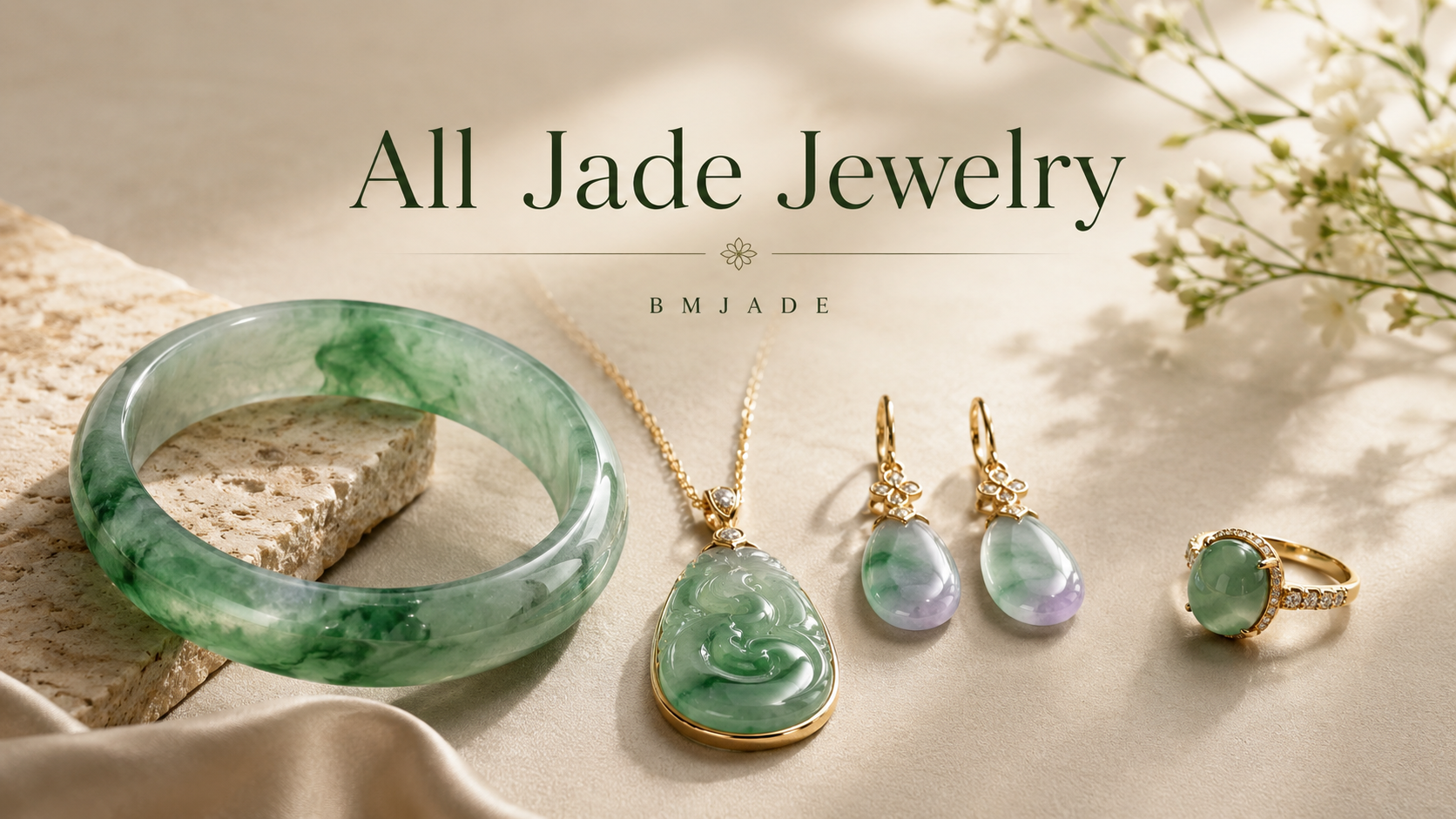
Jadeite Jade Jewelry

Jadeite is the harder of the two minerals sold as jade, and the source of the colours most people picture when they hear the word: imperial green, icy translucent white, lavender, blue. Gem-quality material comes almost entirely from one district in Kachin State, northern Myanmar — and our founder has been buying rough there since 2016.

Everything here is natural Type A jadeite, cut and finished in our Kunming workshop, with a certificate you can verify by serial number.

Skip to results list

Active filters:

77 items
Column grid
Column grid

Filter

Active filters:

Type A Certified

Each bracelet is verified untreated jadeite or nephrite.

NGTC Authentication

Every order ships with an official certificate and traceable number.

Free Shipping Over $40

Fast, tracked delivery on all jade bracelet orders.

30-Day Returns

Shop with confidence — returns within 30 days.See more returns policy

Why Choose a BMjade Jade Bracelet

Why Choose a BMjade
Jadeite Jewellery

1. Type A only, and Type A means something specific. Type A is a treatment classification, not a quality grade: natural jadeite, cut and polished, never acid-bleached, never polymer or resin impregnated, never dyed. Type B, Type C and B+C are all still technically "real jadeite" — which is exactly how they are sold elsewhere — and worth a fraction of natural stone. We do not stock them at any price.

2. We buy our own rough at Hpakant. Gem-quality jadeite forms only where tectonic plates subduct at particular pressures, and the overwhelming majority of jewellery-grade material comes from a single district in northern Myanmar. Hong travels there several times a year, working with licensed dealers he has known for years, and selects stones at the boulder stage for texture and water — not finished pieces from a wholesaler's tray. More about how BMjade started.

3. We grade on water before colour. Jadeite is priced on three axes and carat weight is not one of them. Colour matters, but translucency — what the trade calls water (种水) — multiplies it: a vivid green that is also icy sits far above the same green in opaque material. Hold a piece to the light and you can see the difference yourself.

4. Texture is the third axis, and the one that shows. The fineness of the interlocking crystal grain decides how the polish reads. Top material looks like frozen water under a loupe; coarser stone shows visible granularity. Fine texture also produces cui xing (翠性) — the tiny frost-like glints natural jadeite throws under angled light, which glass and heavily treated material cannot reproduce.

5.A certificate with every piece — and money behind it. Every piece ships with an NGTC certificate whose serial number you can check on the issuing laboratory's own website, before you order or years afterwards.

The Lifetime Authenticity Guarantee

This is the part most jade sellers will not put in writing — and it covers both jades, on each material's own terms.

If at any time after your purchase, NGTC, GIA, or any other qualified independent gemological laboratory issues a written report showing that a ring we sold you is not what we described — meaning any of the following:

  • the mineral is not the one stated (a piece sold as jadeite is nephrite, or the reverse, or is neither);
  • a jadeite piece sold as Type A has in fact been bleached, resin-impregnated or dyed;
  • a nephrite piece sold as natural has in fact been dyed or wax-coated;

— then we will refund the full purchase price, reimburse your laboratory testing fee, and reimburse the cost of approved tracked return shipping.

There is no time limit. The guarantee is separate from our 30-day return window, and it covers sale items, promotional items, exchanged items and gifts. Full terms are in our refund and returns policy.

Colours and Grades

Imperial jadeite describes the rare combination of pure green hue, high saturation and even distribution — the top of the scale, and a word that should never appear beside a two-digit price. Below it, imperial green jadeite and apple green run through every tone to light green jadeite.

Lavender jadeite and purple are the quiet favourites, rarer than mid-grade green and instantly recognisable to anyone who knows the material. White jadeite and icy stone are graded on translucency more than hue — the top of that scale is glass-grade, where light passes through almost cleanly. Blue jadeite is our own signature colour and among the rarest we work with. Red and yellow come from the skin layers of the boulder; black jadeite suits heavier, more modern designs.

Across every colour, the same rule holds: translucency multiplies colour, and texture decides how the polish reads. A small, vivid, icy stone is worth more than a large, pale, opaque one — every time.

Because every stone is natural, no two pieces are identical — what you see photographed is the piece you receive. Filter by category, colour, translucency and price above.

Frequently asked questions

What does Type A jadeite mean?

Type A means untreated: cut and polished only, with no acid bleaching, no resin impregnation and no dye. It is a treatment classification rather than a quality grade — a pale, opaque stone can be perfectly Type A. Quality is judged separately, on colour, water and texture.

Is all Burmese jadeite Type A?

No. Burma is where most gem-quality jadeite is mined, but treatment happens after mining, and a great deal of Burmese material is bleached, filled or dyed before it reaches the market. Origin and treatment status are two separate questions, and only a certificate answers the second.

What does "icy" jadeite mean?

Icy describes translucency, not colour — a stone light passes through cleanly, like frosted ice. Icy material is graded above semi-translucent and opaque, and icy stones with strong colour are the most valuable combination in jadeite.

How is jadeite priced?

On colour, translucency and texture — not on size. Two pieces of identical dimensions can differ by orders of magnitude when one lets light through cleanly and carries even colour while the other is opaque and patchy. Treatment status is the other multiplier. How jade is priced.

How can I tell natural jadeite from treated?

Under a loupe, acid-bleached and resin-filled stone usually shows a fine spiderweb of etch lines or an orange-peel texture in the surface reflection; dyed stone gives itself away by where the colour sits, pooling in cracks rather than following the stone's structure. Both pass every touch test, because both are jadeite. Full method in our authentication guide.

Jadeite or nephrite — which should I choose?

Choose jadeite for translucency and vivid green, lavender or icy colour. Choose nephrite for a warm, waxy lustre, exceptional toughness and the deepest roots in Chinese jade tradition. Both are stocked here — see our nephrite jade jewelry for the other side.

Do you sell the full range in both materials?

Yes — browse the complete jade jewelry collection to see jadeite and nephrite together, or use the category links above to stay within jadeite.

Shop Jadeite by Category

Jadeite Jade Bracelets & Bangles
Floating Flower Jadeite Jade Bangle 53mm

Jadeite Jade Bracelets & Bangles

Jadeite Jade Earrings & Studs
Clover Green Jadeite Jade Stud Earrings, Gold

Jadeite Jade Earrings & Studs

Jadeite Jade Necklaces & Pendants
Blue jade heart pendant with 18K gold bail and sterling silver chain

Jadeite Jade Necklaces & Pendants

Jadeite Jade Rings
Natural Blue Jadeite Hand-Carved Dragon Ring for Men

Jadeite Jade Rings

View More Jade Jewelry Collections

Real Jade Jewelry
Authentic Jade Jewelry — Real Type A Jadeite, NGTC Certified

Real Jade Jewelry

Jade Necklaces & Pendants
Authentic Jade Necklaces & Jadeite Pendants

Jade Necklaces & Pendants

Jade Rings
Authentic Jade Rings & Adjustable Jadeite Rings

Jade Rings

Jade Earrings & Studs
Real Jade Earrings & Jadeite Studs – S925 Silver, 14K & 18K Gold

Jade Earrings & Studs