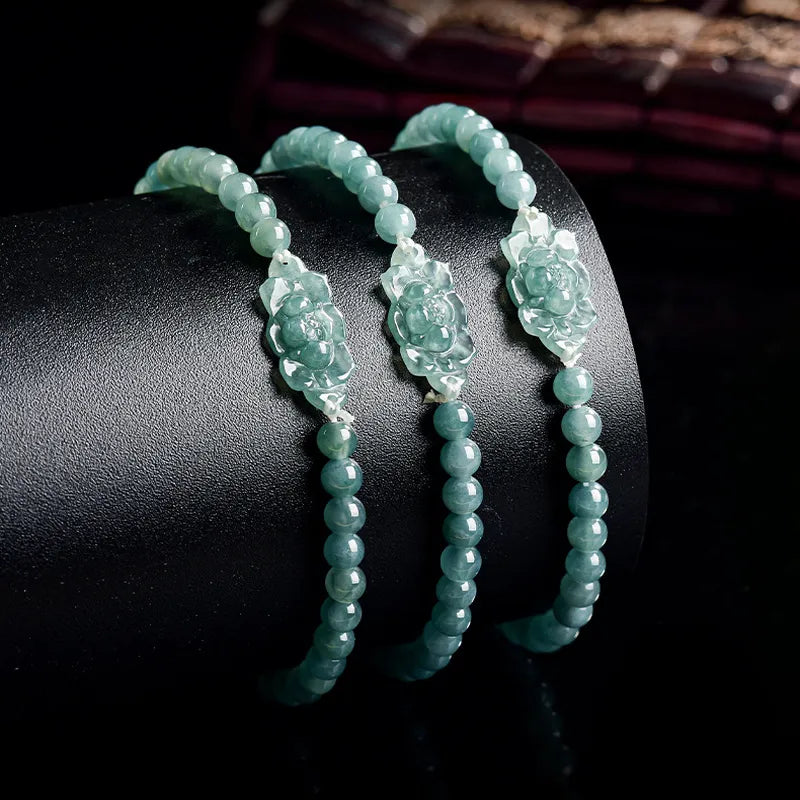
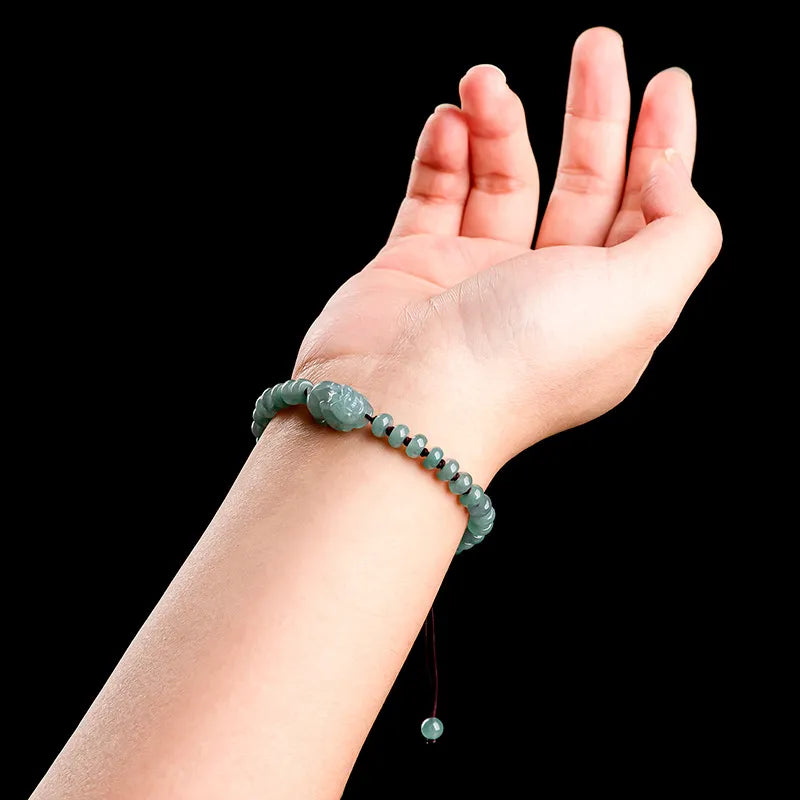

How to Judge the Warm and Smooth Touch of Jade Bracelets During Selection
When selecting a jade bracelet, the tactile experience of warmth and smoothness is a crucial factor that reflects the quality and authenticity of the jade. This article delves into the key aspects to consider when evaluating the tactile warmth and smoothness of jade bracelets, helping you make an informed choice.
Understanding the Nature of Jade's Warmth
The Science Behind Jade's Thermal Conductivity
Jade, whether it's nephrite or jadeite, has unique thermal properties. Unlike metals that conduct heat rapidly, jade has relatively low thermal conductivity. This means that when you first touch a jade bracelet, it may feel cool to the touch, especially in colder environments. However, as you wear it, the jade gradually absorbs and retains your body heat, creating a warm and comfortable sensation. This transition from cool to warm is a characteristic feature of genuine jade and is often described as "warming up to the body."
Distinguishing Genuine Jade from Imitations
One common misconception is that all cool-feeling stones are jade. In reality, many imitations, such as glass or certain plastics, may also feel cool initially but lack the ability to warm up like genuine jade. To test this, hold the bracelet in your hand for a few minutes. If it remains consistently cold or fails to warm up, it may be an imitation. Genuine jade, on the other hand, will gradually adapt to your body temperature, providing a pleasant and natural warmth.
Evaluating the Smoothness of Jade Bracelets
The Role of Texture in Smoothness
The smoothness of a jade bracelet is closely related to its texture. High-quality jade has a fine and uniform texture, with no visible graininess or rough patches. When you run your fingers over the surface of the bracelet, it should feel silky and luxurious, akin to touching a piece of high-quality silk. This smoothness is a result of the jade's internal structure, where the mineral crystals are tightly packed and arranged in an orderly manner.
Identifying Surface Imperfections
While some natural jade may have minor surface imperfections, excessive roughness or pitting can indicate lower quality or poor craftsmanship. Use a magnifying glass to inspect the surface of the bracelet closely. Look for any signs of uneven polishing, scratches, or pits. These imperfections can not only affect the bracelet's aesthetic appeal but also its tactile comfort. A well-polished jade bracelet should have a flawless surface that feels consistently smooth to the touch.
Practical Tips for Assessing Warmth and Smoothness
The Hand-Warming Test
A simple yet effective way to assess the warmth of a jade bracelet is the hand-warming test. Place the bracelet in the palm of your hand and gently rub it for a few seconds. Pay attention to how quickly it warms up. Genuine jade, with its low thermal conductivity, will take a bit longer to warm up compared to imitations. However, once it does, it will retain the heat, providing a lasting warm sensation. If the bracelet warms up too quickly or feels excessively hot, it may be a sign of a synthetic material or poor-quality jade.
The Water Droplet Test
Another useful method to evaluate the smoothness of a jade bracelet is the water droplet test. Place a small droplet of water on the surface of the bracelet and observe how it behaves. On a high-quality, smooth jade surface, the water droplet will form a perfect sphere and roll off easily without leaving any traces. This is because the smooth surface reduces the surface tension, allowing the water to flow freely. In contrast, a rough or porous surface will cause the water droplet to spread out or be absorbed, indicating lower smoothness.
The Visual Inspection Under Natural Light
While tactile evaluation is crucial, visual inspection under natural light can also provide valuable insights into the warmth and smoothness of a jade bracelet. Natural light reveals the true color and texture of the jade, allowing you to spot any inconsistencies or flaws. Look for a bracelet with a consistent color distribution and a lustrous, oily sheen. This sheen, often described as "jade luster," is a sign of high-quality jade with excellent smoothness and warmth. Avoid bracelets with a dull or artificial-looking shine, as they may be treated or imitation jade.