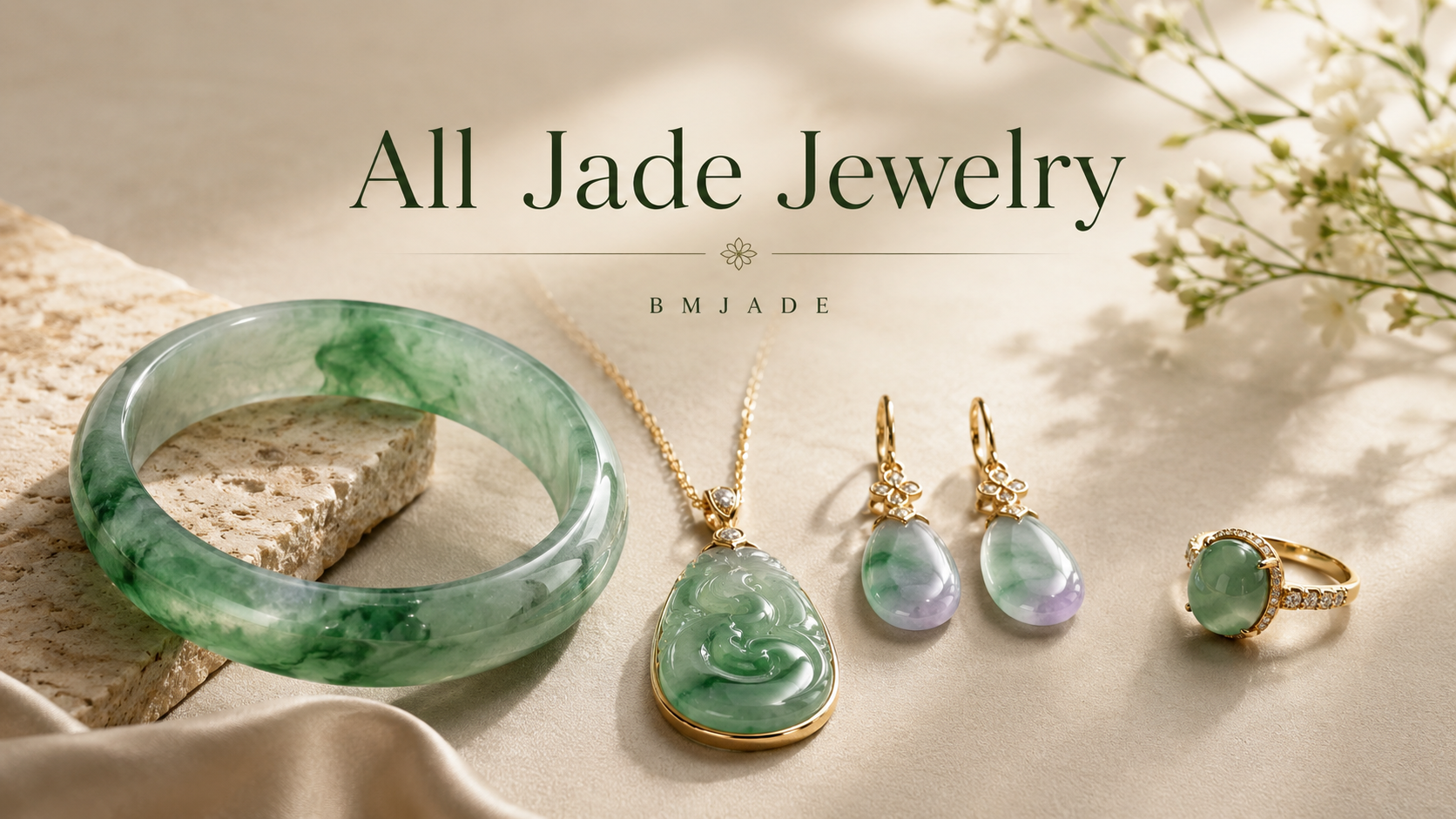
Jade and emerald are both famous green gemstones, but they are not valued in the same way.
Emerald is a green variety of beryl and is one of the classic Western luxury gemstones. It is prized for vivid green color, transparency, brilliance, and fine-jewelry use. Jade is a broader gem category that mainly includes jadeite and nephrite. It is valued for toughness, texture, cultural meaning, carving potential, and, in fine jadeite, color, transparency, Type A treatment status, and certificate trust.
So which is better: jade or emerald?
The answer depends on what you want.
Choose emerald if you want a faceted green gemstone with Western luxury appeal, brilliance, and formal jewelry tradition. Choose jade if you want a tougher, more symbolic, wearable, carved, or culturally meaningful green gemstone with strong daily-wear and heirloom potential.
At BMjade, we focus on certified Type A natural jadeite jewelry because jade value begins with honest material and treatment disclosure. If you are comparing jade and emerald before buying, explore BMjade’s certified Type A jadeite jewelry, including jade bracelets, necklaces, earrings, and rings.
This guide compares jade vs emerald by value, durability, meaning, treatment, certification, jewelry use, engagement rings, and buyer fit.
Quick Answer: Jade vs Emerald — Which Should You Choose?
Choose emerald if you want:
- A faceted green gemstone
- Western luxury jewelry style
- Strong brilliance and sparkle
- May birthstone meaning
- Classic formal rings and earrings
- More standardized gemstone pricing
- Traditional fine-jewelry presentation
Choose jade if you want:
- A tougher gemstone for bangles, bracelets, and carved pieces
- Cultural symbolism and heirloom meaning
- Type A jadeite with certificate disclosure
- Smooth texture instead of sparkle
- Carved pendants and symbolic jewelry
- Daily-wear bracelets and bangles
- A gemstone associated with protection, harmony, and longevity
The simplest comparison is:
Emerald is harder and more brilliant. Jade is tougher and more symbolic.
Both can be beautiful. They simply serve different jewelry purposes.
Jade vs Emerald at a Glance
| Factor | Jade | Emerald |
|---|---|---|
| Material | Jadeite, nephrite, and in some gemological contexts green omphacite | Green variety of beryl |
| Main appearance | Smooth, waxy, glassy, icy, or translucent body color | Transparent to translucent faceted green gem |
| Main jewelry forms | Bangles, bracelets, pendants, rings, beads, carvings | Rings, earrings, pendants, necklaces, faceted stones |
| Hardness | Jadeite about 6.5–7 Mohs; nephrite about 6–6.5 | About 7.5–8 Mohs |
| Toughness | Very high; jade is known for toughness | Fair to good; emeralds often need more careful setting and wear |
| Pricing style | Usually by finished piece and quality factors | Usually by carat and quality factors |
| Main value drivers | Type A status, color, transparency, texture, size, carving, certificate | Color, clarity, cut, carat, origin, treatment |
| Common treatment issue | Type A vs Type B/C jadeite | Oil or resin filling of fractures |
| Best for | Daily bracelets, bangles, carved pendants, symbolic gifts | Formal rings, earrings, faceted pendants, luxury jewelry |
| Buyer risk | Treated jadeite, dyed quartzite, imitation jade | Fracture filling, clarity enhancement, durability care |
| Common certificates | NGTC, GIA, and other gem labs | GIA, AGL, SSEF, Gübelin, and other gem labs |
What Jade and Emerald Actually Are
Jade and emerald are different materials.
What Is Jade?
Jade is not one single mineral. In modern gemology and jewelry trade, jade mainly refers to jadeite and nephrite. GIA also notes that under certain conditions, green omphacite may be included under the jade umbrella.
For most jewelry buyers, the key distinction is:
- Jadeite: often associated with fine jade jewelry, Burmese jadeite, Imperial green jadeite, lavender jadeite, icy jadeite, and Type A treatment disclosure.
- Nephrite: also real jade, deeply important in Chinese jade culture, Hetian jade traditions, Māori pounamu, and carved objects.
For jadeite jewelry, Type A status matters because it confirms natural untreated jadeite.
What Is Emerald?
Emerald is a green variety of beryl. Its green color comes from trace elements such as chromium, vanadium, and iron. Fine emeralds are prized for vivid green color, transparency, and faceted brilliance.
Emerald belongs to the same mineral family as aquamarine and morganite, but its green color and historical luxury status make it one of the most famous colored gemstones.
In simple terms:
Jade is valued as a tough, symbolic, often carved gemstone. Emerald is valued as a vivid, faceted green gemstone.
Durability: Emerald Is Harder, Jade Is Tougher
This is one of the most important differences between jade and emerald.
Hardness and toughness are not the same.
Hardness means resistance to scratching.
Toughness means resistance to breaking, chipping, or fracturing.
Emerald is harder than jade. Jade is tougher than emerald.
| Durability Factor | Jade | Emerald |
|---|---|---|
| Scratch resistance | Lower than emerald | Higher than jade |
| Breakage resistance | Excellent toughness | More care needed due to inclusions and fractures |
| Daily bangle/bracelet use | Very suitable when cared for | Not usually used for bangles |
| Faceted ring use | Less common, can scratch more easily | Common, but needs protective setting |
| Carving use | Excellent | Less common |
| Impact risk | Still avoid hard impact | Avoid impact and pressure |
| Cleaning caution | Avoid harsh chemicals and abrasive surfaces | Avoid ultrasonic/steam if treated or included |
GIA describes jadeite and nephrite as not unusually hard but exceptionally tough. Emerald, while harder, often contains inclusions and may have filled fractures, so it needs careful handling, especially in rings.
For daily jewelry, this means:
- Emerald resists scratches better.
- Jade resists breakage and chipping better.
- Both need sensible care.
- Neither should be worn during heavy work, gym training, harsh cleaning, or impact-heavy activity.
Value Factors: How Jade and Emerald Are Priced Differently
Jade and emerald are priced differently.
Emerald is usually priced by carat, with value driven by color, clarity, cut, carat weight, origin, and treatment. Jade is usually priced by finished piece, with value driven by material, Type A treatment status, color, transparency, texture, size, carving, polish, condition, and certificate.
| Value Factor | Jade | Emerald |
|---|---|---|
| Pricing unit | Usually finished piece | Usually per carat |
| Color | Important, especially fine green jadeite | Most important factor |
| Transparency | Very important for fine jadeite | Important, but emerald often has inclusions |
| Texture / clarity | Jade texture is central | Emerald clarity is important |
| Treatment | Type A vs treated jadeite is critical | Clarity enhancement must be disclosed |
| Size | Large fine jadeite pieces are rare | Larger clean emeralds are rare |
| Cutting | Carving, polish, thickness, symmetry | Faceting and cut quality |
| Certificate | Confirms material and treatment | Confirms identity, treatment, origin when tested |
| Market structure | Less standardized | More standardized than jade |
A jade piece should not be valued only by color name. An emerald should not be valued only by size.
For jadeite, GIA explains that color, transparency, and texture are major value factors. For emerald, GIA emphasizes color as the most important quality factor, with clarity, cut, and carat also affecting value.
Color and Appearance: Two Different Kinds of Green Beauty
Emerald and jade can both be green, but their beauty is different.
Emerald Green
Emerald is famous for vivid green to bluish green color. Fine emeralds have a rich, saturated green appearance and can show brilliance through faceting.
Emerald beauty is about:
- Vivid green color
- Transparency
- Faceted brilliance
- Internal glow
- Luxury jewelry style
- Fine ring and earring presentation
Emerald is usually chosen by people who want a recognizable fine gemstone look.
Jade Green
Jade green can range from pale green to apple green, deep green, bluish green, and Imperial green jadeite. Jade can also appear in lavender, white, icy, yellow, black, red, blue-green, and multicolor forms.
Jade beauty is about:
- Smooth texture
- Body color
- Translucency
- Surface polish
- Depth
- Carving
- Natural variation
- Symbolic shape
Jade does not need to sparkle to be beautiful. Its beauty is quieter and more tactile.
For a deeper jade color guide, read BMjade’s Jade Colors and Their Meanings.
Treatments: Emerald Oiling vs Type A/B/C Jadeite
Both jade and emerald can be treated. The treatment systems are different.
Emerald Treatments
Many emeralds are clarity-enhanced with oil, resin, or polymer fillers. This is common in the emerald trade and should be disclosed by degree.
Emerald filling can improve apparent clarity, but buyers should know:
- Treatment type matters.
- Treatment degree matters.
- Filled fractures may be affected by heat, chemicals, ultrasonic cleaning, steam cleaning, or time.
- High-quality reports may describe clarity enhancement.
A treated emerald can still be valuable when the treatment is properly disclosed.
Jadeite Treatments
Jadeite treatment categories are usually described as Type A, Type B, Type C, and B+C.
| Jadeite Type | Meaning |
|---|---|
| Type A jadeite | Natural untreated jadeite |
| Type B jadeite | Bleached and polymer-filled |
| Type C jadeite | Dyed |
| Type B+C jadeite | Bleached, filled, and dyed |
For jadeite, Type A is the most trusted choice for fine jade jewelry. Treated jadeite can still be decorative if disclosed, but it should not be sold as natural Type A jadeite.
The key difference:
Emerald treatment is often about clarity enhancement. Jadeite treatment is often about whether the jadeite is natural untreated Type A or chemically altered.
Certification: GIA, AGL, SSEF, NGTC, and Jade Reports
Certification matters for both jade and emerald.
For emerald, buyers often look for reports from labs such as GIA, AGL, SSEF, Gübelin, and other respected gemological institutions. Reports may identify the stone, describe treatment, and sometimes discuss origin.
For jadeite, NGTC is widely used in the Chinese and Asian jadeite trade, especially for Type A jadeite identification. GIA is globally recognized and also provides jade reports. For international resale, insurance, or Western buyer familiarity, GIA may be useful. For Asian jadeite trade, NGTC is often more practical.
A good jade or emerald report should help answer:
- What is the material?
- Has it been treated?
- What treatment is present?
- Does the report match the item?
- Can the report number be verified?
- Does the seller explain the report clearly?
A certificate does not automatically make a gemstone valuable. It reduces uncertainty.
For jade certificate details, read BMjade’s NGTC vs GIA Jade Certification Guide.
Meaning and Symbolism: Western Luxury vs Jade Cultural Depth
Jade and emerald carry different symbolic worlds.
Emerald Meaning
Emerald is strongly associated with:
- Western luxury jewelry
- May birthstone tradition
- Royal jewelry
- Love and renewal
- Spring and growth
- Formal romance
- High jewelry
- Classic green gemstone beauty
Emerald works especially well for buyers who want a recognizable luxury gemstone with brilliance and Western fine-jewelry tradition.
Jade Meaning
Jade is strongly associated with:
- Chinese culture
- Protection symbolism
- Harmony
- Longevity
- Wisdom
- Family blessing
- Virtue
- Refinement
- Daily wearing
- Heirloom meaning
- Carved symbols
Jade works especially well for buyers who want meaningful jewelry, cultural symbolism, a daily object, or a piece that can carry personal intention.
Neither meaning is better. They are different.
For deeper jade symbolism, read BMjade’s Jade Meaning Guide.
Best Jewelry Uses: Rings, Pendants, Earrings, Bangles, and Bracelets
Jade and emerald are suited to different jewelry forms.
| Jewelry Type | Jade | Emerald |
|---|---|---|
| Engagement rings | Unique, symbolic, needs care against scratching | Classic luxury choice, needs protective setting |
| Daily rings | Good if protected from scratches and impact | Good with protective setting and care |
| Earrings | Smooth cabochons, drops, carved styles | Faceted studs, drops, halo designs |
| Pendants | Excellent for carvings and symbolic shapes | Excellent for faceted luxury pendants |
| Bangles | One of jade’s strongest forms | Not typical |
| Beaded bracelets | Common and wearable | Rare |
| Carvings | Excellent | Uncommon |
| Men’s jewelry | Strong in bracelets, pendants, rings | Less common but possible |
| Heirloom gifts | Strong cultural fit | Strong luxury-jewelry fit |
If you want a bangle, bracelet, carving, or symbolic pendant, jade is usually the better choice.
If you want a faceted green gemstone ring, earrings, or formal necklace, emerald may be the better choice.
Jade vs Emerald for Engagement Rings
Emerald and jade can both be used in engagement rings, but they send different messages.
Emerald Engagement Ring
Choose emerald if you want:
- Classic green gemstone luxury
- Western fine-jewelry tradition
- Faceted brilliance
- A May birthstone connection
- A formal engagement-ring look
- Pairing with diamonds
Emerald is harder than jade, but many emeralds contain inclusions or filled fractures. A protective setting is important, especially for daily wear.
Jade Engagement Ring
Choose jade if you want:
- A non-traditional engagement ring
- Cultural symbolism
- Smooth cabochon beauty
- Type A jadeite meaning
- A ring with protection or harmony symbolism
- A softer, quieter look than diamond or emerald
Jade is tougher than emerald, but it is less scratch-resistant. A jade engagement ring should be worn thoughtfully and protected from hard surfaces, abrasive materials, and heavy impact.
For a full discussion, read BMjade’s Jade Engagement Ring Guide.
Jade vs Emerald for Daily Wear
For daily wear, the better choice depends on the jewelry type.
Choose jade for daily wear if you want:
- Bracelet or bangle
- Pendant
- Beaded bracelet
- Carved piece
- Smooth ring or cabochon
- Symbolic jewelry
- Less sparkle and more meaning
Choose emerald for daily wear if you want:
- Faceted ring
- Stud earrings
- Pendant necklace
- Fine jewelry style
- Brilliance
- Birthstone jewelry
- A more classic Western gemstone look
Both jade and emerald can last for generations when cared for properly. Both can be damaged if worn carelessly.
Jade vs Emerald for Gifts
Emerald and jade both make meaningful gifts, but they fit different occasions.
| Gift Situation | Better Fit |
|---|---|
| May birthday | Emerald is the modern birthstone; jade can be symbolic if preferred |
| Chinese cultural gift | Jade |
| Mother’s Day gift | Jade or emerald, depending on style |
| Anniversary gift | Jade for meaning; emerald for luxury romance |
| Protection or peace symbolism | Jade |
| Formal romantic jewelry | Emerald |
| Daily bracelet gift | Jade |
| Luxury green gemstone ring | Emerald |
| Men’s meaningful jewelry | Jade is often more versatile |
| Minimalist green pendant | Either, depending on style |
A good gift should match the recipient, not only the gemstone tradition.
Which Stone Fits Which Buyer?
Choose jade if you:
- Prefer smooth texture over sparkle
- Like cultural symbolism
- Want a bracelet, bangle, or carved pendant
- Care about protection, harmony, or longevity meaning
- Want daily jewelry with personal intention
- Prefer Type A jadeite with certificate disclosure
- Like understated luxury
- Appreciate Chinese jade culture
- Want a meaningful gift for family or partner
Choose emerald if you:
- Prefer faceted brilliance
- Want a classic Western luxury gemstone
- Like transparent green stones
- Want May birthstone jewelry
- Prefer formal rings or earrings
- Want a gemstone traditionally paired with diamonds
- Like high-jewelry style
- Want a familiar fine-jewelry look
Choose based on what you will actually wear.
Common Buyer Mistakes
Avoid these mistakes when comparing jade and emerald:
- Thinking all green stones are similar
- Judging jade by color alone
- Judging emerald by carat alone
- Ignoring treatment disclosure
- Assuming a certificate proves high value
- Comparing jade and emerald only by price
- Expecting jade to sparkle like emerald
- Expecting emerald to be tough like jade
- Wearing emerald rings without protective settings
- Wearing jade rings during abrasive work
- Buying jadeite without Type A disclosure
- Buying emerald without treatment information
- Treating auction-level examples as normal benchmarks
A good comparison starts with the right question:
What kind of jewelry do you want, and how will you wear it?
Source Notes and Methodology
This article is buyer education, not financial, tax, insurance, or investment advice.
The comparison is based on:
- Public gemological references on jade, jadeite, nephrite, and emerald.
- GIA quality factors for jadeite and emerald.
- General jewelry-care guidance for jade and emerald.
- BMjade’s practical experience with Type A jadeite jewelry.
- Buyer questions about green gemstones, daily wear, and meaningful gifts.
Important limits:
- Price ranges vary by market, seller, certificate, and individual quality.
- Auction-level jadeite and emerald examples are not normal benchmarks for everyday jewelry.
- Resale value is not guaranteed.
- Cultural meanings are simplified for buyer education.
- Always read the certificate and seller disclosure for the actual piece.
FAQ About Jade vs Emerald
Is jade the same as emerald?
No. Jade and emerald are completely different materials. Jade mainly refers to jadeite and nephrite, while emerald is a green variety of beryl.
Which is more valuable, jade or emerald?
It depends on quality. Fine emeralds and fine Type A jadeite can both be very valuable. Ordinary jade and ordinary emerald can both be much more affordable.
Is jade more durable than emerald?
Jade is tougher and more resistant to breaking or chipping. Emerald is harder and more scratch-resistant. Both need care.
Is emerald harder than jade?
Yes. Emerald is about 7.5–8 on the Mohs scale. Jadeite is about 6.5–7, and nephrite is about 6–6.5.
Is jade better than emerald for daily wear?
Jade is often better for bangles, bracelets, pendants, beads, and carvings. Emerald is often better for faceted rings, earrings, and formal jewelry, but it needs protective settings.
Is jade or emerald better for an engagement ring?
Emerald is more traditional for Western engagement rings. Jade is more symbolic and unconventional. Jade rings need protection from scratches, while emerald rings need protection from impact and fracture stress.
Which stone has more meaning?
Both have meaning. Emerald is linked with Western luxury, love, renewal, and May birthstone tradition. Jade is linked with protection, harmony, longevity, virtue, and Chinese cultural symbolism.
Is emerald a birthstone?
Yes. Emerald is the modern birthstone for May.
Is jade a birthstone?
Jade is not a modern Western monthly birthstone. It may appear in some alternative or mystical birthstone lists, but it should be described as symbolic or alternative.
Does jade come only in green?
No. Jade can be green, lavender, white, icy, yellow, black, red, blue-green, or multicolor.
Does emerald come in colors other than green?
Emerald is defined by its green color. Other colors of beryl have different names, such as aquamarine or morganite.
Is jadeite the same as jade?
Jadeite is one type of real jade. Nephrite is the other main type of real jade.
Is nephrite better than emerald?
They are too different to compare directly. Nephrite is real jade and important in jade culture, while emerald is a faceted green beryl used in fine jewelry.
Is Type A jadeite important?
Yes. For jadeite, Type A means natural untreated jadeite. It is the most trusted choice for fine jadeite jewelry.
Are emerald treatments normal?
Yes. Many emeralds are clarity-enhanced with oil or resin. Treatment should be disclosed clearly.
Are jade treatments normal?
Treated jadeite exists, but Type A natural jadeite is the most trusted category. Type B, Type C, and B+C jadeite should be disclosed and priced differently.
Which is better for men’s jewelry, jade or emerald?
Jade is often more versatile for men’s bracelets, pendants, and rings. Emerald can also work for men’s jewelry, especially rings, cufflinks, or formal pieces.
Which is better for a gift, jade or emerald?
Choose emerald for a classic luxury gemstone or May birthstone gift. Choose jade for cultural symbolism, protection meaning, daily wear, or a meaningful heirloom-style gift.
Can jade and emerald be worn together?
Yes. Jade and emerald can be worn together, but they have different care needs. Avoid rubbing jade against harder gemstones or sharp metal edges.
Which should I buy first?
Buy jade first if you want symbolic daily jewelry. Buy emerald first if you want a faceted green luxury gemstone. The better choice depends on your style and purpose.
Final Thoughts
Jade and emerald are both beautiful green gemstones, but they are not interchangeable.
Emerald is harder, more brilliant, and strongly tied to Western fine-jewelry tradition. It is an excellent choice for faceted rings, earrings, pendants, and May birthstone jewelry.
Jade is tougher, more symbolic, and especially strong in bangles, bracelets, carved pendants, rings, beads, and heirloom-style gifts. Fine Type A jadeite is valued not only for color, but also for transparency, texture, treatment status, size, craftsmanship, and certificate trust.
The best choice is not about which stone is universally better. It is about which stone fits your life.
Choose emerald if you want sparkle, formal luxury, and faceted green beauty. Choose jade if you want cultural meaning, daily wear, smooth texture, carving, and personal symbolism.
At BMjade, we believe jade jewelry should be natural, verifiable, meaningful, and wearable. If you are ready to compare jade as your green gemstone choice, explore BMjade’s certified Type A jadeite jewelry and choose a piece that fits your style, meaning, and confidence.