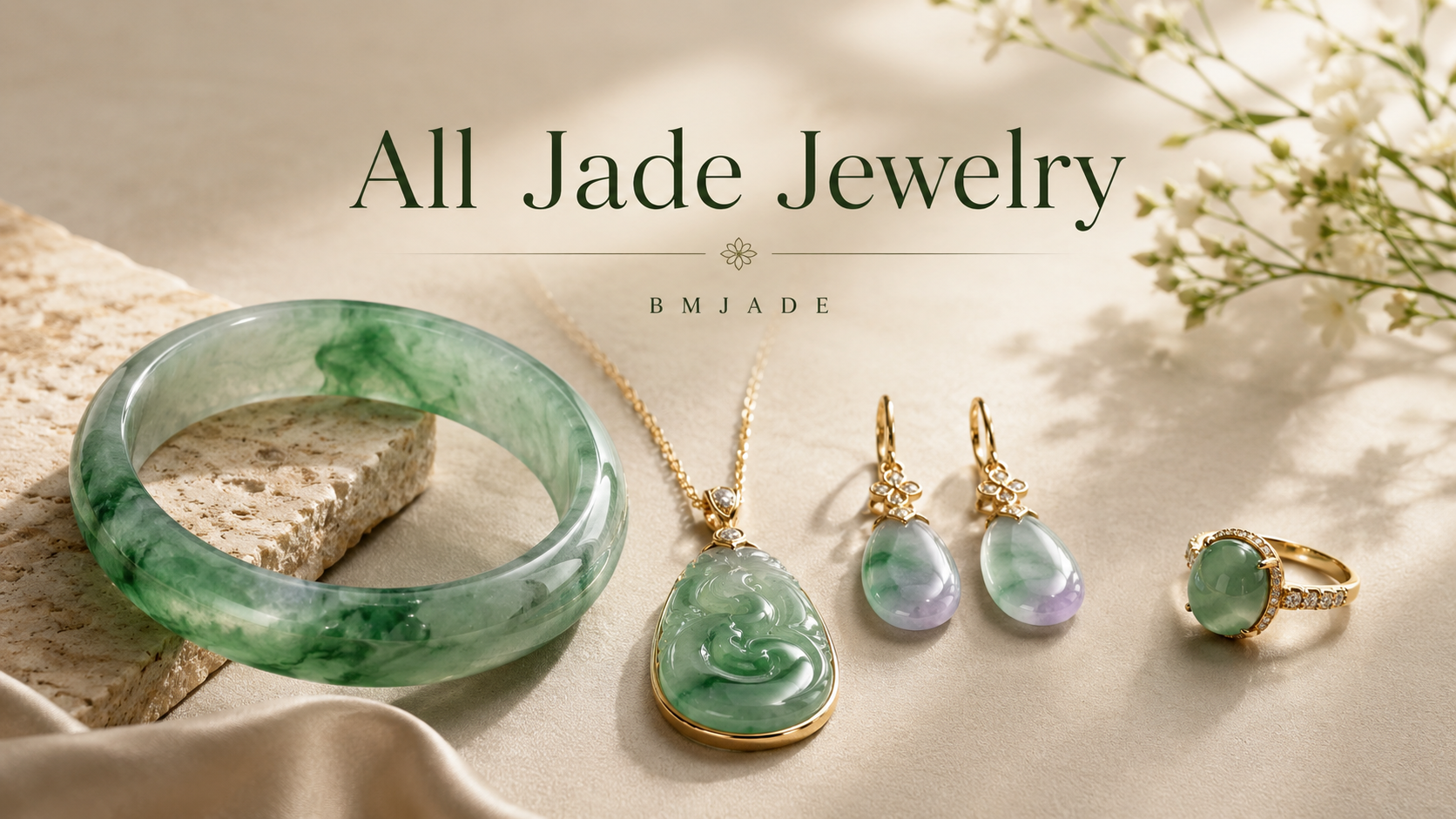
Jade is one of the most meaningful gemstones in the world, but it is also one of the most misunderstood. Many people think jade is simply a green stone. In reality, jade is a family of gemstone materials with different mineral types, colors, textures, treatments, origins, values, and cultural meanings.
If you are new to jade, the most important thing to understand is this: jade is not just one simple stone. In gemology, the word “jade” mainly refers to two different materials — jadeite and nephrite. They can look similar at first glance, but they are not the same in rarity, texture, market value, or jewelry use.
At BMjade, we focus on certified Type A natural jadeite jewelry because the jade market can be confusing for buyers. A piece may be called “jade,” but that does not automatically mean it is untreated, valuable, or suitable for long-term wear. Understanding what jade stone really is will help you choose jade bracelets, jade necklaces, jade earrings, and jade rings with much more confidence.
What Is Jade Stone?
Jade stone is a tough gemstone material used for jewelry, carvings, beads, bangles, pendants, rings, earrings, ornaments, and cultural objects. For thousands of years, jade has been valued not only for its beauty, but also for its strength, smooth texture, symbolic meaning, and deep connection with Asian, Mesoamerican, and other cultural traditions.
In modern gemology, jade usually refers to two main materials:
- Jadeite
- Nephrite
Both are genuine jade, but they are different stones from a mineralogical point of view. Jadeite is generally rarer and more strongly associated with fine jade jewelry, especially high-quality Burmese jadeite. Nephrite is historically important, especially in Chinese jade culture, and is often known for its soft, oily luster and excellent toughness.
This is why two pieces can both be “real jade” but have very different prices, textures, colors, and market positions.
Is Jade a Stone, a Crystal, or a Gemstone?
In everyday language, jade is often called a stone. In jewelry and gemology, jade is better described as a gemstone material. Some people in crystal or spiritual communities may call jade a crystal, but gemologically, jade is not the same kind of single crystal as quartz.
Jade is usually made of very small interlocking mineral crystals. This structure gives jade its famous toughness. That toughness is one reason jade has been used for ancient tools, ritual objects, carvings, bangles, and jewelry.
So the simplest answer is:
Jade is a real gemstone material, commonly called a stone, and mainly includes jadeite and nephrite.
Jadeite vs Nephrite: The Two Main Types of Jade
The most important jade lesson for beginners is the difference between jadeite and nephrite.
What Is Jadeite?
Jadeite is the rarer and usually more valuable type of jade. It is the material most often associated with fine jade jewelry, especially high-quality Burmese jadeite. Jadeite can appear in many colors, including green, icy white, lavender, yellow, black, red, blue, grey, and mixed-color patterns.
The most famous jadeite color is vivid green, often associated with imperial jade. However, not all good jadeite has to be deep green. Icy jadeite, lavender jadeite, white jadeite, and yellow jadeite can also be beautiful and desirable when the texture, translucency, polish, and overall harmony are strong.
For serious buyers, treatment status is just as important as appearance. BMjade focuses on Type A natural jadeite, meaning the jadeite has not been acid-bleached, polymer-filled, or dyed. This matters because untreated jadeite preserves the natural structure and long-term beauty of the stone.
What Is Nephrite?
Nephrite is another genuine form of jade. It has a long history in Chinese jade culture and is often associated with Hetian jade. Compared with jadeite, nephrite usually has a softer, waxier, and more oily appearance. Its colors are often more muted, including white, creamy white, grey, green, spinach green, yellowish, brown, and black tones.
Standard nephrite jewelry is often more affordable than fine jadeite, although top-quality Hetian nephrite can still be highly valuable. Nephrite is especially admired for carvings, traditional objects, ornaments, and pieces where a soft, warm texture is preferred.
Jadeite vs Nephrite Comparison
| Factor | Jadeite | Nephrite |
|---|---|---|
| Main market position | Fine jade jewelry, high-end bangles, cabochons, pendants | Traditional jade objects, carvings, some jewelry |
| Rarity | Usually rarer | Usually more common |
| Texture | Can be glassy, icy, fine, vivid, or translucent | Often waxy, oily, soft, and compact |
| Colors | Green, lavender, white, icy, yellow, black, red, blue, mixed colors | White, green, grey, brown, yellowish, black |
| Value range | Can be very high, especially untreated fine jadeite | Usually lower, except top Hetian nephrite |
| BMjade focus | Yes — certified Type A jadeite | Not our main focus |
Both jadeite and nephrite are real jade. The better choice depends on what you want: fine jewelry, cultural symbolism, collectibility, budget, or daily wear.
How Does Jade Stone Form?
Jade forms through geological transformation under pressure and heat over long periods of time. Jadeite and nephrite form under different geological conditions, which is one reason they have different structures, colors, and appearances.
The key feature of jade is its compact, interlocking structure. This makes jade unusually tough compared with many other gemstones. Toughness is not the same as hardness. A gemstone can be hard but brittle, or slightly softer but very tough. Jade is admired because it can resist breaking better than many stones when properly cut and worn.
This toughness helped jade become important in ancient cultures. Before jade became luxury jewelry, it was used for tools, ceremonial objects, ornaments, and carvings. Later, as carving techniques developed, jade became a symbol of refinement, protection, virtue, status, and beauty.
Still, jade is not indestructible. A jade bracelet, pendant, ring, or earring can chip, crack, or break if it hits a hard surface sharply. This is why jade jewelry should be worn with care, stored separately, and cleaned gently.
What Does Jade Stone Look Like?
Jade can look very different from one piece to another. Some jade is bright green and translucent. Some is icy white and almost glassy. Some is lavender, yellow, black, grey, red, or mixed with natural color zones. Some jade looks smooth and even, while other jade shows clouds, veins, patches, inclusions, or color roots.
Real jade does not have to be perfect. Natural jade often has small internal textures, cotton-like areas, mineral lines, color variations, or uneven translucency. These features are part of the stone’s natural character.
The quality of jade is usually judged by several factors:
- Material type
- Treatment status
- Color
- Translucency
- Texture
- Polish
- Craftsmanship
- Size
- Shape
- Certification
- Overall beauty
Many beginners focus only on color, but experienced jade buyers know that color is only one part of the full picture. A piece with strong color but poor texture may not be as desirable as a softer, more balanced piece with better translucency and polish.
Is All Jade Green?
No. Green is the most famous jade color, but jade can appear in many colors. Jadeite can be green, white, icy, lavender, yellow, black, red, blue, grey, or multi-color. Nephrite can also appear in white, green, grey, brown, black, and yellowish tones.
If you want a deeper explanation of color symbolism, rarity, and buying meaning, you can read our full guide to jade colors and meanings here:
In this article, the most important point is simple: real jade is not always green, and green jade is not automatically the best jade.
What Is Real Jade Stone?
Real jade should be jadeite or nephrite. However, the word “jade” is often used loosely in the jewelry market. Some items sold as jade may actually be treated jadeite, dyed stone, serpentine, aventurine, quartz, glass, plastic, or other jade-like materials.
This is why buyers should be careful with vague product descriptions such as:
- “Natural green stone”
- “Jade-like stone”
- “Oriental jade”
- “New jade”
- “Korean jade”
- “Mountain jade”
- “Green crystal jade”
Some of these names may refer to materials that are not true jadeite or nephrite. The name may sound attractive, but it does not always tell you what the stone really is.
For jade jewelry buyers, the question is not only “Is this jade?” but also:
- Is it jadeite or nephrite?
- Is it natural or treated?
- Is it dyed?
- Is it polymer-filled?
- Is there a certificate?
- Is the seller clearly disclosing the material?
Type A, Type B, and Type C Jade Explained Simply
In the jadeite jewelry market, treatment status is extremely important. You may see terms like Type A, Type B, Type C, and B+C jade.
Type A Jadeite
Type A jadeite is natural jadeite that has not been acid-bleached, polymer-filled, or dyed. It may receive traditional surface polishing or waxing, but the internal structure and color are natural.
This is the type of jadeite BMjade focuses on.
Type B Jadeite
Type B jadeite has been chemically treated, usually by acid bleaching, and then filled with polymer or resin. This process can make lower-quality jadeite look cleaner or more translucent, but it changes the stone’s structure and long-term stability.
Type C Jadeite
Type C jadeite has been dyed to enhance or change its color. Dyed jade may look attractive at first, but the color is not natural and may not represent the true value of the stone.
B+C Jadeite
B+C jadeite has been both treated and dyed. This is usually much less valuable than untreated Type A jadeite.
For serious jade buyers, Type A certification matters because two pieces may look similar in photos but have very different authenticity, durability, and value.
What Is Jade Stone Used For?
Jade is used in many ways, from ancient carvings to modern fine jewelry. At BMjade, our focus is wearable jade jewelry that combines natural material, craftsmanship, and daily meaning.
Jade Bracelets and Bangles
Jade bracelets and bangles are among the most traditional and recognizable jade jewelry forms. A jade bracelet shows the body of the stone clearly, including color distribution, translucency, texture, and polish.
Many people choose jade bracelets for daily wear, cultural meaning, protection symbolism, and personal connection. Because a bracelet uses a larger amount of jade material than a small pendant or ring, quality and certification are especially important.
Explore BMjade’s collection of:
Jade Necklaces and Pendants
Jade necklaces and pendants are popular because they are easy to wear and can carry strong personal meaning. A pendant sits close to the heart, which makes it a meaningful choice for gifts, protection symbols, or daily spiritual reminders.
Jade pendants can be simple cabochons, smooth beads, carved symbols, or traditional motifs such as Buddha, Guan Yin, Pixiu, dragon, phoenix, or Ping An Kou.
Explore:
Jade Earrings
Jade earrings bring color and softness near the face. They can be subtle, elegant, and easy to match with everyday outfits. Small jade studs, drops, and dangle earrings are especially suitable for people who want jade jewelry without wearing a larger bracelet or pendant.
Explore:
Jade Rings
Jade rings are more personal and expressive. They may use cabochon jade, carved jade, adjustable bands, silver settings, gold-plated silver, or other designs. A jade ring can feel modern while still carrying the traditional meaning of jade.
Explore:
What Does Jade Stone Mean?
Jade has many meanings across cultures. In Chinese culture, jade is often connected with virtue, purity, protection, harmony, longevity, beauty, and noble character. It is not only a decorative stone; it has long been seen as a material that reflects inner quality.
In modern jewelry, people often choose jade because it feels personal. Some wear jade as a symbol of protection. Some choose it for calmness and balance. Some buy jade as a family gift. Others choose jade because of its connection with Chinese culture, feng shui, or meaningful life transitions.
Different jade jewelry forms can carry slightly different feelings:
| Jade Jewelry Type | Common Meaning |
|---|---|
| Jade bracelet | Protection, daily balance, tradition, continuity |
| Jade necklace | Close-to-heart meaning, blessing, personal symbol |
| Jade earrings | Elegance, softness, beauty, subtle protection |
| Jade ring | Identity, promise, personal reminder, daily connection |
| Jade pendant | Symbolic protection, cultural story, meaningful gift |
Jade meaning should not be treated as instant magic. A jade piece becomes meaningful because of its material, craftsmanship, cultural background, and the personal relationship you build with it over time.
Is Jade Stone Valuable?
Jade can be affordable, expensive, or extremely valuable. The price depends on many factors, including whether it is jadeite or nephrite, whether it is treated, the color quality, translucency, texture, size, carving, origin, and certification.
In general, untreated Type A jadeite is more desirable than heavily treated jadeite. Fine jadeite with strong color, good translucency, fine texture, and reliable certification can command much higher prices than ordinary jade.
However, not every real jade piece has to be expensive. A smaller pendant, simple pair of earrings, or lighter-color jade ring can still be real, beautiful, and meaningful without reaching collector-level prices.
For a full breakdown of jade value, price ranges, quality factors, and buying mistakes, read our full guide:
How Much Is Jade Worth? Jade Price and Value Guide
How to Tell If Jade Stone Is Real
The safest way to confirm jade is through proper gemological testing and certification. Home tests can sometimes give clues, but they are not enough for serious buying decisions.
Common home tests include:
- Cold touch test
- Light test
- Sound test
- Scratch test
- Magnification
- Weight comparison
The problem is that many imitations and treated stones can still pass simple visual or touch-based tests. Some treated jadeite may look very convincing in photos. Some non-jade green stones can feel cool, heavy, or smooth. This is why relying only on home tests can be risky.
A better jade buying process is:
- Ask whether the stone is jadeite or nephrite.
- Ask whether it is Type A, Type B, Type C, or treated.
- Look for clear product photos.
- Check whether the seller provides a certificate.
- Avoid vague material descriptions.
- Compare the price with the quality claim.
- Buy from a seller who explains natural jade clearly.
At BMjade, every jade jewelry piece is selected as Type A natural jadeite and comes with an NGTC certificate, giving buyers more confidence in the material and treatment status.
How to Choose Jade Stone Jewelry
Choosing jade jewelry is not only about picking a beautiful color. You should think about material, meaning, wearability, certification, and your personal style.
1. Choose the Right Jade Type
If you want fine jade jewelry, certified Type A jadeite is usually the strongest choice. It has strong market recognition, rich color possibilities, and long-term appeal when the quality is good.
If you prefer traditional carving objects or soft, oily white jade, nephrite may also be meaningful. But for buyers specifically looking for high-quality jade jewelry, jadeite is often the main material to consider.
2. Choose a Color You Will Actually Wear
Green jade is classic, but it is not the only option. Icy jade can feel clean and elegant. Lavender jade can feel soft and feminine. Yellow jade can feel warm and unique. Black jade can feel strong and modern. White jade can feel calm, minimal, and refined.
The best color is not always the most expensive color. The best color is the one that suits your skin tone, wardrobe, budget, and emotional connection.
3. Choose the Right Jewelry Form
| Buyer Need | Recommended Jade Jewelry |
|---|---|
| Daily traditional wear | Jade bracelet or bangle |
| Meaningful gift | Jade necklace or pendant |
| Subtle everyday elegance | Jade earrings |
| Personal statement | Jade ring |
| First jade purchase | Small pendant, earrings, or adjustable ring |
| Strong cultural symbolism | Guan Yin, Buddha, Pixiu, Ping An Kou, dragon, or phoenix pendant |
4. Check the Certificate
For jadeite jewelry, certification is very important. It helps confirm the material and treatment status. This is especially useful because treated jadeite and imitation stones can look convincing online.
A good jade seller should make the buying process clear, not mysterious. You should be able to understand what the stone is, what treatment status it has, and what makes the piece special.
5. Accept Natural Variation
Because jade is a natural stone, each piece may show small differences in color, texture, pattern, translucency, and internal structure. No two natural jade jewelry pieces are exactly the same.
These variations are not necessarily flaws. They are part of what makes real jade jewelry unique.
Common Misunderstandings About Jade Stone
Misunderstanding 1: Jade Is Always Green
Jade can be green, white, lavender, yellow, black, red, blue, grey, or mixed color. Green is famous, but it is not the only real jade color.
Misunderstanding 2: Darker Green Always Means Better Jade
Not always. Jade value depends on color tone, saturation, evenness, translucency, texture, treatment, and overall beauty. A dark green piece with poor texture may be less desirable than a lighter piece with better translucency and polish.
Misunderstanding 3: Every Green Stone Is Jade
Many green stones are not jade. Aventurine, serpentine, glass, dyed quartz, and other materials can be sold under jade-like names. Material identification matters.
Misunderstanding 4: Real Jade Must Be Perfectly Clear
Real jade can be translucent, semi-translucent, cloudy, icy, opaque, or textured. Natural inclusions, cotton-like areas, and color roots are common in jade.
Misunderstanding 5: A Cheap “Natural Jade” Listing Is Always a Good Deal
Sometimes it is. But if the price is too low for the claimed quality, you should check the material, treatment, certificate, and seller credibility carefully.
Misunderstanding 6: Home Tests Are Enough
Home tests can be interesting, but they cannot reliably confirm whether jadeite is untreated Type A jadeite. Certification is much safer for serious buyers.
FAQ About Jade Stone
What is jade stone?
Jade stone is a gemstone material mainly referring to jadeite and nephrite. It is used in jewelry, carvings, ornaments, cultural objects, and meaningful gifts.
Is jade a real stone?
Yes. Jade is a real gemstone material. However, the word “jade” is sometimes misused for imitation stones, treated materials, or jade-like products, so clear identification is important.
What are jade stones made of?
Jade stones are mainly made of jadeite or nephrite. These two materials have different mineral compositions, textures, colors, and market values.
Is jadeite better than jade?
Jadeite is not separate from jade. It is one type of jade. Jadeite is usually rarer and more valuable than nephrite, especially in fine jewelry, but both jadeite and nephrite can be genuine jade.
What color is jade stone?
Jade can be green, white, lavender, yellow, black, red, blue, grey, brown, or mixed color. Green is the most famous jade color, but real jade is not always green.
What does jade stone mean?
Jade often symbolizes protection, harmony, purity, wisdom, longevity, prosperity, and personal balance. In Chinese culture, jade is also connected with virtue and noble character.
Is jade stone expensive?
Jade can be affordable or very expensive. Its value depends on material type, treatment status, color, translucency, texture, craftsmanship, size, origin, and certification.
How can I tell if jade stone is real?
The safest way is to check certification from a reliable gemological lab. Visual tests, cold touch tests, and sound tests are not enough to confirm untreated real jade.
Is jade good for jewelry?
Yes. Jade is tough, beautiful, meaningful, and suitable for bracelets, necklaces, earrings, rings, pendants, beads, and bangles. It should still be protected from hard impact and harsh chemicals.
What jade jewelry should beginners buy first?
Beginners can start with a certified Type A jadeite pendant, pair of earrings, adjustable ring, or bracelet. These pieces are wearable, meaningful, and easier to match with daily outfits.
Final Thoughts: Jade Is More Than a Green Stone
Jade is more than a beautiful green stone. It is a gemstone family, a cultural symbol, a jewelry material, and a personal object that can carry meaning for many years. Once you understand the difference between jadeite and nephrite, natural and treated jade, color and quality, you can choose jade jewelry with much more confidence.
For buyers, the most important lesson is simple: do not buy jade based only on color or price. Look for clear material disclosure, Type A treatment status, trustworthy certification, natural beauty, and a piece you will actually enjoy wearing.
If you are ready to choose a piece of real jade jewelry, explore BMjade’s certified Type A jadeite collections, including jade bracelets, jade necklaces, jade earrings, jade rings, and meaningful jade pendants.