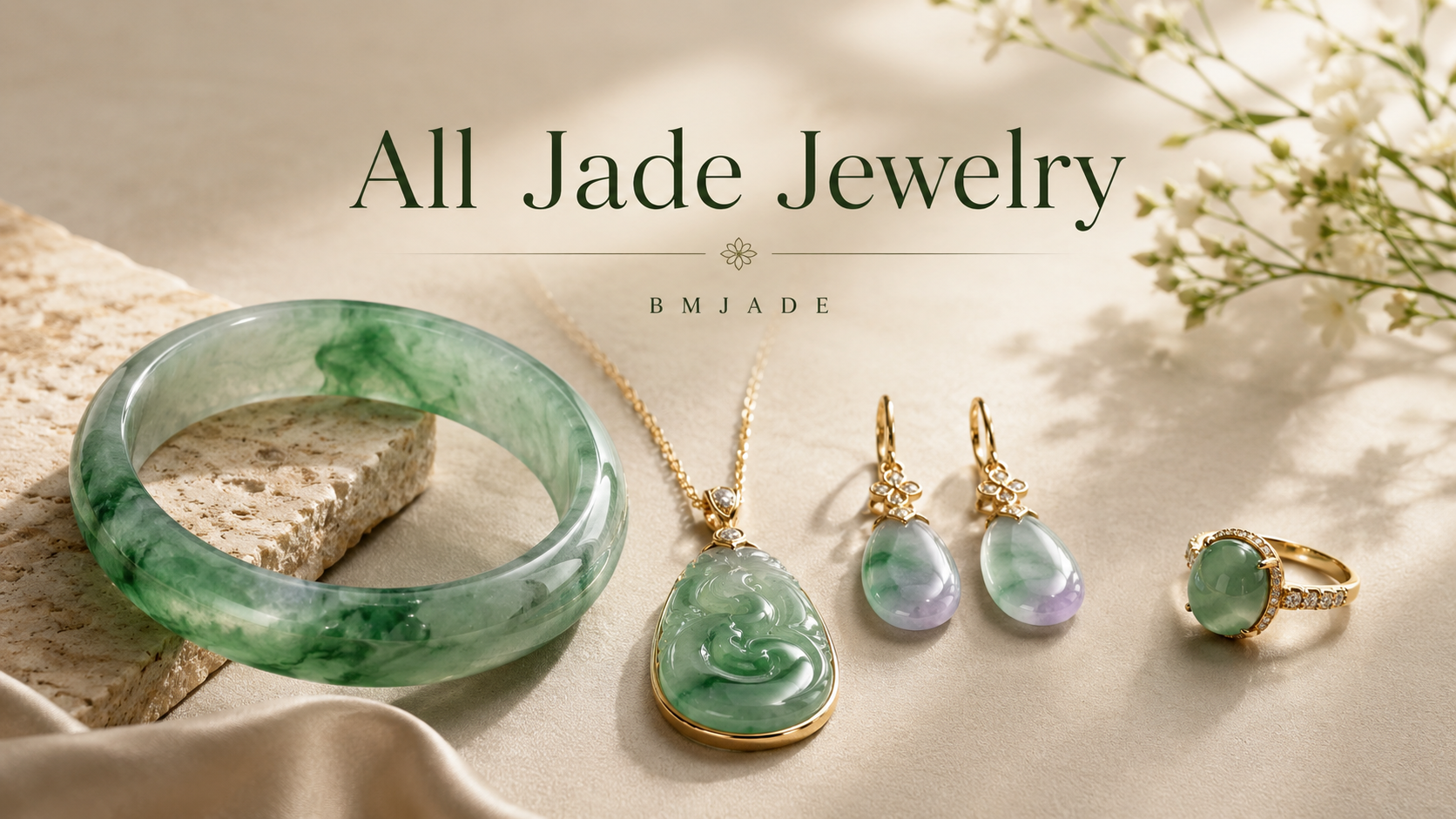
A jade bracelet can look beautiful in a photo, feel cool in the hand, and still not be the jade you think it is. This is why jade authentication matters.
For buyers, the biggest question is usually simple: how can I tell if a jade bracelet is real? The honest answer is that home tests can help you avoid obvious fakes, but they cannot reliably prove that a bracelet is Type A natural jadeite. A real-looking bracelet may still be treated, dyed, polymer-filled, or made from another green stone.
The safest way to confirm valuable jade is through proper gemological testing and clear treatment disclosure. At BMjade, every piece we sell is selected as Type A natural jadeite and supported with certification, because real jade is not only about appearance. It is about material, treatment status, long-term value, and trust.
This guide explains what Type A jade means, how to recognize common warning signs, which home tests are useful but limited, why scratch tests should be avoided, and what a jade certificate should tell you before buying.
Quick Answer: How Can You Tell If a Jade Bracelet Is Real?
To tell if a jade bracelet is real, start with these checks:
- Look for natural color variation, not flat artificial color.
- Check the internal texture under light.
- Avoid pieces with round air bubbles, which may indicate glass.
- Notice whether the bracelet feels cool and dense in the hand.
- Compare the price with normal Type A jadeite market value.
- Ask whether the bracelet is jadeite or nephrite.
- Ask whether it is Type A, Type B, Type C, or treated jade.
- Request a certificate from a recognized gemological laboratory.
The most important point is this:
Home tests can help you screen out obvious fakes, but they cannot prove Type A untreated jadeite. For valuable jade bracelets, laboratory testing is the most reliable method.
If you want to avoid uncertainty, choose a certified Type A jadeite bracelet with clear photos, exact measurements, and transparent treatment disclosure. You can browse BMjade’s certified Type A jade bracelets by size, color, and style.
Real Jade vs Type A Jade: What Is the Difference?
Many people use “real jade” and “Type A jade” as if they mean the same thing, but they are not always identical.
“Real jade” usually means the material is either jadeite or nephrite. These are the two gem materials traditionally recognized as jade.
“Type A jade” is more specific. In the jadeite market, Type A jadeite means natural jadeite that has not been chemically bleached, dyed, or polymer-filled. It may be polished and sometimes waxed as part of normal finishing, but its body has not been chemically altered to improve color or transparency.
This distinction matters because a bracelet can be made of jadeite but still be treated. A treated jadeite bracelet may still be “jade” in material, but it is not the same value, durability, or collectibility as Type A natural jadeite.
For BMjade, Type A jadeite is the standard we focus on because it offers the strongest combination of natural beauty, cultural value, and long-term trust.
Jadeite vs Nephrite: Two Materials Called Jade
Before judging whether a jade bracelet is authentic, you should know which kind of jade it is.
Jadeite
Jadeite is generally rarer and often more valuable, especially in fine green, lavender, icy, and highly translucent qualities. Burmese jadeite is especially important in the jewelry market. Many high-value jade bangles and bracelets are made from jadeite.
Nephrite
Nephrite is also real jade. It is known for its smooth, waxy texture and strong toughness. Chinese Hetian jade is one of the most famous nephrite varieties.
Both jadeite and nephrite can be genuine jade, but they are different materials. A seller should not describe nephrite as jadeite. If you are buying a jadeite bracelet, the certificate and product description should clearly say jadeite.
For a deeper explanation of jade types, you can read BMjade’s guide to jadeite, nephrite, and jade varieties.
Type A vs Type B vs Type C Jade Bracelets
Treatment status is one of the most important parts of jade authentication.
| Jade Type | Meaning | Buyer Risk |
|---|---|---|
| Type A Jadeite | Natural jadeite, not bleached, dyed, or polymer-filled | Best choice for long-term value |
| Type B Jadeite | Acid-bleached and polymer-impregnated | Lower value and possible long-term stability concerns |
| Type C Jadeite | Dyed jadeite | Color may be artificial or less stable |
| Type B+C Jadeite | Bleached, polymer-filled, and dyed | High risk for buyers |
| Imitation Jade | Glass, resin, quartz, serpentine, aventurine, or other materials | Not true jadeite jade |
A Type B or Type C jade bracelet may look attractive at first, especially in photos. The color may appear bright, even, or unusually vivid. But treatment changes value significantly.
This is why a jade bracelet should not be judged by color alone. A beautiful green bracelet without reliable treatment disclosure can still be risky.
The Most Reliable Method: Jade Certificate and Lab Testing
The most reliable way to authenticate a jade bracelet is through a professional gemological laboratory.
A good jade certificate should clearly state:
- The material: jadeite or nephrite
- Whether the stone is natural
- Whether treatment is detected
- Whether it is consistent with Type A jadeite
- The item tested
- Basic measurements or identifying details
- Laboratory name and report number
For jadeite, treatment detection is especially important. Polymer impregnation, dyeing, and bleaching may not be obvious to the eye. Advanced testing such as infrared spectroscopy can help detect polymer treatment that normal home tests cannot confirm.
At BMjade, we emphasize certification because jade is a trust-based purchase. A buyer should not need to rely only on a seller’s words, filtered photos, or traditional home tests.
When buying online, always ask:
- Does the certificate identify the material as jadeite?
- Does it confirm natural jadeite?
- Does it mention treatment status?
- Is the report from a recognized lab?
- Does the product description match the certificate?
A certificate does not automatically mean a bracelet is high quality, but it helps confirm what the material is. After authentication, you can then judge color, texture, translucency, carving, polish, and wearability.
Home Tests Can Help, But They Cannot Prove Type A Jade
Many buyers search for easy ways to test jade at home. These methods can sometimes help you identify obvious imitations, but they are not enough for expensive jade.
The main problem is that treated jade and high-quality imitations can pass simple tests. A bracelet may feel cool, sound crisp, look dense, and still not be Type A jadeite.
Home tests should be used only as screening tools.
They may help you notice:
- Glass bubbles
- Plastic-like weight
- Unnatural color
- Poor polish
- Surface coating
- Obvious dye concentration
- Suspiciously low price
They cannot reliably confirm:
- Type A treatment status
- Polymer impregnation
- Subtle dyeing
- Fine jadeite quality
- Long-term value
- Origin
- Laboratory-grade authenticity
For valuable jade, do not stop at home tests. Ask for certification.
Visual Clues: Color, Texture, and Inclusions
Your eyes can tell you a lot, but they cannot tell you everything.
Natural Color Variation
Natural jade often has variation. Green may flow through the stone in clouds, streaks, patches, veins, or soft transitions. Lavender, white, yellow, black, and icy jade can also show natural zoning.
Be cautious if the color looks too flat, too even, or too neon. Dyed jade may show color concentrated in cracks, grain boundaries, or surface-reaching lines.
Internal Texture
Under light, real jade often shows a natural internal structure. Jadeite may have a granular or fibrous texture depending on quality. Nephrite often appears more fibrous or silky.
Glass imitations may look too uniform. Resin or plastic imitations may look cloudy in an artificial way.
Inclusions and Imperfections
Not every inclusion is bad. Natural jade may contain small mineral spots, clouds, lines, or texture variations. In fact, a perfectly uniform bracelet at a very low price can be suspicious.
However, large cracks, weak zones, dye-filled lines, and obvious surface treatment should be examined carefully.
Bubbles Are a Warning Sign
Round air bubbles are one of the clearest signs that a bracelet may be glass, not jade.
Natural jade does not form round air bubbles like glass. If you see small circular bubbles inside the bracelet under magnification, be cautious.
However, do not confuse bubbles with natural mineral inclusions. Mineral spots are usually irregular, not perfectly round like trapped gas bubbles.
A jeweler’s loupe or macro photo can help, but again, visual inspection is not a replacement for lab testing.
UV Light Test: What It Can and Cannot Tell You
Some buyers use a 365nm UV flashlight to check jade. This can be useful, but it must be interpreted carefully.
A strong unnatural fluorescence may suggest resin, dye, glue, or treatment. This is especially suspicious if the glow appears in cracks, along veins, or across the whole surface in an artificial-looking way.
However, the absence of fluorescence does not prove Type A jade. Some treated jade may not glow strongly. Some natural materials may show weak or uneven reactions. Surface wax, repair materials, lighting conditions, and camera settings can also affect what you see.
Use UV as a warning tool, not a final test.
A safe conclusion is:
Strong unnatural glow is a reason to investigate further.
No glow is not proof of Type A jade.

Sound Test: Useful but Limited
The jade sound test is popular. People gently tap two jade bangles together or tap a bracelet with another hard object and listen for a clear, resonant tone.
Dense jade may produce a crisp sound. Glass, plastic, or heavily treated material may sound duller.
But this test has many limitations.
Sound depends on:
- Bracelet thickness
- Shape
- Internal cracks
- Size
- Treatment
- How it is held
- What it is tapped with
- Whether it has repairs or settings
A cracked natural jade bracelet may sound dull. A fake bracelet may still sound convincing. Also, tapping jade against hard objects can damage it.
If you use a sound test, be gentle and do not strike valuable jade. It should never be your main authentication method.
Cold Touch and Weight Test
Real jade often feels cool to the touch at first. It may also feel dense and heavier than plastic or resin imitations of similar size.
This can be a helpful first impression, but it is not proof.
Glass can also feel cool. Some imitation stones are also dense. Room temperature, hand temperature, bracelet size, and material thickness can all affect the result.
Use the cold touch and weight test only as a basic screening step.
If a bracelet feels extremely light, plastic-like, or warm immediately, that is a warning sign. But if it feels cool and heavy, you still need certification for valuable jadeite.
Why You Should Avoid Scratch Tests
Some online guides suggest scratching glass or using a steel needle to test jade hardness. BMjade does not recommend this.
A jade bracelet is jewelry, not a test sample. Scratch tests can damage the bracelet, create marks, reduce polish, or weaken trust in the piece. They can also give misleading results because hardness varies between materials, surfaces, and imitations.
Even if jadeite and nephrite are relatively hard, they can still be scratched or damaged by careless testing. A fine jade bracelet should never be tested with a knife, nail, needle, sandpaper, or glass plate.
A better rule is:
Do not perform destructive tests on jewelry you want to keep, wear, sell, or pass down.
For authentication, use professional testing instead.
Water Drop Test: Not an Authentication Method
Another common home test is the water drop test. Some people believe that a drop of water will bead on real jade and spread on fake jade.
This test is not reliable.
Water behavior depends on surface polish, oil, wax, dust, coating, cleaning residue, and the curve of the bracelet. A polished imitation can bead water. A real jade bracelet with oil or soap residue may behave differently.
At most, the water drop test tells you something about the surface condition. It does not prove that the bracelet is jadeite, nephrite, or Type A jade.
Price Is Also a Clue
Price cannot authenticate jade, but it can warn you.
Fine Type A jadeite is not usually cheap, especially in strong green, icy, lavender, or highly translucent quality. If a bracelet is advertised as natural Burmese jadeite, imperial green, untreated Type A, and high quality, but the price is extremely low, be cautious.
Common red flags include:
- “Imperial green” at a very low price
- No certificate
- Only heavily edited photos
- No return policy
- No close-up images
- No inner diameter measurement
- Vague wording like “natural stone” instead of jadeite
- Seller avoids treatment questions
- Same photo used for many listings
- Color looks too perfect or artificial
A fair price should match the bracelet’s material, size, color, texture, translucency, workmanship, and certification.
For deeper pricing context, read BMjade’s jade price guide before buying high-value pieces.
How to Assess Jade Bracelet Quality After Authentication
Once you know the bracelet is real and untreated, the next step is quality assessment.
Authentication answers the question:
Is this jade what the seller says it is?
Quality answers a different question:
How beautiful, wearable, rare, and valuable is this jade bracelet?
Color
Color is one of the most important factors. Vivid, rich, natural color is more desirable than dull or grayish color. Green is the most famous jadeite color, but lavender, icy, yellow, white, black, and multicolor jade can also be beautiful.
Transparency
Translucency can increase value, especially in icy and high-quality jadeite. However, not all good jade must be highly transparent. Some traditional jade has a softer, more opaque beauty.
Texture
Fine texture gives jade a smoother, more refined look. Coarse texture can make a bracelet look grainy or less elegant.
Polish
A well-polished jade bracelet should feel smooth against the skin. Poor polish can make the surface look dull or uneven.
Shape and Thickness
A bracelet should have balanced shape, comfortable inner diameter, and enough thickness for durability. Very thin bangles may be elegant but can be more vulnerable to impact.
Cracks
Surface lines, stone veins, and cracks are not the same thing. Cracks that affect structure are more serious. Always inspect the bracelet under light.
Certification
For high-value jadeite, certification is not optional. It is part of the quality and trust package.

Buying Checklist for Authentic Jade Bracelets
Before buying a jade bracelet online, check the following:
- Does the seller identify the material as jadeite or nephrite?
- Is the bracelet described as Type A if it is jadeite?
- Is there a certificate from a recognized laboratory?
- Does the certificate match the product?
- Are the photos clear and natural-looking?
- Are close-up images provided?
- Is the color consistent across photos and video?
- Is the inner diameter listed?
- Are cracks, stone lines, or inclusions disclosed?
- Is the price realistic for the claimed quality?
- Does the seller explain treatment status?
- Is there a return or exchange policy?
- Does the seller have jade-specific knowledge?
A good seller should not be afraid of questions. If the answer to every question is vague, that is a warning sign.
BMjade’s Approach to Jade Bracelet Authentication
At BMjade, we focus on Type A natural jadeite because we believe jade should be honestly represented. Our pieces are selected through a supply chain that connects Burmese jadeite sourcing with skilled carving and polishing in Yunnan.
For buyers, this means we care about more than surface beauty. We look at material, treatment status, polish, measurements, wearability, and cultural meaning.
Every jade bracelet should be something you can understand before you buy. You should know what material it is, how it was described, how it fits, and why its value makes sense.
If you are choosing your first jade bracelet, start with authenticity. A bracelet that is natural, certified, and clearly measured is always a better foundation than a bracelet that only looks impressive in photos.
You can explore BMjade’s natural jade bracelets to compare colors, sizes, and styles with clearer confidence.
FAQ About Real Jade Bracelet Authentication
How can I tell if my jade bracelet is real?
Look for natural color variation, dense weight, cool touch, internal texture, no round air bubbles, and realistic pricing. However, these signs cannot prove Type A jade. A lab certificate is the most reliable confirmation.
What is the most reliable jade test?
For valuable jadeite, professional gemological testing is the most reliable method. Lab testing can detect treatments that home tests cannot confirm.
What does Type A jade mean?
Type A jadeite means natural jadeite that has not been chemically bleached, dyed, or polymer-filled. It may be polished and waxed as part of normal finishing.
Is Type B jade fake?
Type B jadeite is still jadeite material, but it has been acid-bleached and polymer-impregnated. It is treated jade and is much less desirable than Type A jadeite.
Is Type C jade fake?
Type C jadeite is dyed jadeite. It may be real jadeite material, but the color is artificially enhanced. Its value is lower than natural untreated jadeite.
Can fake jade pass the cold touch test?
Yes. Glass and some imitation stones can also feel cool. Cold touch alone cannot prove that a bracelet is real jade.
Does real jade always feel heavy?
Real jade often feels dense, but weight alone is not enough. Some imitation materials can also feel heavy, while bracelet size and thickness can affect weight.
Does real jade have bubbles?
Natural jade should not have round air bubbles like glass. Round bubbles are a warning sign of glass imitation.
Can real jade glow under UV light?
Some natural materials may show weak reactions, and some treated jade may not glow strongly. UV testing can raise suspicion, but it cannot prove Type A jade by itself.
Can I use a flashlight to tell if jade is real?
A flashlight can help you observe texture, translucency, cracks, and color distribution. It cannot confirm treatment status or prove Type A jadeite.
Should I scratch jade to test it?
No. Scratch tests can damage the bracelet and give misleading results. Do not test valuable jade with knives, needles, glass, or sandpaper.
Do I need a certificate for a jade bracelet?
For valuable jadeite, yes. A certificate helps confirm material and treatment status, especially when buying online.
What should a jade certificate say?
A useful certificate should identify the material, such as jadeite, and state whether treatment is detected. For Type A jadeite, it should support that the jade is natural and untreated.
Is jadeite better than nephrite?
Not always. Jadeite is often rarer and can be more valuable in fine qualities, but nephrite is also genuine jade with deep cultural importance. The better choice depends on your budget, taste, and purpose.
Can a cheap jade bracelet be real?
Yes, some lower-quality jade bracelets can be real. However, very cheap bracelets advertised as high-grade Type A jadeite should be treated with caution.
Final Thoughts
Learning how to tell if a jade bracelet is real begins with observation, but it should not end there. Home tests can help you avoid obvious fakes, but they cannot reliably prove Type A jadeite.
The safest approach is to combine common-sense screening with proper certification. Look at color, texture, weight, bubbles, price, and seller transparency. Then confirm the material and treatment status through a trustworthy certificate.
A real jade bracelet should not rely on mystery. It should be clearly described, fairly priced, properly measured, and honestly supported.
At BMjade, we believe authentic jade should be beautiful, meaningful, and verifiable. If you are ready to choose a piece with confidence, explore our jade bracelet collection and find a certified Type A jadeite bracelet made for long-term wear.