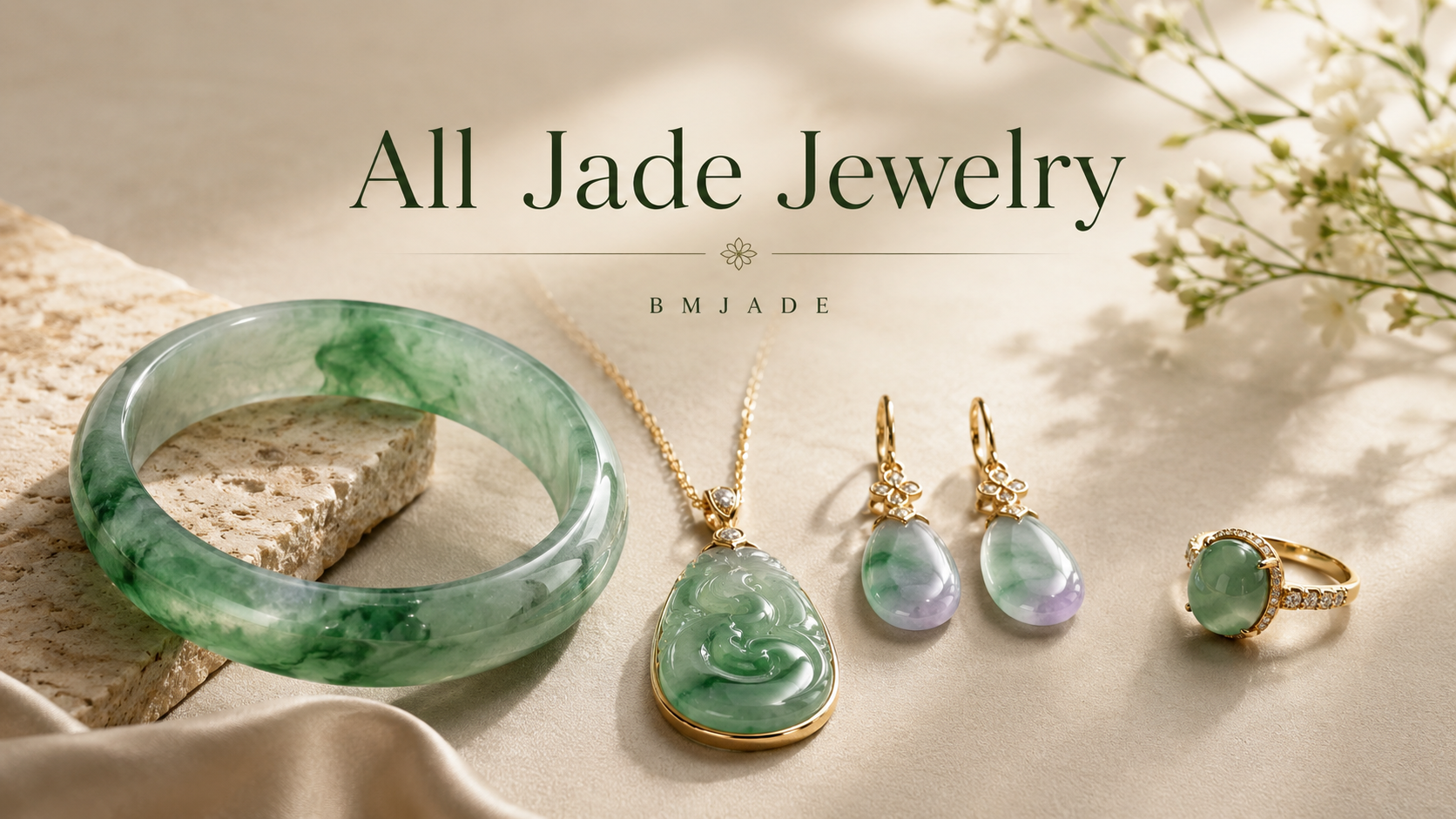
The jadeite market has split into two different realities. Top-grade certified Type A Burmese jadeite keeps climbing because truly fine material is scarce and collectors still compete for it. Mid-tier jadeite is falling because livestream commerce has flooded the market with comparable inventory, and inflated retail markups can't survive a price search. Understanding which side of that split a piece sits on matters more than any forecast.
I've been sourcing between Hpakant, Ruili, and our Kunming workshop since 2016, and this article is what that split looks like from the inside: the numbers, the auction records, the livestream data, and the price ranges we actually work with. If you're comparing 2026 prices before buying, BMjade's certified Type A jadeite jewelry is where our own ranges below come from.
One note before the data. The price ranges here are BMjade's 2026 retail and sourcing reference ranges for certified Type A material, not universal market prices; actual value depends on color, translucency, texture, size, cutting, certificate, and demand. Forecasts are market scenarios drawn from our sourcing experience and public industry research. None of this is financial advice.
Quick Answer: What's Happening in the 2026 Jadeite Market
The 2026 jadeite market is bifurcated. Top-grade certified Type A jadeite is appreciating due to constrained Burmese supply and collector demand, while mid-tier commercial jadeite is flat to declining because livestream platforms have made ordinary inventory easy to compare. Certification now matters more than color: it's a good year to buy verified Type A material, and a bad year to buy anything undocumented.
The 2026 Market in One Table
| Market segment | 2026 direction | Why |
|---|---|---|
| Top-grade Type A (Imperial green, fine lavender) | Rising | Scarcity, collector demand, flight to quality |
| Icy (Bing Zhong) jadeite | Stable to strong | Clean modern look, strong jewelry demand |
| Mid-tier commercial jadeite | Pressured / falling | Livestream price comparison, excess visible inventory |
| Treated (B/C) or undocumented jade | Weak | Buyer awareness rising, certification demand rising |
How Big Is the Jadeite Market in 2026?
Depends who's counting. Narrow gemstone-only definitions put the global jadeite market at roughly US$680 million in 2026, growing at about 6.5% CAGR through 2035. Broader definitions that include all jadeite and nephrite jewelry run US$5–8 billion. Under either definition, China dominates consumption at roughly 85% of global demand, with Hong Kong, Taiwan, and Singapore as the significant secondary markets, and Myanmar supplies nearly all of the world's gem-quality rough.
Those topline growth numbers hide the real story, though. Growth is not evenly distributed across quality tiers. It's concentrating at the top.
Why Top-Grade Jadeite Keeps Rising
Five forces are pushing the top of the market higher even as the middle compresses:
- Constrained supply from Hpakant. Mining permits, geopolitical complications, environmental degradation at mature sites, and tighter government controls have all reduced new top-grade rough entering the market.
- Flight to quality. When buyers distrust the middle of a market, money moves to the top of it. Certified, documented, exceptional pieces absorb demand that used to spread across tiers.
- Certification trust. A trusted lab report converts a beautiful stone into a defensible asset. Top-grade pieces almost always carry one; that's part of why they hold value.
- Collector depth in Greater China. The buyer pool for trophy jadeite is deep, patient, and not price-sensitive in the way retail buyers are.
- Auction validation. Every headline sale resets what collectors believe the ceiling is.
The auction record supports this. The Hutton-Mdivani necklace sold for over US$27 million at Sotheby's Hong Kong in 2014 and still anchors the category. More recently, a 43-bead imperial green jadeite necklace brought HK$36 million (about US$4.6 million) at Sotheby's Hong Kong in November 2025, a pair of imperial jadeite earrings crossed US$12 million, and an imperial bangle sold for over US$3.8 million, which works out to roughly US$69 million per kilogram, more than a thousand times the value of gold by weight. Across 28 dedicated jade auctions worldwide in the first half of 2024, total transaction value reached US$285 million, up 22.5% year over year.
Be careful what you conclude from those numbers. A trophy necklace does not prove that a $300 commercial pendant will appreciate. What the records prove is narrower: exceptional material with documentation occupies a luxury-collector category that ordinary jadeite cannot enter, no matter how green it looks.
Why Mid-Tier Jadeite Is Falling
The bottom-end story is happening on Douyin, Taobao Live, RedNote, and Kuaishou, and it's reshaping the jadeite market more profoundly than anything else in 2026.
An academic paper by Yi Ma in Wiley's Economic Anthropology journal (published online in late 2025), "From Rare to Common: The Live Streaming Industry of Jadeite Trade in Ruili in the China–Myanmar Borderlands," documents the shift with hard numbers from Ruili, the border city where most Burmese jadeite enters China. Before 2017, Ruili's trade ran on face-to-face deals between long-term specialists, and finished pieces typically moved at a few thousand to tens of thousands of yuan through layered dealer networks. Then livestreaming arrived. At one major Ruili livestream base alone (Duo Bao Zhi Cheng), more than 1,100 vendors registered between 2017 and 2019.
What that did to the mid-tier is simple economics. A piece that once passed through three or four markup layers before reaching a store counter now gets held up to a phone camera next to fifty comparable pieces. Weak certification is harder to hide. Vague "Burmese jade" claims are less convincing. The retail premium that mid-tier jadeite used to carry — the premium of scarcity-by-obscurity — is gone, because nothing ordinary is obscure anymore.
The middle of the market isn't dead. It's compressed, and it will stay compressed.
2026 Type A Jadeite Price Ranges by Grade
These are BMjade's 2026 retail and sourcing reference ranges for certified Type A jadeite jewelry, consistent with our full jade price guide. They are reference points, not quotes; two pieces with the same color name can differ in value by 10x on translucency and texture alone.
| Category | 2026 reference range (per piece) | 2024–2026 trend |
|---|---|---|
| Imperial green, high translucency | US$100,000+ into the millions; collector/auction territory | Strong upward pressure |
| Fine lavender, high translucency | US$3,000–30,000+ | Strong at the top, weak below it |
| Icy / Bing Zhong | US$1,500–15,000 | Stable to strong |
| Apple green / bright commercial green (bangle) | US$500–2,500 | Flat to slightly pressured |
| Opaque commercial green (bangle) | US$100–400 | Pressured |
| Bean variety / coarse texture | US$50–200 | Weak |
| Treated (Type B/C) | A fraction of Type A; equivalent-looking untreated material prices 5x to over 100x higher | Weak if undisclosed |
That last row deserves emphasis. According to data published in Gems & Gemology and confirmed across Sotheby's and Christie's Hong Kong results from 2019 through 2024, the treated-versus-untreated gap is the single most decisive price factor in jade: larger than color, larger than size. Which is why every question about jade value eventually becomes a question about certification.
What I Saw at Hpakant, Ruili, and Kunming
At the Hpakant rough tables in October 2025, I looked at a mid-size boulder with a promising icy window, the kind of material that opened around ¥400,000 when I last priced comparable rough in early 2023. It opened at ¥560,000, and the dealer wouldn't move. His explanation stuck with me: "The good windows don't need to travel anymore." He meant that with fewer quality boulders coming out of the pits, sellers of genuinely fine rough can wait for the buyer instead of chasing one. Ten years ago the leverage ran the other way. Meanwhile, ordinary rough at the same tables sat unsold at prices that hadn't moved in two years.
Ruili is where the two halves of the market physically share a street. On my last trip through the livestream bases there, I watched a vendor sell an apple-green Type A bangle on camera for ¥6,800 in under four minutes. That's a piece a traditional retail counter would have tagged at ¥15,000 or more in 2019, after passing through two or three dealer hands. Same stone, same certificate, less than half the price, because the camera stripped out every markup layer between the border and the buyer. We passed on a similar lot that afternoon: nothing wrong with the material, but at livestream-visible prices there was no room left for us to add anything except a story, and we don't sell stories.
In our Kunming workshop, the change shows up in customer questions. Five years ago buyers asked about color. Now the first question is almost always "Is it Type A, and can I verify the certificate myself?" That shift, more than any price index, tells me where this market is going: toward documentation, away from stories.
Certification Is the Dividing Line
In a split market, the certificate is what determines which side a piece trades on.
Type A means natural jadeite with no chemical treatment. Type B has been acid-bleached and polymer-filled; Type C is dyed; B+C is both. Imitations (glass, resin, quartzite, serpentine) aren't jadeite at all. If you want to check a piece yourself before paying for a lab, our guide on how to tell if a jade is real walks through the home tests and, just as important, what each one can't prove.
Standardization is also coming from the top of the industry: the CIBJO Fei Cui Guide, under development by the World Jewellery Confederation, could establish unified international nomenclature and trade standards by 2026 or 2027, which would professionalize disclosure across the global market.
Our own position is simple. Every BMjade piece ships with an NGTC certificate verifiable on NGTC's official site, and we back it with a lifetime guarantee: if any reputable lab ever finds one of our pieces to be non-jadeite or treated, we refund the full order plus your testing and return shipping. In a market where fake certificates sell online for a few yuan, "verify it yourself" is the only claim worth making.
What This Means for You
Buying for daily wear or gifts: mid-tier compression is good news. Wearable Type A pieces (bangles, pendants, rings, studs) are more accessible than they've been in years, if you screen for treatment disclosure and realistic pricing. Ignore investment language entirely; buy for authenticity, comfort, and meaning. A modest certified piece with clear disclosure beats a bright, undocumented one at any price.
Buying as a collector: be stricter. Collector-level purchases need strong Type A confirmation from a trusted lab, fine color and translucency together, minimal fractures, and clear documentation. And go in with realistic liquidity expectations: jadeite is less liquid and less standardized than gold, and selling later requires the right buyer and the right paperwork.
What to avoid in 2026: undocumented "natural jade" at any tier, livestream "steals" priced far below the ranges above, and any purchase justified mainly by someone's price forecast — including ours.
Outlook: 2026–2030
I expect the split to persist. Top-grade certified material should stay strong while Burmese supply stays constrained; mid-tier stays price-sensitive as long as livestream inventory keeps everything comparable; undisclosed treated material keeps losing ground as buyers get educated.
Two wildcards could bend the curve. A supply shock from Myanmar (tighter permits, escalation, or a disaster at Hpakant) would push top-grade prices up fast. And consumer-grade AI authentication tools, if they mature, could partially rebuild trust in the mid-tier and soften its decline. Neither is guaranteed. Treat this outlook as scenario, not promise.
FAQ
Is jadeite getting more expensive in 2026?
Top-grade certified Type A jadeite is rising, especially fine green, high-translucency lavender, and quality icy material. Mid-tier commercial jadeite is flat to falling due to livestream price comparison. There's no single "jade price" in 2026; the tier determines the direction.
Is now a good time to buy jadeite?
For certified Type A material at realistic prices, yes: mid-tier compression has improved access to wearable authentic pieces. It's a bad time to buy undocumented jade hoping it's authentic, because that's exactly the segment losing value.
Is jadeite a good investment?
Only top-quality certified pieces have meaningful collector value, and even those are less liquid than gold or diamonds. Most buyers should purchase jade for authenticity, beauty, and meaning first. Never buy on a price forecast alone.
Why is mid-tier jadeite falling?
Livestream commerce made ordinary inventory visible and comparable. A study in Economic Anthropology documents over 1,100 vendors registering at a single Ruili livestream base, replacing the layered dealer networks that once supported mid-tier retail markups.
What does Type A jadeite mean?
Natural jadeite with no chemical bleaching, dyeing, or polymer impregnation — only traditional polishing and wax finishing. Type A certification from a lab like NGTC is the baseline for any jadeite purchase above trivial prices, because untreated material prices 5x to over 100x higher than treated equivalents.
How do I verify a jadeite certificate?
Check the certificate number or QR code directly on the issuing lab's official website; for NGTC, that means NGTC's own verification page. Never trust the printed card alone; counterfeit certificates with forged accreditation marks sell online for a few yuan.
This article combines BMjade sourcing observations (2024–2026), GIA's published jadeite quality framework, public auction records, and academic research on the livestream jadeite trade. Reference prices are BMjade's own retail and sourcing ranges, not universal market prices.
External Sources and Further Reading
- GIA: Jadeite Jade Quality Factors
- GIA: Jade Care and Cleaning Guide
- Ma, Yi. "From Rare to Common: The Live Streaming Industry of Jadeite Trade in Ruili in the China–Myanmar Borderlands," Economic Anthropology 13, no. 1 (2026): e70026. Open access.
- The Jewellery Editor: Barbara Hutton Jadeite Necklace
- Vrije Universiteit Amsterdam: Jade Rush — Materiality, Mistrust, and the Livestreaming Jadeite Trade