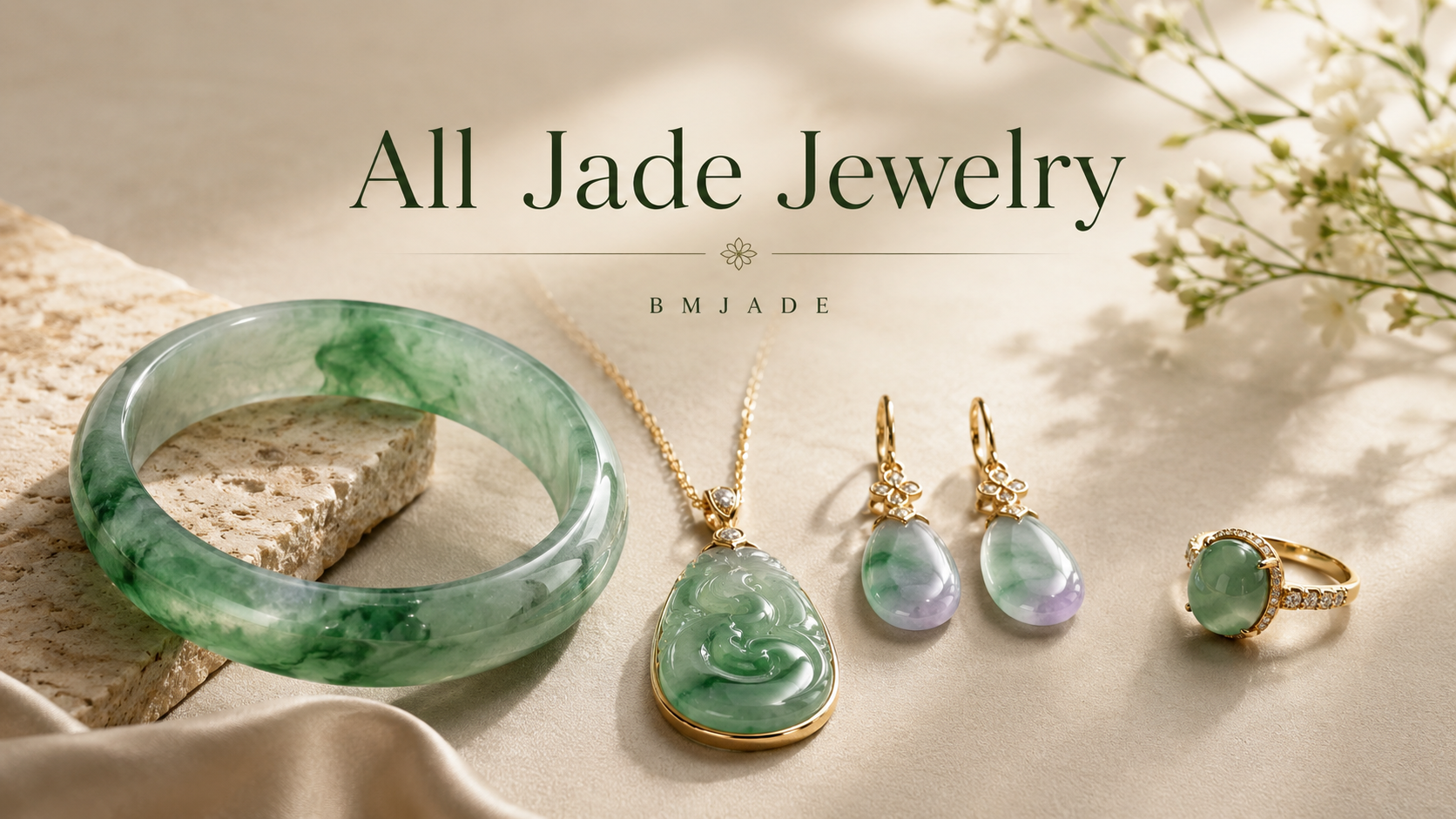
Burmese jadeite has a special place in the jade world.
For many serious jade buyers, Myanmar jadeite — especially material associated with the Hpakant region — remains the most recognized benchmark for fine jadeite jewelry. It is closely connected with vivid green jadeite, lavender jadeite, icy jadeite, translucent bangles, fine cabochons, and the highest end of the modern jadeite market.
But that does not mean every Burmese jadeite piece is valuable. It also does not mean every non-Burmese jadeite piece is inferior.
Origin matters, but origin alone is never enough.
A jadeite piece should be judged by material, Type A treatment status, color, transparency, texture, size, condition, craftsmanship, certificate details, and seller transparency.
At BMjade, our core specialty is certified Type A jadeite jewelry connected to the Burmese jadeite market and finished through our Kunming workshop. We do not describe jadeite as valuable simply because a seller calls it “Burmese.” A Burmese origin claim should never replace material testing, treatment disclosure, and careful visual evaluation.
If you are comparing real jadeite jewelry before buying, explore BMjade’s certified Type A jadeite jewelry, including jade bracelets, necklaces, earrings, and rings.
This guide explains why Burmese jadeite remains the fine-jewelry benchmark, what Hpakant jadeite means, why Type A certification matters more than origin claims, how Burmese jadeite compares with other jadeite origins, and what buyers should know about sourcing risk.
Quick Answer: Why Is Burmese Jadeite So Valued?
Burmese jadeite remains highly valued because Myanmar, especially the Hpakant region, is associated with some of the most recognized fine jadeite jewelry material in the modern market. The best Burmese jadeite can show vivid green color, strong translucency, fine texture, and enough structural quality for bangles, cabochons, beads, pendants, and collector-level jewelry.
However, Burmese origin alone does not make jadeite valuable.
A smart buyer should verify:
- Is it jadeite?
- Is it Type A natural untreated jadeite?
- Is the color natural?
- Is the transparency strong?
- Is the texture fine?
- Are there cracks or weak areas?
- Is the craftsmanship good?
- Is the certificate real and matched to the item?
- Is the seller clear about what can and cannot be proven?
The safest buyer rule is:
Certified Type A jadeite with clear quality is more important than an unsupported “Burmese jade” claim.
Source Notes: What This Burmese Jade Guide Can and Cannot Prove
This article is a buyer education guide written from a sourcing and jewelry-selection perspective. It is not an appraisal, financial recommendation, or guarantee of geographic origin.
Important notes:
- Burmese jadeite is a market benchmark, not an automatic quality guarantee.
- Material and treatment status matter more than origin claims.
- Not every jade certificate proves geographic origin.
- Many lab reports primarily confirm material and treatment status.
- Visual clues cannot prove Burmese origin.
- Auction records are exceptional examples, not normal retail benchmarks.
- Myanmar jade sourcing involves ethical, political, and transparency risks.
- This article is not investment advice.
GIA identifies jadeite’s three most important value factors as color, transparency, and texture. These factors matter more to buyers than a country name alone.
What “Burmese Jade” Actually Means
“Burmese jade” usually refers to jadeite from Myanmar.
Myanmar was formerly called Burma, so the terms Burmese jade, Myanmar jade, and Burmese jadeite are often used interchangeably in the jewelry trade.
In most fine jewelry contexts, Burmese jade means jadeite, not nephrite.
This matters because real jade includes two main materials:
| Material | Is It Real Jade? | Buyer Note |
|---|---|---|
| Jadeite | Yes | The main material in fine Burmese jadeite jewelry |
| Nephrite | Yes | Important in Hetian jade, pounamu, and classical jade culture |
| Dyed quartzite | No | Often sold under misleading jade-like names |
| Serpentine | No | Green stone, but not jadeite or nephrite |
| Glass / resin / plastic | No | Imitation material |
| Treated jadeite | Jadeite material, but treated | Must be disclosed and priced differently |
A seller may call something “Burmese jade,” but the first buyer question should be:
Is it jadeite, and is it Type A?
Why Hpakant Jadeite Became the Fine-Jewelry Benchmark
The Hpakant region in northern Myanmar is one of the most important names in the jadeite trade. For generations, it has been associated with high-quality jadeite rough used in bangles, beads, cabochons, pendants, carvings, and fine jewelry.
Hpakant jadeite became famous because the best material can show the qualities buyers value most:
- Vivid green color
- Lavender jadeite
- Icy translucency
- Fine texture
- Strong polish
- Good structural integrity
- Suitable bangle material
- Fine cabochon quality
- High market recognition
This does not mean every stone from Hpakant is top grade. Most jadeite rough is not fine jewelry quality. Many pieces may be opaque, cracked, pale, coarse, treated, or commercially modest.
The reason Burmese jadeite remains a benchmark is not because every Burmese piece is excellent.
It is because the highest-quality Burmese jadeite has shaped how the modern jadeite market defines fine jadeite beauty.
GIA’s Three Jadeite Value Factors: Color, Transparency, and Texture
When evaluating Burmese jadeite, do not start with origin. Start with quality.
GIA identifies jadeite’s three most important quality factors as:
- Color
- Transparency
- Texture
These three factors explain why two Burmese jadeite pieces can have completely different prices.
Color
Fine jadeite color should be attractive, natural-looking, and well balanced. Vivid green is the most famous, but Burmese jadeite can also appear in lavender, white, icy, yellow, black, red-brown, and multicolor forms.
The strongest green jadeite is not just “green.” It should have life, saturation, depth, and balance.
Transparency
Transparency gives jadeite visual depth. Highly translucent jadeite may look watery, glowing, or icy.
A piece with good transparency often feels more alive than a flat opaque piece, especially when the texture is also fine.
Texture
Texture describes how fine or coarse the jadeite body appears.
Fine texture makes jade look smoother, cleaner, and more refined. Coarse texture can look grainy, dull, or cloudy.
A Burmese origin claim cannot fix poor texture. A famous origin does not override actual quality.
Burmese Jadeite vs Other Jadeite Origins
Burmese jadeite is not the only jadeite in the world.
Guatemala is also an important jadeite source. GIA has reported on Guatemalan jadeite, including blue to green-blue material often called “Olmec blue” in the trade, and notes its Mesoamerican cultural importance.
A balanced comparison looks like this:
| Origin | Main Material | Market Position |
|---|---|---|
| Myanmar / Burma | Jadeite | Most recognized benchmark for fine jadeite jewelry |
| Guatemala | Jadeite | Distinctive blue-green and darker jadeite; important Mesoamerican heritage |
| Japan / Russia / others | Jadeite in some contexts | More limited or niche market recognition |
| Hetian / Hotan tradition | Nephrite | Classical Chinese nephrite tradition, not jadeite |
Guatemalan jadeite is real jadeite and can be beautiful in its own right, especially for distinctive blue-green and darker green material.
But in the modern fine jadeite jewelry market, Myanmar remains the most recognized source for vivid green and highly translucent jadeite.
The key point:
Burmese jadeite has the strongest fine-jewelry recognition, but quality and verification still matter more than origin language.
For a broader origin guide, read BMjade’s Burmese vs Guatemalan vs Hetian Jade Guide.
Auction-Level Burmese Jadeite: What Hutton-Mdivani Shows — and What It Does Not
Auction records show how high exceptional jadeite can go, but they should not be used as normal retail benchmarks.
The Hutton-Mdivani Jadeite Necklace by Cartier is one of the most famous jadeite jewelry examples. Sotheby’s Hong Kong sold the necklace in 2014 for HK$214 million, setting a record for jadeite jewelry at the time.
This necklace is exceptional because it combines:
- Rare jadeite bead quality
- Matching bead color and size
- Cartier craftsmanship
- Historical provenance
- Collector demand
- Auction visibility
- Extraordinary market context
It does not mean ordinary Burmese jadeite jewelry should be priced like auction jewelry.
For everyday buyers, the Hutton-Mdivani example teaches one useful lesson:
Top jadeite value comes from a rare combination of material quality, craftsmanship, provenance, and market trust.
It is not enough for a seller to say “Burmese jade.”
Myanmar Jade Sourcing Risks: What Buyers Should Know
Burmese jadeite has beauty and market prestige, but Myanmar jade sourcing also has serious complexity.
Myanmar’s jade industry has been associated with conflict, smuggling, unsafe mining, corruption, environmental damage, and human-rights concerns. Global Witness has reported extensively on Myanmar’s jade trade and its links to military elites, armed groups, and opaque supply chains.
This is why ethical sourcing language needs to be honest.
BMjade cannot guarantee a perfectly traceable or ethically pure supply chain in a market as complex as Myanmar jade. What we can do is work with established dealers, ask sourcing questions, avoid suspicious material, keep purchase documentation where available, and use independent lab testing to verify the stone itself.
Buyers who care about sourcing should ask:
- What does the seller know about the supply chain?
- Is the material clearly identified?
- Is treatment status disclosed?
- Are certificate details provided?
- Does the seller overstate what they can prove?
- Does the seller acknowledge Myanmar jade sourcing complexity?
A trustworthy seller should not pretend the Myanmar jade trade is simple.
Type A Certification Matters More Than Origin Claims
For most buyers, Type A certification matters more than unsupported Burmese origin claims.
Type A jadeite means natural untreated jadeite. It has not been chemically bleached, dyed, or polymer-impregnated.
| Jadeite Type | Meaning | Buyer Note |
|---|---|---|
| Type A jadeite | Natural untreated jadeite | Most trusted category for fine jadeite jewelry |
| Type B jadeite | Bleached and polymer-filled | Must be disclosed and priced differently |
| Type C jadeite | Dyed | Color is artificial |
| Type B+C jadeite | Bleached, filled, and dyed | High buyer caution |
| Imitation jade | Not jadeite or nephrite | Should not be sold as real jade |
A treated “Burmese jade” claim is not better than a certified Type A jadeite piece with honest disclosure.
For jadeite jewelry, always ask:
- Is the material jadeite?
- Is it Type A?
- Is there a certificate?
- Does the certificate match the exact item?
- Does the report confirm treatment status?
- Can the report be verified?
For more detail, read BMjade’s NGTC vs GIA Jade Certification Guide.
Can a Certificate Prove Burmese Origin?
Sometimes origin testing may be possible, but ordinary jade certificates do not always include geographic origin.
Many jade reports primarily confirm:
- Material
- Treatment status
- Report number
- Photo match
- Measurements
- Weight
- Lab name
A report may confirm jadeite and Type A treatment status without proving Myanmar origin.
This matters because sellers sometimes use “Burmese jade” as a marketing phrase. If the report does not state origin, do not assume the origin is proven.
A safer buyer statement is:
This is certified Type A jadeite, and the seller states it is connected to the Burmese jadeite trade.
That is more honest than claiming geographic origin with no documentation.
Visual Clues Are Not Proof: How to Avoid Imitations
Some buyers use home checks such as cold touch, weight, sound, and visible inclusions.
These may sometimes help screen obvious plastic or glass imitations, but they cannot prove Burmese origin, Type A status, or treatment status.
Visual clues are not proof.
A Burmese jadeite piece may show:
- Attractive green, lavender, icy, or white tones
- Fine texture
- Translucency
- Natural-looking color variation
- Smooth polish
- Internal stone structure
- Bangle, cabochon, or bead form
But these clues do not prove origin.
A seller should not claim:
- “It rings, so it is Burmese.”
- “It feels cold, so it is Type A.”
- “It is green, so it is Myanmar jade.”
- “It has inclusions, so it is natural.”
- “It looks imperial, so it is valuable.”
For serious jadeite buying, certificate verification matters more than home tests.
Read BMjade’s Why Jade Home Tests Aren’t Enough.
What Makes Fine Burmese Jadeite Valuable?
Fine Burmese jadeite becomes valuable when several factors appear together.
| Value Factor | Why It Matters |
|---|---|
| Type A status | Confirms natural untreated jadeite |
| Color | Strong color drives demand, especially fine green |
| Transparency | Adds depth and luminous beauty |
| Texture | Fine texture creates refinement |
| Size | Large clean material is rare |
| Thickness | Thin pieces may look better in photos than in reality |
| Condition | Cracks, chips, and weak areas reduce value |
| Craftsmanship | Cutting, carving, polish, and setting affect final value |
| Certificate | Reduces material and treatment uncertainty |
| Seller transparency | Helps buyers trust the description |
Burmese jadeite should be evaluated as jadeite first and Burmese second.
A weak piece does not become fine jade just because it is from Myanmar.
Should You Buy Burmese Jadeite in 2026?
You should consider Burmese jadeite if you want:
- Fine jadeite jewelry
- Type A jadeite
- Strong market recognition
- Green, lavender, icy, or high-translucency jadeite
- A jade bangle, pendant, ring, bead, or cabochon
- Chinese jadeite jewelry tradition
- A meaningful family gift
- A wearable piece with certificate support
You should be cautious if:
- The seller gives no certificate
- Treatment status is unclear
- The price seems too low for the claim
- Photos are heavily edited
- The seller promises investment returns
- The origin claim is unsupported
- The seller ignores sourcing complexity
- The item is described only as “natural Burmese jade” without details
The best Burmese jadeite purchase is not the one with the loudest origin claim.
It is the one with the clearest evidence.
How BMjade Approaches Burmese Jadeite
BMjade’s core specialty is Type A jadeite jewelry connected to the Burmese jadeite market and finished through our Kunming workshop.
Our approach is:
- Prioritize Type A jadeite
- Provide clear material disclosure
- Use real product photos
- Explain size, setting, and design
- Provide certificate details when applicable
- Avoid exaggerated investment promises
- Treat jade symbolism as cultural meaning, not guaranteed effects
- Acknowledge Myanmar sourcing complexity
- Help buyers understand what they are purchasing
BMjade focuses on certified Type A jadeite jewelry, with certificate details and real product photos provided on product pages when applicable.
We believe Burmese jadeite deserves respect, but not blind marketing.
FAQ About Burmese Jadeite
What is Burmese jadeite?
Burmese jadeite usually means jadeite from Myanmar. It is the most recognized source category for fine jadeite jewelry in the modern jade market.
Is Burmese jade the same as jadeite?
Usually, yes. In fine jewelry, Burmese jade commonly refers to jadeite from Myanmar, not nephrite.
Why is Burmese jadeite so valuable?
Burmese jadeite is valuable when it combines Type A natural status, strong color, good transparency, fine texture, size, craftsmanship, and certificate support.
Is all Burmese jadeite valuable?
No. Burmese jadeite can be high-grade, mid-grade, low-grade, treated, cracked, opaque, or poorly described. Origin alone does not determine value.
Is Burmese jadeite better than Guatemalan jadeite?
Burmese jadeite has stronger market recognition for fine jadeite jewelry, especially vivid green and translucent material. Guatemalan jadeite is also real jadeite and can be beautiful, especially in blue-green tones.
Is Burmese jadeite better than Hetian jade?
They are different materials and traditions. Burmese jadeite is jadeite; Hetian jade is usually nephrite. One is not automatically better than the other.
What is Hpakant jade?
Hpakant jade refers to jadeite associated with the Hpakant mining region in northern Myanmar, one of the most famous jadeite-producing areas in the modern trade.
Does a certificate prove Burmese origin?
Not always. Many certificates confirm material and treatment status but do not include geographic origin. Read the report carefully.
What does Type A Burmese jadeite mean?
It means jadeite described as Burmese in origin and confirmed as natural untreated Type A jadeite. Type A status is the key treatment category.
Can Burmese jadeite be treated?
Yes. Burmese jadeite can be Type A, Type B, Type C, or B+C. Treatment status must be verified.
How can I tell if Burmese jadeite is real?
Check material identity, Type A status, certificate details, product photos, seller transparency, and whether the report matches the item.
Can home tests prove Burmese jadeite?
No. Cold touch, sound, weight, and light tests cannot prove Burmese origin or Type A status.
Is Burmese jadeite a good investment?
Jadeite is a specialized and less-liquid market. Buyers should not purchase Burmese jadeite based on promised appreciation. Focus on authenticity, quality, certificate, condition, and wearability first.
Does Burmese jadeite hold value?
Exceptional certified Type A Burmese jadeite may attract collector demand, but resale value is not guaranteed. Most jade jewelry should be bought for beauty, meaning, authenticity, and wearability.
Why is Myanmar jade sourcing controversial?
Myanmar jade sourcing is complex because the industry has been associated with conflict, unsafe mining, smuggling, corruption, and transparency concerns.
Should I avoid Burmese jadeite because of sourcing concerns?
That is a personal decision. Buyers who care about sourcing should ask sellers for transparency, documentation, and honest limits on what can be proven.
Is BMjade Burmese jadeite Type A?
BMjade focuses on certified Type A jadeite jewelry, with certificate details and material information provided on product pages when applicable.
What should I check before buying Burmese jadeite?
Check material, Type A status, color, transparency, texture, condition, size, certificate, seller transparency, and return policy.
Is “Burmese jade” enough proof?
No. “Burmese jade” is a seller claim unless supported by documentation. Material and treatment verification matter more.
What is the safest Burmese jadeite to buy?
The safest choice is clearly described Type A jadeite with certificate details, real photos, proper sizing, realistic pricing, and a transparent seller.
Final Thoughts
Burmese jadeite remains the benchmark for fine jade jewelry because Myanmar jadeite has shaped the modern market’s idea of premium jadeite beauty.
But the word “Burmese” should never be used as a shortcut for value.
A good jadeite buyer asks better questions:
- Is it jadeite?
- Is it Type A?
- Is the color natural and attractive?
- Is the transparency strong?
- Is the texture fine?
- Is the piece well made?
- Is the certificate real?
- Does the seller acknowledge what can and cannot be proven?
- Does the price match the evidence?
At BMjade, we believe Burmese jadeite should be natural, verifiable, meaningful, and wearable. If you are ready to compare certified Type A jadeite jewelry with clearer material disclosure, explore BMjade’s authentic jade jewelry collection and choose jade with confidence.