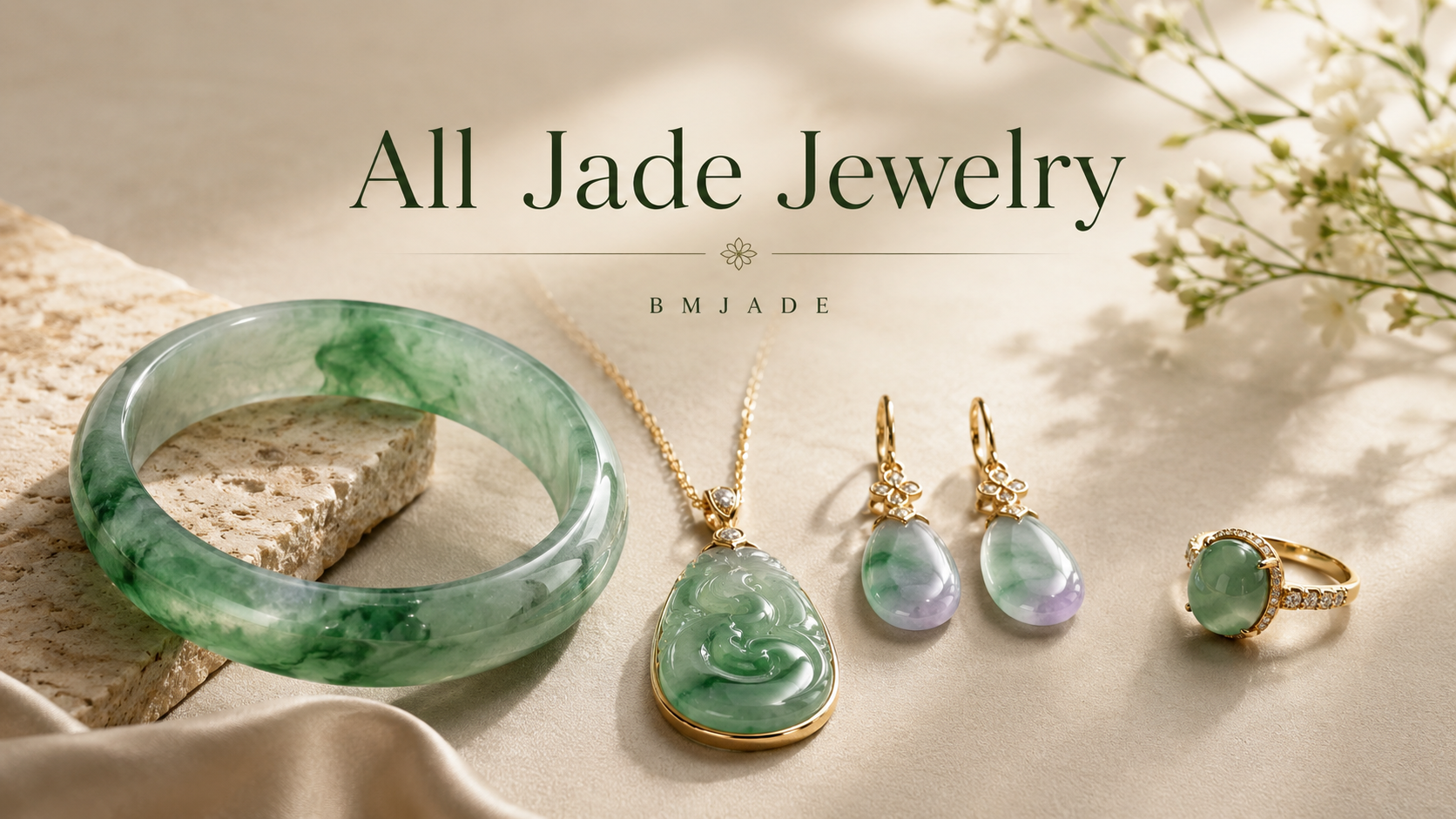
If you are wondering how to tell if a jade necklace is real, here is the safest answer: don’t rely on color, cold touch, sound, or a single photo. A real jade necklace will be clearly identified as jadeite, nephrite, or another accepted jade material, and its treatment status will be openly disclosed.
For jadeite necklaces, the most important term buyers should understand is Type A jadeite. Type A jadeite refers to natural jadeite that has not been dyed or polymer-treated. A beautiful green necklace isn’t automatically real jade — what makes a jade necklace truly real comes down to material truth, treatment transparency, and verification you can actually trust.
Key Takeaways
- A real jade necklace may be jadeite or nephrite, but fine jade jewelry often focuses on jadeite.
- Type A jadeite means natural jadeite that has not been dyed or polymer-treated.
- Color, transparency, texture, and polish can help evaluate jade quality, but they cannot prove authenticity alone.
- Home tests such as cold touch, light inspection, sound, or scratch tests are limited and can mislead buyers.
- A valuable jade necklace should come with clear material information and, when appropriate, a verifiable certificate.
- The safest way to buy a real jade necklace online is to check seller transparency, treatment disclosure, certificate details, and return policy.
Table of Contents
- What Does “Real Jade Necklace” Actually Mean?
- Type A Jadeite: The Most Important Term Buyers Should Know
- Jadeite vs Nephrite: Both Are Real Jade, But Not the Same
- Visual Signs of a Real Jade Necklace
- Why Home Tests Are Not Enough
- Common Fake Jade Necklace Materials to Watch For
- How to Read and Verify a Jade Necklace Certificate
- Red Flags When Buying a Jade Necklace Online
- BMjade’s Approach to Type A Jade Necklace Authentication
- Real Jade Necklace Buyer’s Checklist
- Frequently Asked Questions
- Conclusion
What Does “Real Jade Necklace” Actually Mean?
A real jade necklace is not simply a necklace made from a green stone. In modern gemology, the word jade points to two materials: jadeite and nephrite. They are different minerals, with different compositions, visual qualities, and market values. GIA also notes that “jade” has sometimes been incorrectly applied to other materials that merely resemble jade — another reason buyers need to look past color alone.
For buyers, the first question shouldn’t be “Is it green?” The sharper question is: what material is it, and has it been treated?
A trustworthy jade necklace listing will tell you whether the piece is jadeite or nephrite, and disclose whether the jade is natural, dyed, bleached, polymer-filled, or otherwise treated. If a product description only says “genuine jade” without spelling out the type or treatment status, take it as a warning sign.
Real jade doesn’t have to mean expensive. A simple nephrite pendant is real jade. So is a lower-translucency jadeite necklace. The point isn’t that every jade necklace must be high-end — it’s whether the seller describes the piece honestly.
If you’re buying for cultural meaning, daily wear, or as a gift, authenticity matters because the story behind the piece matters. A jade necklace shouldn’t only look beautiful — it has to actually be what the seller claims it is.

Type A Jadeite: The Most Important Term Buyers Should Know
For jadeite jewelry, Type A is one of the most important terms a buyer can learn. A Type A jade necklace means the jadeite is natural and has not been artificially dyed or polymer-treated. The stone may have been cut, carved, drilled, polished, and set into jewelry — but the jade itself has not been chemically altered to change its color or fill in its structure.
Type A doesn’t mean “the best color,” and it doesn’t imply every Type A jadeite necklace is Imperial green or investment-grade. Type A describes treatment status — not beauty grade.
That distinction matters because jadeite shows up across many quality levels. Some Type A jadeite is pale, opaque, and modestly priced; some is vivid, translucent, and extremely valuable. Treatment status tells you whether the material is natural and untreated. Color, transparency, texture, size, and craftsmanship are what then determine quality and value.
GIA identifies three primary quality factors for jadeite: color, transparency, and texture. Buyers typically also weigh evenness of color, polish, surface reflections, and any fractures when evaluating finished jadeite pieces.
You may also come across the terms Type B, Type C, or B+C jade. These are widely used in the trade to describe treated material:
- Type A jadeite: natural jadeite, not dyed or polymer-treated.
- Type B jadeite: jadeite that has often been acid-bleached and polymer-filled.
- Type C jadeite: dyed jadeite.
- Type B+C jadeite: jadeite that has been both bleached/polymer-filled and dyed.
GIA’s gem treatment guide notes that jadeite can be acid-bleached to strip unwanted brown coloration and then impregnated with polymer to improve appearance. Polymer impregnation, GIA adds, is easier to detect by qualified gemological laboratories using magnification and advanced analytical techniques.
That is why a Type A jade necklace is more than a marketing phrase. For a buyer, it functions as a trust standard.
If you want to compare authentic examples, BMjade’s Type A certified jade necklaces are chosen with buyers in mind who care about natural jadeite, treatment disclosure, and verifiable authenticity.

Jadeite vs Nephrite: Both Are Real Jade, But Not the Same
Many buyers assume jade is one single stone. In reality, jadeite and nephrite are both jade — but they aren’t the same material.
Jadeite is the material most often linked with fine jadeite jewelry, especially the vivid green Burmese variety. It can appear in green, lavender, white, yellow, orange, black, gray, and other colors. GIA notes that jadeite ranges from semi-transparent to opaque and often shows uneven coloration — which gives carvers interesting visual texture to work with.
Nephrite is just as real. Its colors tend to be more muted, and the material ranges from translucent to opaque. Nephrite has a very long history in Chinese jade culture — particularly the eras before Burmese jadeite came to be highly prized.
Britannica describes polished nephrite as having a more oily luster, while polished jadeite appears more vitreous or glassy. The same source identifies the area around Mogaung in northern Myanmar as a long-standing source of gem-quality jadeite, with nephrite drawn from a much wider range of geographic sources.
So nephrite shouldn’t be dismissed as fake jade. It can be meaningful, beautiful, and historically significant in its own right. What it cannot be is sold as jadeite when it is actually nephrite.
For online buyers, this is a major red flag: if a product title says “jade necklace” but the seller can’t tell you whether it’s jadeite or nephrite, ask questions before purchasing. And if a necklace is priced like fine jadeite but described only as “natural green jade,” the listing isn’t transparent enough.

Visual Signs of a Real Jade Necklace
Visual inspection helps you evaluate a jade necklace, but it can’t prove authenticity on its own. The goal is to look for natural stone character, quality cues, and the kind of red flags that hint at something off.
Color
Natural jadeite color is rarely perfectly even. Pieces often show soft mottling, color roots, or subtle shifts in tone — details that make the stone feel alive and mineral-like.
Be cautious with color that looks too flat, too bright, too neon, or too uniform across the entire pendant. Dyed materials can come across as overly saturated or artificial. That said, color alone proves nothing — some high-quality jadeite genuinely has very strong color, and plenty of real jade is pale or uneven.
Transparency
Real jadeite spans the full range from opaque to semi-transparent. Higher translucency is often more desirable in fine jadeite jewelry, but a real jade necklace doesn’t need to be icy or highly translucent to be authentic.
A completely opaque piece can still be real jade; a translucent piece can still be treated. Transparency helps you judge quality, not authenticity on its own.
Texture
Jade has a dense, mineral quality that reads differently from glass or plastic. Under good light, real jade often reveals depth, fine internal structure, cloudiness, or natural variation through the body of the stone.
Even so, texture isn’t a final test. Skilled imitations can look convincing in photos, and treated jadeite can still display natural-looking structure.
Polish and Carving
A well-made jade necklace typically shows smooth polish, balanced carving, clean drill holes, and comfortable edges. Poor polish, rough drill holes, or sloppy carving don’t automatically mean the stone is fake — but they do point to low-quality workmanship.
For carved pendants, take a close look at the edges, curves, and fine details. A meaningful jade necklace deserves to show both material quality and real craftsmanship.
When choosing the right pendant size and necklace length, BMjade’s jade necklace size guide will walk you through how different pendant sizes sit near the collarbone or chest.

Why Home Tests Are Not Enough
Plenty of buyers search for quick ways to test jade at home — the cold touch test, the sound test, the light test, the scratch test. These methods can sometimes flag an obvious fake, but none of them can reliably confirm a real Type A jade necklace.
The Cold Touch Test
Real jade does feel cool to the touch — but so do glass, quartzite, agate, and several stone imitations. A cold sensation tells you nothing definitive about authenticity.
The cold touch test is especially weak for online buyers, since you can’t feel the necklace until it arrives. Even in person, temperature shifts with room conditions, skin temperature, and how long the stone has been handled.
The Sound Test
Some buyers lightly tap jade and listen for a crisp ringing sound. For necklaces, this is both risky and unreliable. The sound shifts with thickness, setting, cord, chain, shape, carving, and any internal fractures the piece may have.
More importantly, tapping a pendant risks damaging it. The sound test simply isn’t worth relying on.
The Light Test
Holding a jade pendant up to light lets you see internal structure, color distribution, and any cracks — useful for observation, but not enough to confirm authenticity.
Dyed quartzite, treated jadeite, glass, and similar materials can fool the eye, especially once they’re polished and set in jewelry. A light test may help you ask sharper questions, but it doesn’t replace a certificate.
The Scratch Test
Don’t scratch your jade necklace. A scratch test can permanently mar the surface, and hardness alone can’t tell you whether jadeite has been dyed, bleached, or polymer-filled.
GIA points out that treatments aren’t always obvious to an untrained eye, and can even be difficult for experts to distinguish without proper testing. Treatment disclosure matters because undisclosed treatment can make a gemstone appear far more valuable than it actually is.
Home tests are a first-pass screen at best. They aren’t the final answer.

Common Fake Jade Necklace Materials to Watch For
Not every green necklace sold as jade is actually jadeite or nephrite. Several materials make attractive decorative stones in their own right — they just shouldn’t be misrepresented as Type A jadeite.
|
Material |
Why It Confuses Buyers |
Buyer Warning |
|
Glass |
Can look glossy, green, and smooth |
May look too uniform or contain bubble-like inclusions |
|
Dyed quartzite |
Can imitate green jade color |
Often sold under trade names; certificate matters |
|
Serpentine |
Sometimes marketed as jade-like stone |
Not jadeite or nephrite |
|
Aventurine |
Naturally green and attractive |
A quartz variety, not jade |
|
Plastic or resin |
Cheap and easy to shape |
Often too light, too warm, or too perfect |
|
Treated jadeite |
May be real jadeite but altered |
Treatment must be disclosed clearly |
The problem is not that these materials exist. Glass, quartzite, serpentine, and aventurine can all be used in jewelry. The problem is when they are sold as “real jadeite” or “natural jade” without proper disclosure.
A buyer should also be careful with vague trade names. Terms like “new jade,” “Malaysia jade,” “Korean jade,” or “green jade stone” may not mean jadeite or nephrite. Always ask what the material actually is.
For a serious jade necklace purchase, especially if the seller claims Type A jadeite, a reliable certificate is far more important than a poetic product name.

How to Read and Verify a Jade Necklace Certificate
A certificate is not just a piece of paper. For jade buyers, it’s often the most important trust document tied to the necklace.
A useful jade necklace certificate will typically include:
- Issuing laboratory name
- Certificate or report number
- Photo of the actual necklace or pendant
- Material identification
- Treatment status
- Basic gemological information
- Date of issue
- Verification method or official query system
The certificate photo matters. If the certificate shows a different pendant — different shape, color pattern, or size — don’t ignore it. Every piece of jade is natural and has its own individual features, so the certificate has to match the actual necklace you receive.

What an NGTC Certificate Helps Confirm
NGTC is one of the major gem testing authorities recognized in China’s jade jewelry market. When BMjade uses NGTC certification, the purpose isn’t to ask buyers to “just trust us.” It’s to provide independent documentation that the customer can verify directly.
An NGTC certificate helps confirm the material identification, testing result, photo match, and certificate number. Even so, buyers should review the details carefully and compare the certificate against the actual necklace in hand.
How to Verify the Certificate
To verify a jade necklace certificate:
1. Go to the issuing lab’s official website.
2. Find the certificate or report query section.
3. Enter the certificate number and anti-counterfeit code if required.
4. Compare the online information with the physical certificate.
5. Check whether the photo, material, and result match the necklace.
Don’t rely on a seller’s screenshot alone. Screenshots can be outdated, edited, or unrelated to the actual piece. The safest approach is always to verify directly through the issuing lab’s official website.
You can also learn more about BMjade’s sourcing, craftsmanship, and authenticity promise on the About BMjade page.
Red Flags When Buying a Jade Necklace Online
Buying a jade necklace online can be perfectly safe — but only if you know what to watch for. A trustworthy seller will be clear, patient, and specific in their answers.
Be cautious if you spot any of the following red flags:
- The necklace is described as “Imperial green jade” but priced far below what the claim suggests.
- The seller cannot say whether the material is jadeite or nephrite.
- The listing says “natural jade” but gives no treatment disclosure.
- There is no certificate for a valuable jadeite necklace.
- The certificate photo does not match the pendant.
- The seller only provides heavily filtered photos.
- There are no close-up images of the pendant surface, carving, or drill holes.
- Every product photo looks overly bright, smooth, or identical in color.
- The seller refuses to answer verification questions.
- There is no clear return policy.
- The listing promises healing, guaranteed luck, guaranteed protection, or guaranteed investment returns.
A serious jade seller doesn’t need exaggerated claims. Real jade carries enough beauty, history, and meaning on its own — no false promises required.
If a necklace is inexpensive and sold as decorative jewelry, the expectations are naturally different. But once a seller claims natural Type A jadeite, collectible quality, or high-value jade, the documentation needs to back the claim.

BMjade’s Approach to Type A Jade Necklace Authentication
BMjade was founded by Hong in 2016 and is based in Kunming, Yunnan, China. The brand focuses on natural jade jewelry — particularly Type A jadeite pieces tied to Myanmar/Burmese jadeite sourcing and Yunnan craftsmanship.
From BMjade’s experience, international buyers tend to ask three questions before choosing a jade necklace:
- Is this real jadeite?
- Is it Type A?
- Can the certificate be verified?
Those are the right questions.
BMjade’s approach is built around independent verification rather than self-claimed authenticity. Each eligible jade necklace is checked and certified before it’s offered to customers. Once a certificate is provided, the buyer can cross-check the certificate photo, report details, and serial number against the actual necklace.
This matters especially for jade, because appearance alone isn’t enough. A beautiful pendant can still be treated, and a green stone can still be an imitation. A seller’s promise has to be backed by transparent documentation.
BMjade also stands behind a lifetime authenticity guarantee: if NGTC, GIA, or another recognized laboratory proves that a BMjade piece sold as Type A is not Type A, the customer can request a full refund under the authenticity guarantee.
For buyers who want verified material, cultural meaning, and wearable design, BMjade’s Type A certified jade necklaces are designed with those exact trust points in mind.

Real Jade Necklace Buyer’s Checklist
Before buying a jade necklace, run through this checklist. It can help you slow down, compare listings more clearly, and sidestep the most common mistakes.
1. Does the seller clearly say jadeite or nephrite?
If the listing only says “jade,” ask for clarification.
2. Is the necklace described as Type A, treated, dyed, or unknown?
Treatment status matters as much as appearance.
3. Is there a certificate from a recognized lab?
This is especially important for Type A jadeite or higher-value pieces.
4. Can the certificate number be verified online?
A certificate should be more than a photo.
5. Do the photos show natural light and close-up details?
Look for color, texture, drill holes, carving, and polish.
6. Does the certificate photo match the necklace?
Compare shape, color pattern, size, and visible features.
7. Is the price realistic for the claimed quality?
Be careful with low prices attached to high-end claims.
8. Does the seller explain returns and authenticity guarantee?
Serious sellers offer clear buyer protection.
9. Are there exaggerated claims?
Avoid listings promising guaranteed luck, healing, protection, or investment returns.
10. Would you still love the necklace for its beauty and meaning?
A real jade necklace should feel personally valuable, not just technically correct.
Once you’ve bought a real jade necklace, care matters just as much. Keep it away from harsh chemicals, perfumes, and rough impact. BMjade’s guide on how to clean jade necklaces safely walks you through how to keep jade beautiful without damaging the stone or setting.
Frequently Asked Questions
How can I tell if a jade necklace is real?
The safest way to tell if a jade necklace is real is to check the material identification, treatment status, certificate, and seller transparency. Visual signs help, but they aren’t enough on their own. For valuable jadeite necklaces, a verifiable certificate from a trusted lab is the strongest confirmation you can get.
What does Type A jade necklace mean?
A Type A jade necklace means the jadeite is natural and has not been dyed or polymer-treated. Type A describes treatment status — not color grade. A Type A necklace can be pale, dark, opaque, translucent, affordable, or expensive depending on color, texture, transparency, size, and craftsmanship.
Is jadeite better than nephrite for necklaces?
Jadeite and nephrite are both real jade. Jadeite is often more prized in fine jewelry because it can show vivid green, lavender, and higher translucency. Nephrite carries a deep cultural history and can be just as beautiful in its own right. The key is honest labeling — not the idea that one is “real” and the other isn’t.
Can fake jade feel cold?
Yes, fake jade can absolutely feel cold. Glass, quartzite, agate, and other stones all feel cool when first touched. The cold touch test can sometimes screen out obvious plastic or resin pieces, but it can’t prove that a necklace is real jadeite, nephrite, or untreated Type A jadeite.
Is a certificate necessary for a jade necklace?
A certificate isn’t strictly necessary for a low-cost decorative necklace, but it becomes very important the moment a seller claims Type A jadeite, high-quality jadeite, or any higher-value piece. A good certificate confirms material identity and treatment status — especially valuable when you’re buying online.
What is the difference between real jade and treated jade?
Treated jade may still be jadeite, but it has been altered through processes like dyeing, bleaching, or polymer filling. Real untreated Type A jadeite hasn’t undergone any of those treatments. Treated jade has to be clearly disclosed because treatment affects value, appearance, durability, and buyer trust.
How do I verify an NGTC jade certificate?
Head to the official NGTC website or the query platform listed on the certificate. Enter the certificate number and anti-counterfeit code if required, then compare the online result against the physical certificate and the necklace itself — checking the photo, material description, and testing conclusion.
Can I buy a real jade necklace online safely?
Yes, you can buy a real jade necklace online safely — as long as the seller is transparent. Look for clear material identification, Type A or treatment disclosure, close-up photos, certificate verification, a return policy, and an authenticity guarantee. Steer clear of sellers who use vague terms, exaggerated claims, or unverifiable certificates.
Conclusion
Learning how to tell if a jade necklace is real comes down to one principle: don’t judge by appearance alone. Color, cool touch, sound, and light inspection can flag obvious problems, but none of them can confirm material identity or treatment status.
A real jade necklace may be jadeite or nephrite. If you’re buying fine jadeite jewelry, focus on Type A status, certificate verification, seller transparency, realistic pricing, and clear photographs. A trustworthy seller will explain what the jade is, whether it has been treated, and exactly how you can verify the certificate.
For BMjade, authenticity isn’t a decoration added after the sale — it’s built into the buying process from the start: natural Type A jade, independent certification, transparent sourcing, and craftsmanship from Kunming, Yunnan.
If you’re ready to choose a piece that brings beauty, meaning, and material confidence together, explore BMjade’s jade necklaces collection.
Sources
- GIA — Jadeite Jade Quality Factors — used for jadeite quality factors such as color, transparency, texture, polish, and value evaluation.
- GIA — Jade Description — used for jadeite, nephrite, jade color range, and jade terminology.
- GIA — An Introduction to Gem Treatments — used for jadeite bleaching, polymer impregnation, treatment disclosure, and limits of visual identification.
- Encyclopaedia Britannica — Jade — used for jadeite vs nephrite differences and Myanmar/Burma as a source of gem-quality jadeite.
- NGTC Official Website — used for certificate/report query information and verification context.