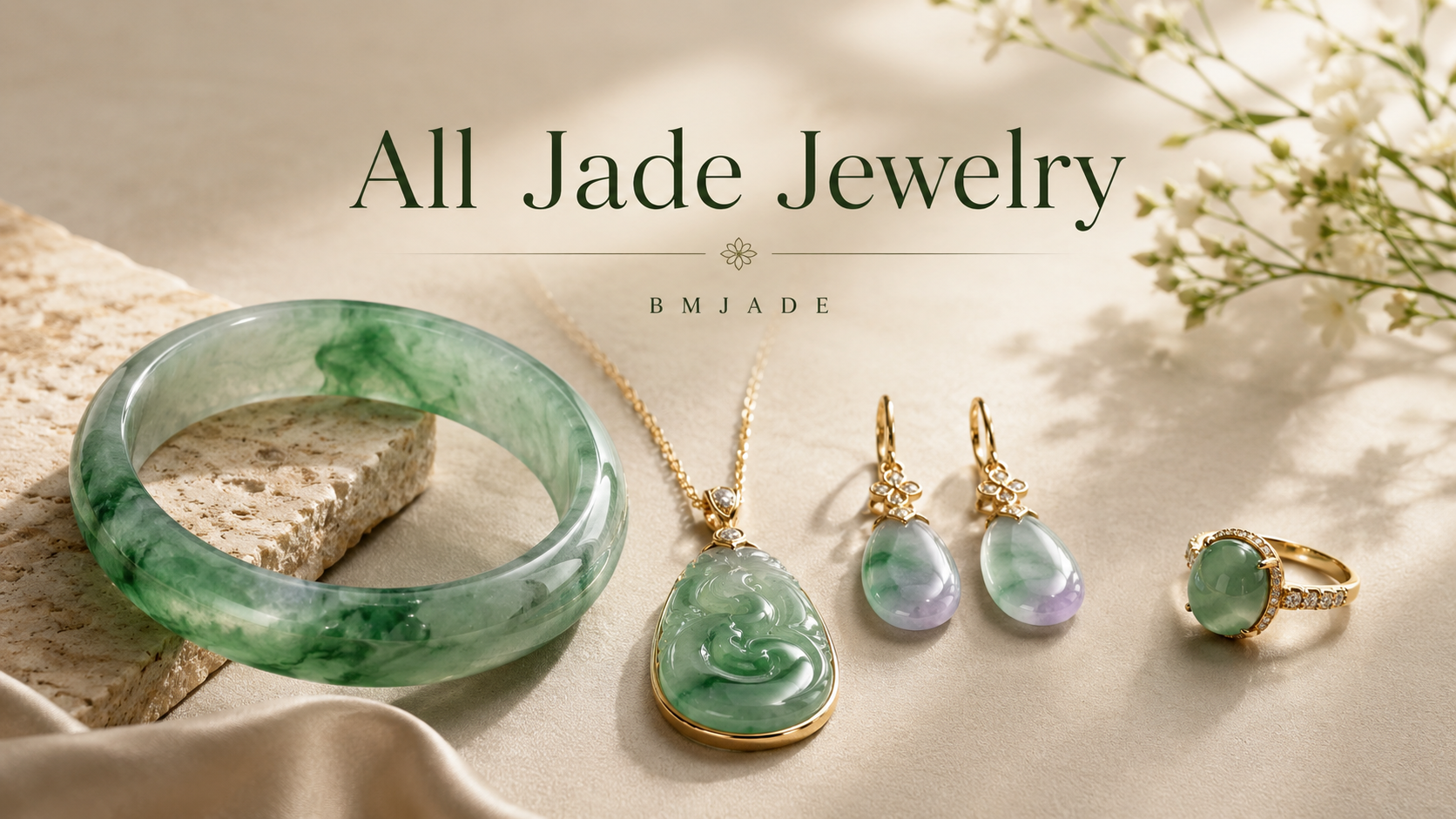
I've been buying Burmese jadeite at the Hpakant market since 2016. In nine years of trips between Yunnan and Myanmar, I've watched the market shift, the prices climb, the mining situation grow harder — and one thing stay completely constant: for serious jade buyers, no other origin even competes. Burmese jadeite is still the world's finest jade, and the gap between it and every other source is, if anything, widening in 2026.
This post is my attempt to explain why — geologically, commercially, and practically. I'll share what I see at the markets that doesn't make it into news reports, the data that does, and the buying advice I give every customer who asks "is Burmese jade really worth it?"
Short answer: yes. Long answer below.

What Makes Burmese Jadeite Geologically Unique
Most articles about Burmese jade focus on the price tags. The geology actually explains them.
Jadeite forms only under very specific conditions: high pressure, relatively low temperature, and a very particular mineral chemistry involving sodium-aluminum silicate. These conditions exist in just a handful of places on Earth — Myanmar, Guatemala, Russia, Japan, Kazakhstan, and tiny amounts in California and New Zealand. Of those, only Myanmar produces jadeite at scale, with the color saturation and translucency the global market wants.
The key region is Hpakant in Kachin State, northern Myanmar. According to the comprehensive overview compiled on Wikipedia's Jade Trade in Myanmar entry, the "Jade Tract" — located in Lonkin Township in Kachin State — encompasses the alluvial region of the Uyu River between the 25th and 26th parallels. Active mining today happens at the Phakant-gyi, Maw Sisa, Tin Tin, and Khansee sites; mines at Tawmaw and Hweka are largely exhausted.
Hpakant sits over a serpentinite belt where the Indian tectonic plate has been subducting under the Eurasian plate for tens of millions of years. The hydrous fluids released during subduction, combined with the local mineral chemistry, produced jadeite deposits with three rare qualities:
- Mineralogical purity — Burmese jadeite is almost pure jadeitic pyroxene with traces of kosmochlor, amphibole, and albite. This purity gives the stone its signature high specific gravity (~3.34) and the famous "ringing" sound when tapped.
- Color saturation — Trace chromium produces the imperial green that exists virtually nowhere else. Trace iron produces the lavender. Trace titanium contributes to the rare "icy blue."
- Translucency — Hpakant produces the highest-translucency jadeite on Earth, including the prized bīng zhǒng (icy) and bō li zhǒng (glassy) varieties.
By contrast, Guatemalan jadeite — the next-largest source — tends toward darker, grayer tones with much lower translucency. Russian jadeite is mostly opaque pale green. Japanese jadeite exists but is virtually unmined commercially.
This is why, when buyers in our collection ask "where is the jade from," they're really asking "is it Burmese." It's the question with the geological answer.

GIA's Quality Standards for Jadeite — The Three Factors That Define Value
Before we talk market data, it's worth grounding the discussion in the global standard for evaluating jadeite quality.
According to the Gemological Institute of America — the world's most authoritative non-commercial gem laboratory — jadeite quality is judged on three primary factors: color, transparency (translucency), and texture.
Color. GIA notes that the most valuable jadeite color is "imperial green" — almost transparent with a vibrant emerald-green color — which historically had a standing order from the Chinese imperial court. The pure, penetrating green should show no hint of gray and look intense even from a distance. Other valued varieties include "kingfisher jade" (slightly less vivid than imperial), "apple jade" (intense yellowish green), and "moss-in-snow jade" (translucent white with green veining).
Transparency. GIA describes jadeite's transparency range as "completely opaque to semi-transparent," with the best material being semi-transparent. Semi-transparency creates the inner glow that experienced collectors recognize immediately — the stone appears lit from within rather than merely polished on the surface.
Texture. GIA describes jadeite texture as "lovely, smooth, and even" in the finest material. Texture is closely linked to translucency: finer grain structure typically supports higher translucency and a more refined polish.
These factors interact. A stone with vivid color but poor translucency reads flat; a stone with high translucency but dull color reads pale; a stone with both, in fine texture, is what collectors will pay six- and seven-figure sums for. We'll come back to this when we look at auction records.

The 2026 Burmese Jade Market — Numbers and What They Actually Mean
The data tells a consistent story. The interpretation is where most articles miss the point.
Myanmar produces upward of 70% of the world's supply of high-quality jadeite, according to Wikipedia's Jade Trade in Myanmar entry — a figure consistent across academic and industry sources. Some estimates from the field push that figure as high as 90% for top-tier material specifically.
What the market data tells us:
The market is growing, but supply is tightening. Mining permits have been harder to obtain since the 2021 political situation. According to a GIA industry report referencing research from the Ash Center for Democratic Governance and Innovation at Harvard University, large stockpiles have built up in warehouses near the Myanmar–China border due to mining outpacing the Chinese retail market's absorption rate during slowdowns. Yet for top-grade material, demand keeps outrunning supply.
Mid-grade jadeite has gotten more volatile. When China's economy slowed in 2022–2023, mid-priced jadeite (the $500–$5,000 piece range) saw the sharpest pullback. Top-grade jadeite barely moved. Imperial green and high-translucency lavender held value or appreciated through the entire downturn. This is consistent with the "flight to quality" pattern across every collectible category.
The retail market is bifurcating. On one side, fully treated Type B and Type C "jade" sold cheaply on global e-commerce platforms — often $20–$50 — to buyers who don't know what they're getting. On the other side, certified Type A jadeite sold by specialists with verifiable lab reports and transparent provenance. The gap between these two markets widens every year.
A 2026 academic study published in Wiley's Economic Anthropology journal documents another major shift: since 2017, jadeite trading at the China–Myanmar border city of Ruili has shifted heavily to live-streaming platforms (Douyin, RedNote, Taobao), fundamentally changing the structure of the trade. The author argues that live streaming has "transformed jadeite from previously being imagined as a rare and relatively expensive gemstone to a more affordable and common set of products" — which has expanded mid-tier demand while creating new authentication challenges for buyers globally.
For an explanation of the Type A / B / C grading system, see our complete guide to authenticating jade jewelry.

What Imperial Green Actually Costs — The Hutton-Mdivani Benchmark
Theory is one thing. The auction record is what tells you what the top of this market really is.
The single most expensive piece of jade jewelry ever sold at auction is the Hutton-Mdivani Jadeite Necklace, which fetched US$27.44 million at Sotheby's Hong Kong on April 6, 2014. This is officially listed by Guinness World Records.
The piece comprises 27 graduated jadeite beads ranging from 15.40mm to 19.20mm in diameter, with a Cartier-designed clasp set with rubies and diamonds. The original auction estimate was US$12.8 million — the final price more than doubled it after a 20-minute battle between seven bidders.
What made these specific 27 beads worth over a million dollars per bead? The Sotheby's auction lot description and the accompanying SSEF (Swiss Gemmological Institute) certification provide the answer:
- All 27 beads are natural Type A jadeite (no impregnation, no dye, no treatment)
- Outstanding translucency — every bead lets light pass through with the characteristic emerald glow
- Extremely fine texture with luminous, perfectly-matching emerald green color
- Provenance — the beads are believed to date to the Qing Imperial Court, then passed through Western nobility before reaching Cartier's collection
The relevant principle for everyday buyers: the same three GIA factors — color, translucency, texture — that grade a $50 cabochon are the same factors that determined a $27 million record. What changes is the magnitude of each factor and the rarity of finding all three at the highest grade in matching pieces.
This is why I tell first-time buyers: don't chase size on a limited budget; chase quality at a smaller size. A 6mm certified Type A imperial green cabochon teaches you what fine jade actually looks like, in a way no 25mm opaque piece ever will.

The Hpakant Reality — What Sourcing Trips Actually Look Like
I want to address something that most jade-jewelry websites avoid: the human and environmental cost of jade mining in Myanmar. Anyone who tells you Burmese jade comes out of the ground without complications isn't being honest with you.
The mining region. Hpakant sits in Kachin State, where the geography is harsh — steep slopes, monsoon rains, unstable rock formations. Industrial-scale mining since the 1990s has dramatically reshaped the landscape.
The disasters. Major landslides at Hpakant have killed mostly hand-pickers (locally called yemase, "the unwashed") working in waste piles below industrial mining operations. According to investigative reporting compiled by the Pulitzer Center on Crisis Reporting, Hpakant's mines are perpetually on the brink of collapse, and landslides recur during the rainy season as a structural feature of the current mining model — not freak accidents.
The structural complexity. A 2019 academic report by the International Growth Centre documents that as of April 2018, Myanmar's jade production covered nearly 12,000 acres across more than 5,300 private permits and 190 joint-venture blocks. Investigative work by Global Witness has documented the ways the trade intersects with armed conflict, military-affiliated companies, and ethnic armed organizations — concluding that "smuggling increased, with up to 90% of all jade mined in Hpakant now smuggled out of the country and into China without ever entering the formal system in Myanmar."
These are real findings from credible sources. They're also not the whole story — particularly at the buyer level, where licensed dealers in official markets operate within frameworks that produce verifiable paperwork.
What I do. I source from established, licensed dealers at Hpakant's official market — not directly from individual mines. The dealers I work with operate within legal frameworks and document their stones' chain of custody. I cannot guarantee perfect ethical purity for every gram of Burmese jadeite ever traded — no honest jade seller can. What I can do, every trip, is buy from sellers I've known for years, prioritize material with clear paperwork, and refuse stones whose provenance feels off.
This is also why I send every piece to NGTC for independent verification. The certificate doesn't speak to mining ethics, but it does speak to the stone itself — and gives our customers something concrete to verify.
If you want to read more about how I personally select rough at the market, see our About page, where I describe the process in detail.
How to Tell Real Burmese Jadeite from Imitations
Whether or not you ever buy from BMjade, here's what to actually check.
The "Burmese" claim is rarely verifiable without a lab. Geographic origin testing exists (looking at trace mineral inclusions and isotope ratios), but it's expensive and not commonly performed for consumer pieces. What you can verify is whether the stone is natural Type A jadeite at all — and that's actually the more important question.
Type A confirmation matters more than country. A natural Type A jadeite from Guatemala will hold value better than a treated Type B from Burma. The hierarchy is:
- Natural Type A jadeite (any origin, but Burmese is most valuable)
- Natural nephrite (different mineral, usually labeled as "jade" honestly)
- Type B/C treated jadeite (avoid if buying for value)
- Synthetic, dyed quartzite, glass (avoid entirely)
Practical home tests:
- Real jade feels distinctly cold and warms slowly
- Real jadeite produces a clear ringing sound when gently tapped (specific gravity ~3.34)
- Real jadeite shows natural inclusions under strong light — perfectly clear color is suspicious
- The piece should feel surprisingly heavy for its size
The real test is the certificate. Look for reports from:
- NGTC — the National Gemstone Testing Center, Asia's most respected jade authority and the lab BMjade uses for every piece
- GIA — Gemological Institute of America, the gold standard in Western markets
- HKJSL — Hong Kong Jade & Stone Laboratory, strong in Asian jade specifically (the Hutton-Mdivani necklace was certified by HKJSL)
- SSEF — Swiss Gemmological Institute, internationally trusted (also certified the Hutton-Mdivani)
- GIT — Gem and Jewelry Institute of Thailand
Every BMjade piece ships with an NGTC report bearing a unique serial number you can verify online. If a seller refuses to provide a report from a recognized lab, walk away — regardless of the country claim.

Should You Buy Burmese Jade in 2026?
The honest answer depends on what you're buying for.
Buy Burmese jade if:
- You want a piece that holds or appreciates in value over decades
- You care about translucency and rich color (Burmese leads here)
- You appreciate the cultural and historical depth of jadeite specifically
- You want a "best in category" item rather than a fashion accessory
Consider alternatives if:
- Your primary concern is ethical sourcing and you can't verify chain of custody to your satisfaction (Hetian nephrite from China, Canadian nephrite, or Guatemalan jadeite from documented sources are all real-jade options)
- Your budget is below $50 for a finished bracelet — at that price point, genuine Type A Burmese jadeite simply isn't realistic
- You want a colored stone purely for fashion — colored gems like emerald, tourmaline, or chrysoprase may serve you better
For most buyers who land on this question, the right move is: start with a smaller, certified Type A Burmese piece rather than a larger, cheaper, uncertified one. A $80 NGTC-certified jadeite pendant teaches you what real jade looks and feels like. A $30 "Burmese jade bangle" from an anonymous seller often teaches you only that you've been deceived.
Browse our certified collections to see what verified Type A Burmese jadeite looks like at different price points: Bracelets · Necklaces · Earrings · Rings.
The Bottom Line
Burmese jadeite still rules the gemstone world in 2026 — not because of marketing, but because the geology produced something the planet only made in one place. The market data, the auction records, and the GIA quality standards all reflect that reality.
But ruling the market also means rising prices, tightening supply, and increasingly visible ethical complexities. For buyers, the practical implications are simple:
- If you want real Burmese jadeite, expect to pay for it — and demand certification
- If your budget is limited, smaller certified is better than larger uncertified
- If you care about ethics, ask your seller specific questions about sourcing — and walk away if you don't get specific answers
I'll keep traveling to Hpakant, keep selecting stones with the buyers I've known for years, and keep sending every piece to NGTC. That's the most I can offer. For the customers who choose us, I think it's enough.
— Hong
Frequently Asked Questions About Burmese Jade
Why is Burmese jade more valuable than other jade?
Burmese jadeite from the Hpakant region in Myanmar has higher mineralogical purity, stronger color saturation (especially imperial green and lavender), and higher translucency than jadeite from any other source. It accounts for the great majority of the world's top-grade jadeite. According to GIA, the three factors defining jadeite quality — color, transparency, and texture — all reach their highest expression in Burmese material.
How can you tell if jade is from Myanmar?
Without a specialized lab origin test, geographic origin claims are difficult to verify. What you can verify is whether the stone is natural Type A jadeite — through certification from NGTC, GIA, HKJSL, SSEF, or GIT. The natural color saturation, high translucency, and characteristic ringing sound when tapped are strong indicators of Burmese jadeite specifically.
Is Burmese jade ethically sourced?
This is a legitimate question with a complex answer. The Burmese jade trade has documented links to environmental damage and conflict in northern Myanmar, particularly around large-scale industrial mining (see investigative reporting from Global Witness and the Pulitzer Center). At the buyer level, ethical sourcing means working with licensed dealers in official markets, prioritizing stones with documented chain of custody, and supporting independent certification. BMjade sources from established licensed dealers at the Hpakant market and sends every piece to NGTC for independent verification.
What's the most expensive jade ever sold?
The Hutton-Mdivani Jadeite Necklace sold for $27.44 million at Sotheby's Hong Kong on April 6, 2014, setting the world auction record for any jade jewelry — listed in Guinness World Records. The piece consists of 27 graduated Type A jadeite beads (15.4mm to 19.2mm) believed to date to the Qing Imperial Court, with a Cartier clasp.
What's the price range for real Burmese jade jewelry?
Entry-level Type A Burmese jadeite jewelry starts around $40–$100 for beaded bracelets and small pendants. Mid-range pieces ($100–$500) include solid bangles, hand-carved pendants, and adjustable rings. High-end pieces ($500–$5,000+) feature higher translucency, better color, and more complex craftsmanship. Imperial green and high-translucency lavender pieces can reach tens of thousands of dollars or more.
What's the difference between Burmese jadeite and Hetian nephrite?
Both are real jade but different minerals. Burmese jadeite (硬玉) is harder, more translucent, and shows brighter colors including imperial green and lavender. Hetian nephrite (软玉) from China is softer, has an oilier "mutton fat" luster, and shows mostly white, cream, and spinach green tones. Most fine jade jewelry buyers prefer jadeite for its visual drama; nephrite has its own deep tradition and warm character.
Will Burmese jade prices continue rising?
Based on supply trends (tightening) and demand trends (growing, especially for top-grade material), top-grade Burmese jadeite is likely to continue appreciating. Mid-grade pieces may show more volatility tied to broader economic cycles, particularly in China. Bottom-grade or treated material is unlikely to appreciate at all and may lose value as authentication tools become more accessible.
Is buying Burmese jade a good investment?
Top-grade certified Type A Burmese jadeite has historically held and grown its value over decades, similar to fine art or rare gemstones. The Hutton-Mdivani necklace appreciated from $2 million in 1988 to $27.4 million in 2014 — a 13x appreciation in 26 years. However, jade is a highly specialized market — value depends heavily on color, translucency, craftsmanship, and certification. For buyers approaching jade as an investment, focus on pieces with strong NGTC or GIA certification, top color and translucency, and provenance documentation. Avoid bottom-grade material regardless of how attractive the price seems.
Related Reading
- Ultimate Guide to Chinese Jade Varieties — Deep dive into jadeite, Hetian, Dushan, and Xiuyan jade
- Ultimate Guide to Authenticating Jade Jewelry — How to verify Type A jade and recognize treatments
- Ultimate Guide to Jade Bracelet Meaning, Feng Shui & Etiquette — Cultural background on jade